Facts
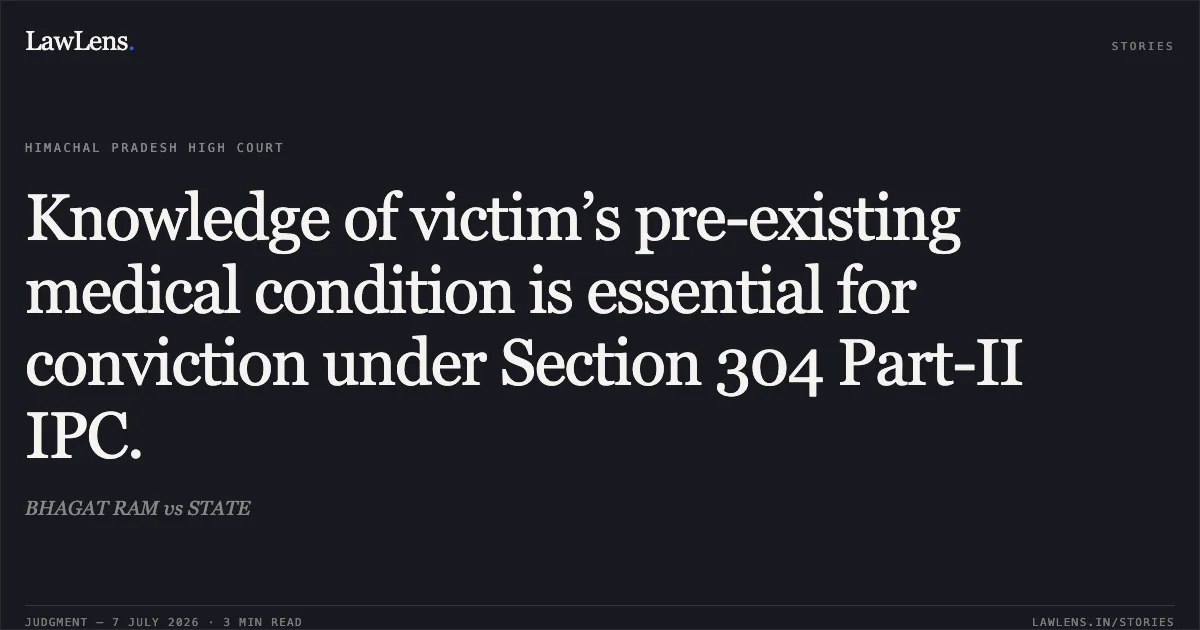
The appellants (accused) were convicted by the Trial Court for various offenses: Bhagat Ram under Section 304 Part-II IPC, and Nirmala Devi and Sanjay Kumar under Section 323 IPC
Source reference: p.2On September 4, 2011, a dispute arose when Bhagat Ram was cleaning a drain
Source reference: p.3Kanta Devi (PW5) attempted to fill the drain, leading to a scuffle where Bhagat Ram allegedly dragged her and inflicted a stick blow on the head of Lal Chand
Source reference: p.3-4Lal Chand, who had a pre-existing hypertrophic heart condition unknown to the accused, died at the hospital
Source reference: p.4The medical evidence attributed the cause of death to acute coronary insufficiency due to sudden fear and anxiety resulting from the assault, although the head injury was simple in nature
Source reference: p.4, 37Issues
1. Whether the act of inflicting a simple injury on a person with an unknown pre-existing heart condition satisfies the ingredients of Section 304 Part-II of the IPC
Source reference: p.38/para. 352. Whether the testimonies of related witnesses can be discarded as "interested" witnesses in the absence of independent witnesses
Source reference: p.18/para. 213. Whether the accused were entitled to the right of private defence of property
Source reference: p.15/para. 17Law Applied
The court applied Section 300 Clause (iv) Illustration (b) of the IPC, which differentiates murder from lesser offenses based on the offender's knowledge of the victim's pre-existing disease
Source reference: p.38It relied on Laltu Ghosh v. State of W.B. [p.18] and Neeraj Sharma v. State of Chhattisgarh [p.31] to establish that related witnesses are natural witnesses whose testimony is valuable if reliable.
Source reference: p.18, 31Sections 103 and 104 of the IPC regarding the right of private defence were considered
Source reference: p.16Precedents like Emperor v. Saberali Sarkar [p.39] and Ramakrishna Panicker v. State of Kerala [p.39] were applied to establish that causing death to a person with an diseased organ, without knowledge of such disease, constitutes simple hurt under Section 323 IPC
Source reference: p.39, 41Reasoning
The High Court observed that while the incident and the act of assault were established through the consistent testimonies of natural/injured witnesses (PW1, PW4, PW5), the Trial Court erred in applying Section 304 Part-II to Bhagat Ram
Source reference: p.31, 36, 49The medical testimony by PW11 confirmed the head injury was simple and that death was caused by coronary failure due to "fear and anxiety"
Source reference: p.37Since the prosecution failed to prove that Bhagat Ram knew of Lal Chand’s heart condition, he could not be attributed with the knowledge that his act was likely to cause death
Source reference: p.38, 44Regarding the right of private defence, the Court found it inapplicable as the victim's party acted to prevent a diversion of water and did not cause apprehension of death or grievous hurt to the accused
Source reference: p.16-17For Nirmala Devi and Sanjay Kumar, the evidence supported their conviction for simple hurt as they beat the other family members
Source reference: p.37Holding
The High Court ruled that in the absence of knowledge of a victim's internal disease, an accused is liable only for the injury actually intended and inflicted
The High Court partly allowed the appeals. It set aside the conviction of Bhagat Ram under Section 304 Part-II IPC and instead convicted him under Section 323 IPC. The conviction and sentences of Nirmala Devi and Sanjay Kumar under Section 323 IPC were upheld. Bhagat Ram was ordered to be produced for a hearing on the quantum of sentence for the modified conviction.
Source reference: p.50Acts & Sections Cited
14 provisions across 2 statutes referred to in this judgment. Each provision opens on LawLens.
Indian Penal Code, 1860
Code of Criminal Procedure, 19731
Original Court PDF
BHAGAT RAMvsSTATE
Click to open original judgment
Original judgment, available to read, download and summarize on LawLens.in