Facts
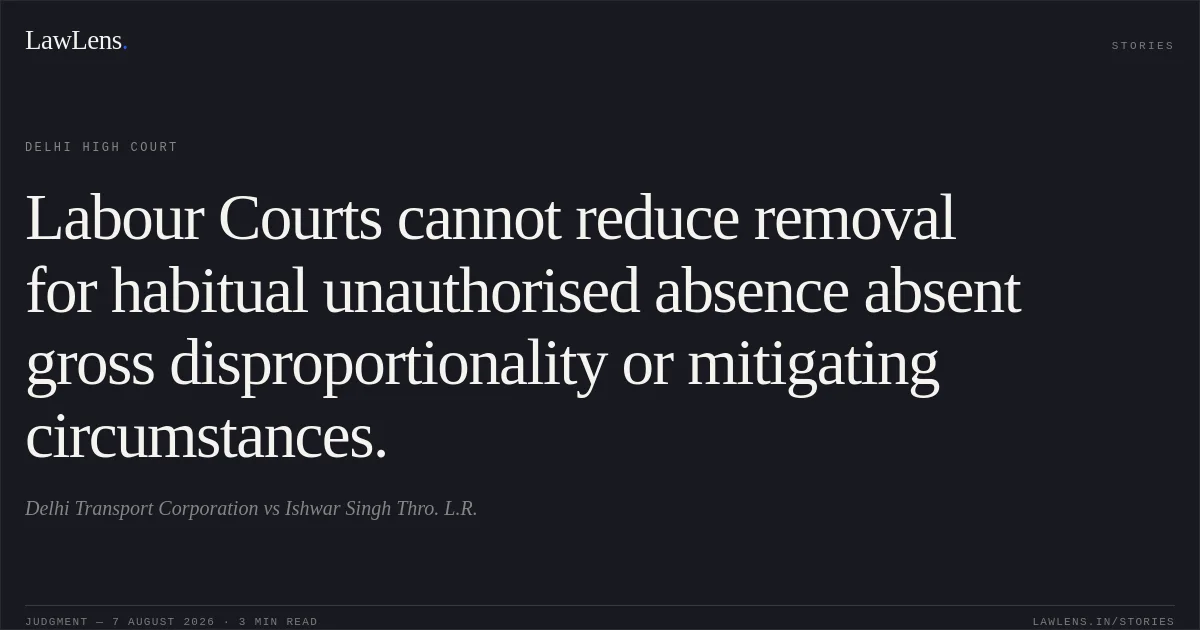
Ishwar Singh joined the Delhi Transport Corporation as a driver in March 1984 and was posted at Yamuna Vihar Depot. The Corporation issued him a charge-sheet alleging unauthorised absence for 266 days during 1 January–31 December 2006. He attributed his absence to his own illness, his wife’s illness, and incarceration in an accident case, and claimed that he had submitted leave applications and medical documents.
Source reference: para. 3Following a domestic inquiry, he was removed from service on 29 May 2008. During the Labour Court proceedings, he died and his legal representatives were substituted.
Source reference: para. 3The Labour Court held that the inquiry was fair and that the charge of unauthorised absence was proved. It also found that the medical documents relied upon related to a later period and that the leave applications had not been produced before the Inquiry Officer or the Court.
Source reference: para. 6Nevertheless, exercising jurisdiction under Section 11A of the Industrial Disputes Act, 1947, the Labour Court considered removal “slightly harsh” and directed that the workman be deemed to have retired on the date of removal, with retiremental and consequential benefits, including pension subject to his having opted for it.
Source reference: paras. 1, 7The Corporation challenged the modification of the punishment. The workman’s legal representatives did not challenge the Labour Court’s findings or the relief granted.
Source reference: paras. 8–10Issues
Whether the Labour Court was justified in exercising jurisdiction under Section 11A of the Industrial Disputes Act, 1947, to substitute the punishment of removal with deemed retirement after upholding the domestic inquiry and finding the charge of unauthorised absence proved?
Source reference: para. 10Whether the punishment of removal for unauthorised absence of 266 days, particularly in light of the workman’s past record, was grossly disproportionate or shocking to the conscience of the Court?
Source reference: paras. 11, 17–18Law Applied
Section 11A of the Industrial Disputes Act permits a Labour Court or Industrial Tribunal to interfere with the punishment imposed by the management, but such discretion is limited and may be exercised only where the punishment is grossly disproportionate, shocks the conscience, or mitigating circumstances justify reduction; sympathy or compassion alone is insufficient.
Source reference: paras. 11–13Applying V. Ramana v. A.P. SRTC, the Court reiterated that judicial review ordinarily concerns the decision-making process and not substitution of the administrator’s choice of punishment, unless the punishment is irrational, procedurally improper, or shocking to the conscience.
Source reference: para. 11Bharat Forge Co. Ltd. v. Uttam Manohar Nakate and Mahindra and Mahindra Ltd. v. N.B. Narawade establish that Labour Courts cannot reduce punishment on irrational or extraneous grounds and must identify disproportionate punishment or genuine mitigating factors.
Source reference: paras. 12–13Under the applicable Standing Orders, absence without prior permission, habitual unauthorised absence, and habitual negligence or lack of interest in the employer’s work constitute misconduct; removal is an expressly permissible penalty under the governing Regulations.
Source reference: para. 14In Delhi Transport Corporation v. Sardar Singh, the Supreme Court held that prolonged unauthorised absence may establish habitual negligence and lack of interest in work, and that treating absence as leave without pay does not amount to sanction or condonation of the absence.
Source reference: para. 15Reasoning
The Labour Court had already upheld the domestic inquiry and found that the workman failed to substantiate his alleged leave or medical justification.
Source reference: para. 6The charge concerned 266 days of unauthorised absence in 2006, whereas the medical documents relied upon related to February 2007–June 2008.
Source reference: para. 6The workman’s previous record also disclosed earlier instances of unauthorised absence and punishments.
Source reference: para. 17Under the Standing Orders and the principle in Sardar Singh, such prolonged and repeated unauthorised absence constituted serious misconduct and could demonstrate lack of interest in the Corporation’s work.
Source reference: paras. 14–17Since removal was an expressly authorised penalty and the Labour Court did not find it grossly disproportionate or shocking to the conscience, its reliance principally on length of service and the effect of removal on the dependants amounted to interference on compassionate grounds, which Section 11A does not permit.
Source reference: paras. 11–18The Labour Court therefore exceeded the permissible limits of its discretion in converting removal into deemed retirement.
Source reference: paras. 18–19Holding
The High Court held that the Labour Court was not justified in modifying the punishment under Section 11A of the Industrial Disputes Act.
The Corporation’s writ petition was allowed; the portion of the award granting deemed retirement and retiremental and consequential benefits was set aside, and the workman’s removal from service was upheld.
Source reference: paras. 18–19The pending application was also disposed of.
Source reference: para. 20Acts & Sections Cited
1 provisions across 1 statute referred to in this judgment. Linked provisions open on LawLens.
Industrial Disputes Act, 19471
Original Court PDF
Delhi Transport CorporationvsIshwar Singh Thro. L.R.
Click to open original judgment
Original judgment, available to read, download and summarize on LawLens.in