Facts
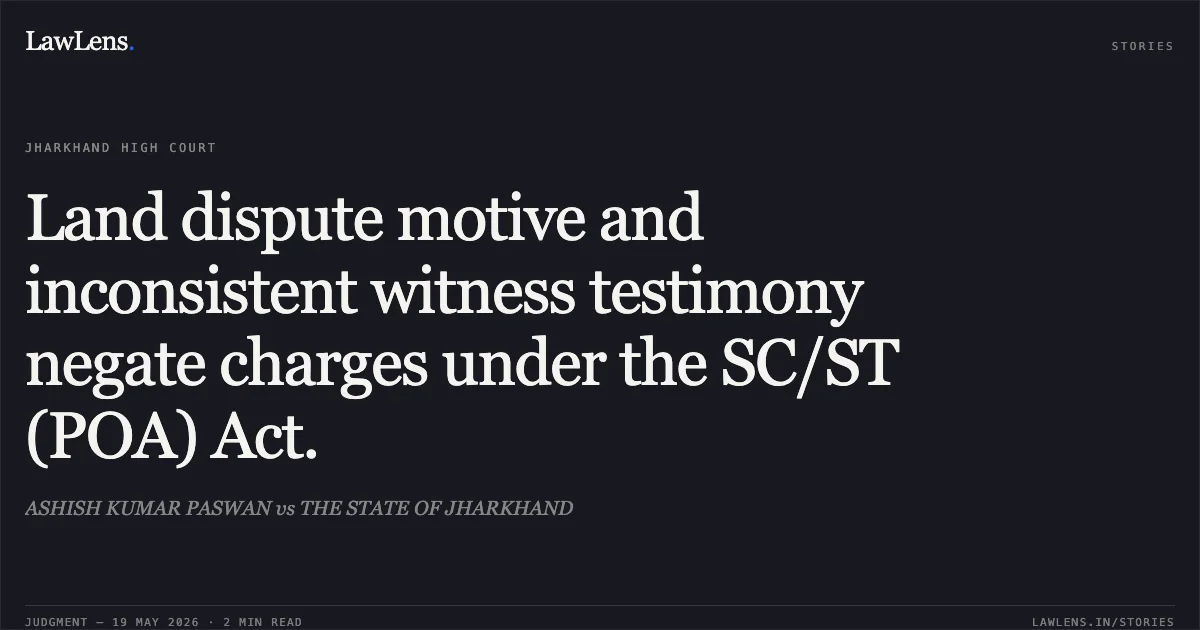
The appellant (complainant) filed a complaint, later converted into Chainpur P.S. Case No. 104 of 2019, alleging that on 05.11.2018, Respondent Nos. 2 and 3 (the accused) abused him using caste-based slurs and assaulted him with fists and slaps at a Block office
Source reference: para 4The appellant further alleged a long-standing land dispute regarding 14 decimals of land allotted to his grandfather, claiming the respondents had grabbed 58 decimals of land and frequently threatened his family
Source reference: para 4Following a trial involving nine prosecution witnesses, the Special Judge, SC/ST (POA) Act, Palamau, acquitted the respondents of all charges via judgment dated 13.09.2024
Source reference: para 2, 10Issues
1. Whether the Trial Court erred in acquitting the respondents for charges under Sections 504 and 506 of the IPC and Sections 3(1)(g), 3(1)(r), and 3(1)(s) of the SC/ST (POA) Act
Source reference: para 2, 112. Whether the prosecution evidence was sufficient to establish that the alleged assault and verbal abuse were motivated by the victim's caste identity rather than a bona fide land dispute
Source reference: para 11Law Applied
The Court applied the evidentiary standards for criminal conviction under Sections 504 (Intentional insult with intent to provoke breach of the peace) and 506 (Criminal intimidation) of the Indian Penal Code, and the specific protections against land dispossession and public humiliation under Sections 3(1)(g), (r), and (s) of the Scheduled Castes and the Scheduled Tribes (Prevention of Atrocities) Act
Source reference: para 2, 7The court relied on the principle that evaluation of evidence is the primary domain of the trial court and that an order of acquittal should not be interfered with unless it is perverse or the evidence is misapplied
Source reference: para 13, 15Reasoning
The Court observed that the prosecution’s case was weakened by significant inconsistencies and improvements in witness testimonies. While P.W.1 and P.W.2 testified to an altercation, they denied witnessing any assault; P.W.3 (the informant) admitted the incident occurred without witnesses and stemmed from a persistent land dispute
Source reference: para 8The Court noted that P.W.4 and P.W.6 admitted to providing hearsay evidence or facts not previously stated to the police
Source reference: para 8The Investigating Officer’s testimony further highlighted that the witnesses’ court depositions deviated significantly from their original statements
Source reference: para 8(VIII)The High Court upheld the Trial Court’s findings that the altercation was a result of a bona fide land dispute (including a pending Title Suit No. 148 of 2020) rather than caste-based malice, and that the prosecution witnesses had significantly improved upon the story to fit the rigors of the SC/ST Act
Source reference: para 11, 14Holding
The High Court dismissed the appeal and affirmed the judgment of acquittal
It held that the prosecution failed to prove the charges beyond a reasonable doubt, as the evidence was inconsistent and the underlying motive for the conflict was a civil land dispute rather than the appellant's caste
Source reference: para 11, 15The court found no legal grounds to interfere with the Trial Court’s evaluation of the evidence
Source reference: para 15Acts & Sections Cited
4 provisions across 3 statutes referred to in this judgment. Each provision opens on LawLens.
Indian Penal Code, 18602
Scheduled Castes and the Scheduled Tribes (Prevention of Atrocities) Act, 19891
Code of Criminal Procedure, 19731
Original Court PDF
ASHISH KUMAR PASWANvsTHE STATE OF JHARKHAND
Click to open original judgment
Original judgment, available to read, download and summarize on LawLens.in