Facts
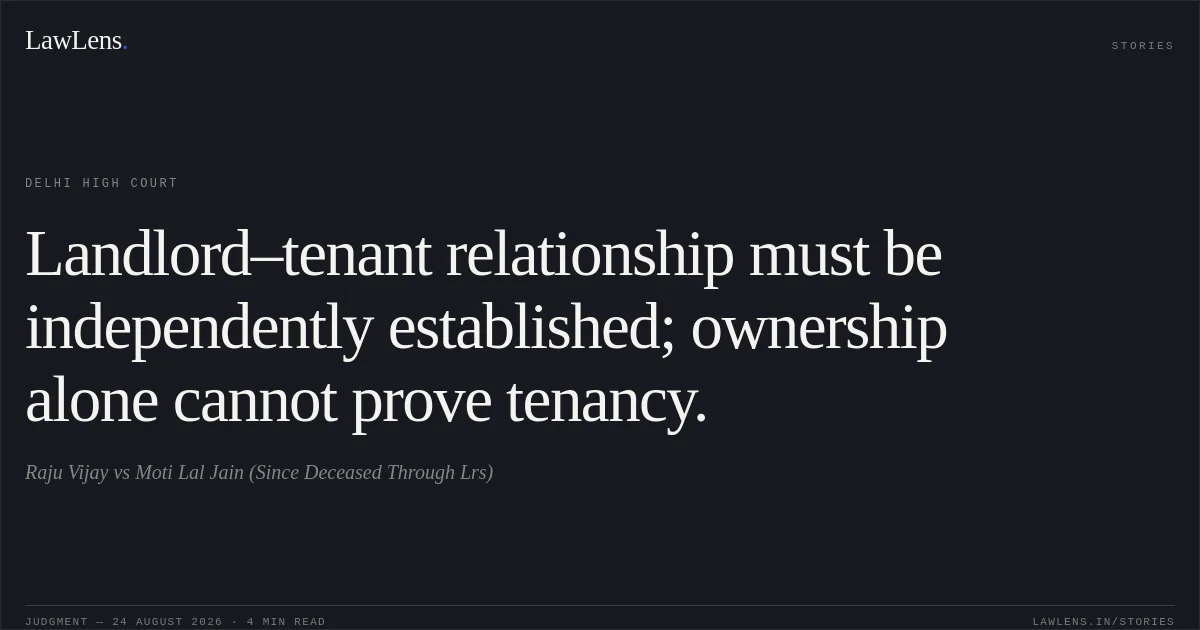
The Respondent-landlord filed an eviction petition under Section 14(1)(e) of the Delhi Rent Control Act, 1958 (“DRC Act”) concerning a shop situated on the first floor of property No. G-I/2, Lawrence Road Industrial Area, Delhi. The learned ACJ-cum-ARC dismissed the Petitioner’s application for leave to defend and passed an eviction order on 9 June 2023.
Source reference: p.1The Petitioner challenged the order under Section 25B(8) of the DRC Act, limiting his challenge to the alleged absence of a landlord-tenant relationship. He contended that the premises had not been let to him by the Respondent and that he occupied it as a licensee under his brother, Kamal Vijay, who allegedly acquired rights in the property through documents executed by the erstwhile owner.
Source reference: pp.2–3The learned ARC rejected this defence principally because the Petitioner had not produced the documents supporting the alleged transfer in favour of his brother. The ARC relied on the Respondent’s GPA-sale documents, held that the Respondent was the owner/landlord, invoked Section 116 of the Indian Evidence Act, 1872, and concluded that a landlord-tenant relationship existed.
Source reference: pp.6–7The Petitioner subsequently placed additional documents on record before the High Court pursuant to an order dated 9 May 2024; those documents had not been before the learned ARC.
Source reference: p.3, para. 6Issues
Whether the learned ARC erred in concluding that a landlord-tenant relationship existed merely because the Petitioner failed to substantiate his defence that his brother was the owner and that he occupied the premises as his licensee?
Source reference: pp.7–9, paras. 18–22Whether the learned ARC was required to independently examine whether affirmative material established the creation or subsistence of a landlord-tenant relationship between the Respondent and the Petitioner?
Source reference: pp.7–10, paras. 19–28Whether the High Court, exercising limited revisional jurisdiction under the proviso to Section 25B(8) of the DRC Act, should interfere with the eviction order and remand the matter for fresh consideration?
Source reference: pp.3–6, 10–12, paras. 10–16 and 29–35Law Applied
The Court applied Section 25B(8) of the DRC Act, holding that the High Court’s jurisdiction is supervisory and revisional, not appellate, and is confined to examining the legality, propriety, jurisdictional validity and decision-making process of the Rent Controller.
Source reference: pp.3–6, paras. 10–15This principle was derived from Sarla Ahuja v. United India Insurance Co. Ltd., (1998) 8 SCC 119; Hindustan Petroleum Corporation Ltd. v. Dilbahar Singh, (2014) 9 SCC 78; and Abid-Ul-Islam v. Inder Sain Dua, (2022) 6 SCC 30, and reiterated in Pankaj Pahwa v. Prem Wati, 2024:DHC:9322, and Sanjeev Hiranandani v. Sunny Grover, 2025:DHC:11285.
Source reference: pp.3–6, paras. 10–15Under Section 14(1)(e) of the DRC Act, the landlord need not establish absolute or indefeasible title, but must demonstrate sufficient title or interest to maintain the eviction petition and establish the foundational landlord-tenant relationship.
Source reference: pp.9–10, paras. 24–28Section 116 of the Indian Evidence Act, 1872, embodies tenant estoppel against denial of the landlord’s title, but such estoppel can operate only after the existence of the landlord-tenant relationship has first been established; it cannot substitute for that foundational determination.
Source reference: p.9, para. 23Reasoning
The High Court held that the learned ARC improperly treated the Petitioner’s failure to produce documents supporting his brother’s alleged ownership as sufficient to establish the Respondent’s competing case. The weakness of the defence did not, by itself, prove that the Petitioner was inducted as a tenant by the Respondent.
Source reference: pp.7–9, paras. 19–22The Petitioner had raised a specific and non-evasive alternative case—that his possession arose through a licence from his brother—and the ARC was therefore required to examine whether the Respondent had independently produced material showing the creation or continuation of a landlord-tenant relationship.
Source reference: pp.8–9, paras. 20–22The ARC’s reliance on Section 116 was legally premature because estoppel presupposes an established tenancy. Likewise, the statement that “every owner is also the landlord” was considered too broad, since ownership alone does not conclusively establish that the person in possession is that owner’s tenant.
Source reference: pp.9–10, paras. 23–28As the record did not adequately disclose the material supporting the alleged jural relationship, the decision-making process suffered from a material error warranting revisional interference.
Source reference: pp.10–11, paras. 29–31Holding
The High Court held that the existence of the landlord-tenant relationship had not been properly determined and that the learned ARC had failed to independently assess the Respondent’s affirmative material on that foundational issue.
The eviction judgment and order dated 9 June 2023 were accordingly set aside. The matter was remanded to the learned ARC for de novo consideration, with liberty to the parties to file further documents and lead evidence as permissible in law.
Source reference: pp.11–12, paras. 31–33The ARC was directed to decide the matter uninfluenced by the High Court’s observations and the parties were directed to appear before it on 10 September 2026. The revision petition and pending applications were disposed of accordingly.
Source reference: p.12, paras. 34–35Acts & Sections Cited
4 provisions across 2 statutes referred to in this judgment. Linked provisions open on LawLens.
Delhi Rent Control Act, 19583
Indian Evidence Act, 18721
Original Court PDF
Raju VijayvsMoti Lal Jain (Since Deceased Through Lrs)
Click to open original judgment
Original judgment, available to read, download and summarize on LawLens.in