Facts
Sarita Singh, the landlord, instituted an eviction petition under Section 14(1)(e) of the Delhi Rent Control Act, 1958, concerning three rooms on the first floor of Property No. 5031, Gali Daroga Chellhu Singh Ghas Mandi, Pahari Dhiraj, Delhi.
Source reference: p.1Rabia Begum, the tenant, sought leave to defend, contending that the landlord possessed reasonably suitable alternative accommodation, including other rooms in the same property and several other properties.
Source reference: pp.5–8She also argued that the premises were situated in a slum area and that prior permission under the Slum Areas (Improvement and Clearance) Act, 1956 was required.
Source reference: pp.5–8The learned ARC dismissed the leave-to-defend application and consequently passed an eviction order dated 5 January 2026.
Source reference: pp.5–8Rabia Begum challenged that order under the proviso to Section 25-B(8) of the DRC Act.
Source reference: p.1Issues
Whether the alleged availability of other accommodation with the landlord, including other rooms in the subject property and interests in other properties, raised a triable issue regarding the landlord’s bona fide requirement under Section 14(1)(e) of the DRC Act.
Source reference: pp.5–8; paras. 18–26Whether the alleged location of the subject premises in a slum area deprived the learned ARC of jurisdiction or required prior permission from the competent authority under the Slum Areas (Improvement and Clearance) Act, 1956 before institution of the eviction petition.
Source reference: pp.5, 8–9; paras. 15–17Whether the findings of the learned ARC warranted interference in the High Court’s limited revisional jurisdiction under the proviso to Section 25-B(8) of the DRC Act.
Source reference: pp.2–4, 8–11; paras. 6–12, 24–28Law Applied
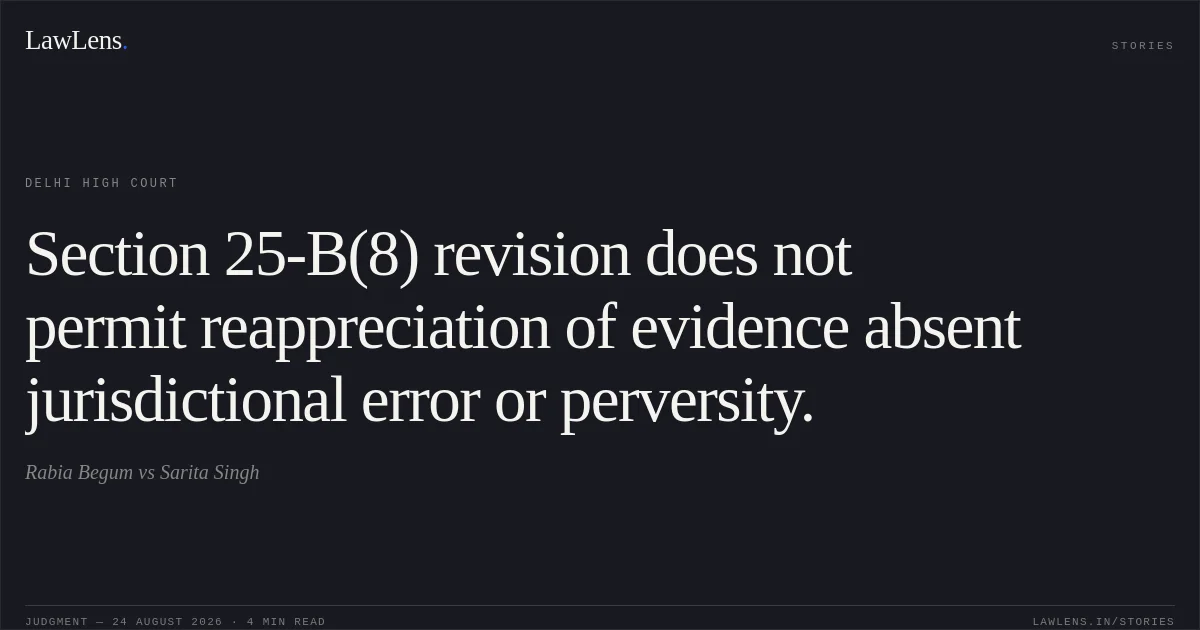
The Court held that revision under the proviso to Section 25-B(8) of the DRC Act is supervisory and not appellate; the High Court may interfere only for jurisdictional error, manifest illegality, material irregularity, perversity, an error apparent on the face of the record, or absence of adjudication, and cannot substitute its own view merely because another view is possible.
Source reference: pp.2–4; paras. 6–12In proceedings under Section 14(1)(e), the mere existence of another property does not defeat bona fide requirement unless the alternative accommodation is shown to be reasonably suitable; the tenant must place prima facie material establishing its availability, the landlord’s right or control over it, and its suitability.
Source reference: pp.5–7; paras. 19–20The Court relied on M.M. Quasim v. Manohar Lal Sharma and Lalta Prasad Gupta v. Sita Ram on alternative accommodation.
Source reference: pp.5–7; paras. 19–20On the slum-area objection, relying on Shafait Ali v. Shiva Mal and Ravi Dutt Sharma v. Rattan Lal Bhargava, the Court applied the principle that the special provisions and procedure under Chapter III-A of the DRC Act prevail over inconsistent requirements of the Slum Areas Act in proceedings under Section 14(1)(e), and prior permission under Section 19(1)(a) of the Slum Areas Act was therefore unnecessary.
Source reference: pp.5, 8–9; paras. 14–17The Court also relied on Sarla Ahuja v. United India Insurance Co. Ltd., Hindustan Petroleum Corporation Ltd. v. Dilbahar Singh, Abid-Ul-Islam v. Inder Sain Dua, Pankaj Pahwa v. Prem Wati and Sanjeev Hiranandani v. Sunny Grover regarding the restricted scope of revisional review.
Source reference: pp.2–4; paras. 7–10Reasoning
The High Court found that the learned ARC had expressly considered both grounds raised by the tenant.
Source reference: pp.5, 8–9; paras. 14–17Regarding the slum objection, the ARC had applied the governing decisions and correctly concluded that prior permission under the Slum Areas Act was not required for a Section 14(1)(e) eviction petition; the tenant produced no material showing that the ARC lacked jurisdiction.
Source reference: pp.5, 8–9; paras. 14–17Regarding alternative accommodation, the ARC examined the specific rooms and properties relied upon by the tenant.
Source reference: pp.5–8; paras. 18–23The landlord identified the occupants of the various rooms in the subject property and explained the ownership, division, tenancy and availability status of the other properties.
Source reference: pp.5–8; paras. 18–23The tenant relied principally on bald assertions and photographs, which did not establish that the premises were vacant, available to the landlord, or reasonably suitable for the landlord’s pleaded requirement.
Source reference: pp.5–8; paras. 18–23Since the tenant did not identify any material that had been ignored or demonstrate perversity or an unreasonable conclusion, the challenge effectively sought a fresh appreciation of evidence—an exercise impermissible in revision under Section 25-B(8).
Source reference: pp.10–11; paras. 24–28Holding
The Court answered the issues against the tenant.
It held that the slum-area objection did not bar the eviction proceedings or require prior permission under the Slum Areas Act, and that the allegations of alternative accommodation did not disclose any triable issue because availability and reasonable suitability had not been prima facie established.
Source reference: pp.8–11; paras. 15–28Finding no jurisdictional error, manifest illegality, material irregularity or perversity in the ARC’s order, the High Court dismissed the revision petition and disposed of all pending applications.
Source reference: p.12; paras. 28–30Acts & Sections Cited
2 provisions across 2 statutes referred to in this judgment. Each provision opens on LawLens.
delhi rent control act, 19581
Slum Areas (Improvement and Clearance) Act, 19561
Original Court PDF
Rabia BegumvsSarita Singh
Click to open original judgment
Original judgment, available to read, download and summarize on LawLens.in