Facts
M/s Dewar World Design Pvt. Ltd., a garment-designing firm of Himalyani Gupta and her son Gaurav Gupta, intended to export garments to a customer in the United States but had not obtained GST registration.
Source reference: paras. 3–5, pp. 3–4It engaged Nitco Air Express, which advised that the goods could be exported through another exporter’s Importer Exporter Code (“IEC”). Nitco thereafter filed shipping bills in the name of Hiba Enterprises, without Hiba’s knowledge or consent, for exporting Dewar’s garments.
Source reference: paras. 3–5, pp. 3–4The Additional Commissioner held that the goods, declared at an FOB value of approximately Rs. 9.26 lakh and exported under Hiba’s IEC, were liable to confiscation under Sections 113(i) and 113(ia) of the Customs Act, 1962, ordered recovery of drawback of Rs. 1,810 with interest, and imposed penalties of Rs. 5,000 each on Dewar, Himalyani Gupta and Gaurav Gupta under Sections 114 and 114AA.
Source reference: para. 6, pp. 4–5The Commissioner (Appeals) upheld that order. The three appellants challenged the appellate order before the CESTAT.
Source reference: paras. 1 and 7, pp. 2, 4Issues
Whether drawback of Rs. 1,810 could be recovered from Dewar when the shipping bills were filed in the name of Hiba Enterprises and there was no evidence that Dewar received the drawback.
Source reference: paras. 8–10, pp. 5–6Whether the appellants could be penalised under Section 114 of the Customs Act for acts rendering the goods liable to confiscation under Section 113 after the goods had already been exported.
Source reference: paras. 11–14, pp. 6–7Whether penalties under Section 114AA were sustainable in the absence of proof that the appellants knowingly or intentionally made, signed, used, or caused to be used any false declaration, statement or document before Customs.
Source reference: paras. 15–17, pp. 7–8Law Applied
The Tribunal applied Section 2(19) of the Customs Act, 1962, which defines “export goods” as goods intended to be taken out of India; Section 113, which permits confiscation only of specified “export goods”; and Section 114, which penalises acts or omissions rendering such goods liable to confiscation.
Source reference: paras. 11–12, pp. 6–7It further applied Section 114AA, requiring that a person knowingly or intentionally make, sign, use, or cause to be used a false or incorrect material declaration, statement or document in a transaction under the Act.
Source reference: para. 15, p. 7In relation to drawback, the Tribunal considered Section 75 and Section 75A of the Customs Act, Rule 16 of the erstwhile Drawback Rules, 1995, and Rule 17 of the Drawback Rules, 2017, holding that recovery can arise only where drawback was actually paid to the concerned person.
Source reference: paras. 6 and 10, pp. 4–6Reasoning
The Tribunal found that, because the shipping bills were filed using Hiba’s IEC, any drawback processed through the Customs EDI system would ordinarily be credited to Hiba’s bank account, not Dewar’s account.
Source reference: para. 10, pp. 5–6Since no shipping bill was filed in Dewar’s name and the Revenue produced no evidence that Dewar received the drawback, recovery of Rs. 1,810 from Dewar was unsustainable; any recovery would require proof of actual payment to Dewar.
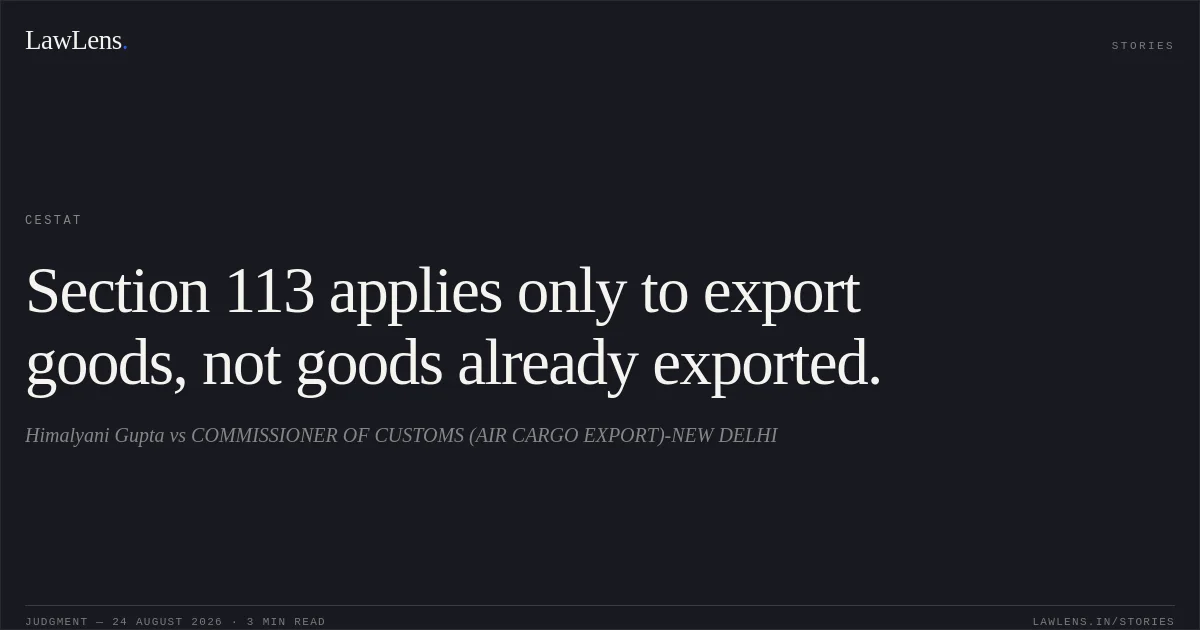
Source reference: para. 10, pp. 5–6For Section 114, the Tribunal distinguished between “export goods,” which are goods intended to be exported, and goods already exported.
Source reference: paras. 12–14, pp. 6–7Once the garments had left India, they ceased to be “export goods” and could no longer be confiscated under Section 113. Consequently, the statutory precondition for imposing penalties under Section 114 was absent.
Source reference: paras. 12–14, pp. 6–7As to Section 114AA, the evidence showed that Nitco filed the false shipping bills in Hiba’s name and misused Hiba’s IEC.
Source reference: paras. 16–17, p. 8The appellants, who were inexperienced in export procedures, had approached Nitco for a single-window export solution. There was no evidence that Dewar, Himalyani or Gaurav made, signed, used, or caused to be used any false document with the requisite knowledge or intention.
Source reference: paras. 16–17, p. 8Holding
The essential mental element under Section 114AA was therefore not established.
The CESTAT allowed all three appeals and set aside the Commissioner (Appeals)’ order, along with the penalties imposed under Sections 114 and 114AA and the drawback recovery demand against the appellants.
Source reference: para. 18, p. 8It held that recovery of drawback from Dewar could not arise absent evidence that Dewar had received it, while leaving open the possibility of recovery with applicable interest if the Department subsequently established such payment.
Source reference: para. 10, pp. 5–6Consequential relief was granted to Himalyani Gupta, Dewar World Design Pvt. Ltd. and Gaurav Gupta.
Source reference: para. 18, p. 8Acts & Sections Cited
8 provisions across 1 statute referred to in this judgment. Each provision opens on LawLens.
Original Court PDF
Himalyani GuptavsCOMMISSIONER OF CUSTOMS (AIR CARGO EXPORT)-NEW DELHI
Click to open original judgment
Original judgment, available to read, download and summarize on LawLens.in