Facts
The petitioner’s order of compulsory retirement had earlier been set aside by the Delhi High Court in its judgment dated 26 September 2025. Since the petitioner had attained the age of superannuation, the Court directed deemed reinstatement and notional fixation of pay and consequential benefits, but expressly denied arrears of pay.
Source reference: p.1, para. 3The petitioner sought review, contending that the Court had failed to consider Fundamental Rule 56(jj), under which the intervening period is treated as spent on duty for all purposes, including pay and allowances, when premature retirement is set aside by a court.
Source reference: p.2, paras. 4, 8He also relied on the decision in South Delhi Municipal Corporation v. Ranvir Singh & Anr., where employees had allegedly received back wages for a portion of the relevant period.
Source reference: p.2, para. 5The respondent opposed the review on the ground that the petition sought appellate reconsideration beyond the limited scope of review jurisdiction.
Source reference: p.2, para. 6The Court condoned a delay of 116 days in filing the review petition.
Source reference: p.1, paras. 1–2Issues
Whether the Court’s failure to expressly refer to Fundamental Rule 56(jj) warranted review of the judgment dated 26 September 2025 and required grant of arrears of pay for the intervening period.
Source reference: p.2, paras. 4, 8–10Whether the relief granted in South Delhi Municipal Corporation v. Ranvir Singh & Anr. justified reviewing or modifying the petitioner’s entitlement to back wages.
Source reference: p.2, para. 5; p.4, para. 11Whether the petitioner’s challenge fell within the limited scope of review jurisdiction, or was in substance an appeal seeking reconsideration of the original judgment.
Source reference: p.4, para. 12Law Applied
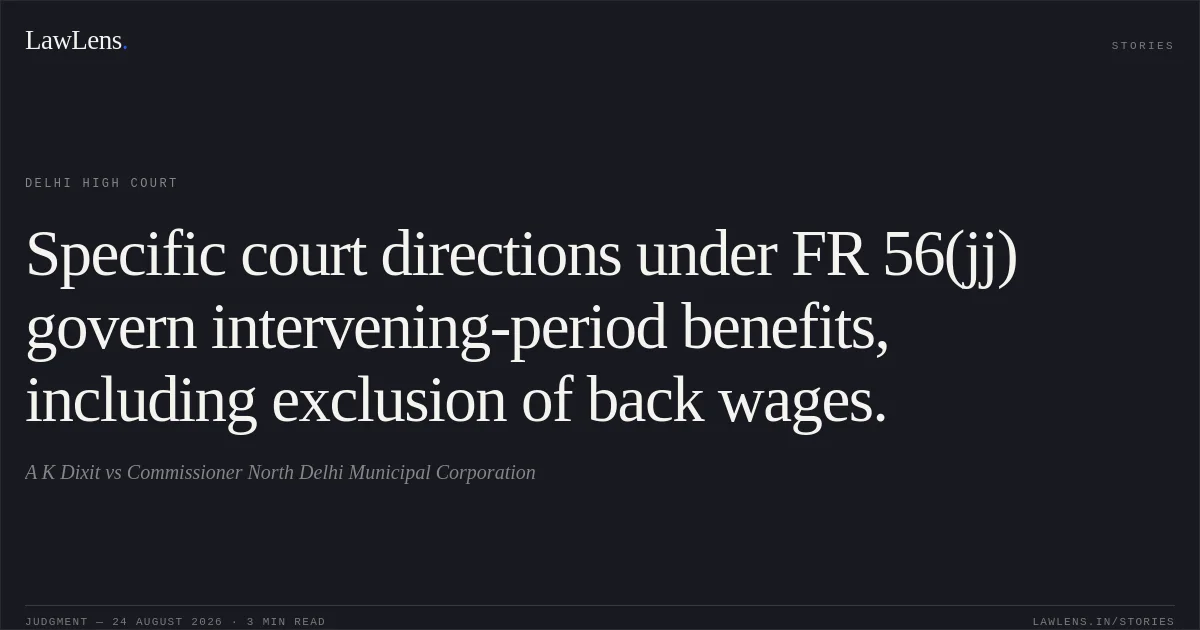
Fundamental Rule 56(jj)(i) provides that where premature retirement is set aside by a court, the intervening period is to be treated as spent on duty for all purposes, including pay and allowances, subject to the rule.
Source reference: p.3, para. 8Rule 56(jj)(ii) specifically provides that where the court sets aside premature retirement with directions regarding regulation of the intervening period, that period must be regulated in accordance with the court’s directions.
Source reference: p.3, para. 8The Court applied the principle that review jurisdiction is limited and cannot be used as a substitute for an appeal; mere omission to refer to a particular provision, where the court has consciously exercised its discretion and issued specific directions, does not by itself constitute a ground for review.
Source reference: p.3, para. 10; p.4, para. 12Reasoning
The Court held that Rule 56(jj)(ii) governed because its earlier judgment had specifically directed how the period between compulsory retirement and the judgment was to be regulated—by granting consequential benefits and notional pay fixation but excluding arrears of pay.
Source reference: p.2, para. 3; p.3, paras. 8–10Accordingly, the Court’s failure to expressly mention Rule 56(jj) did not invalidate or undermine the discretion already exercised in the judgment.
Source reference: p.3, para. 10The reliance on Ranvir Singh was also rejected because the Tribunal’s original order in that case had itself denied arrears of salary; the High Court merely dismissed the challenge to that order and did not subsequently apply Rule 56(jj) to grant back wages.
Source reference: p.4, para. 11The petitioner’s request therefore sought a fresh assessment of the merits and modification of the relief, making it appellate in substance rather than a permissible review.
Source reference: p.4, para. 12Holding
The Court answered the issues against the petitioner. It held that the specific directions in the judgment dated 26 September 2025 governed the regulation of the intervening period under Rule 56(jj)(ii), and that no review was warranted merely because the rule had not been expressly cited.
The reliance on Ranvir Singh was found distinguishable, and the review petition was held to be an impermissible appeal in the guise of review.
Source reference: p.4, paras. 11–12The delay of 116 days was condoned, but Review Petition No. 99/2026 was dismissed for lack of merit.
Source reference: p.1, paras. 1–2; p.4, para. 13Original Court PDF
A K DixitvsCommissioner North Delhi Municipal Corporation
Click to open original judgment
Original judgment, available to read, download and summarize on LawLens.in