Facts
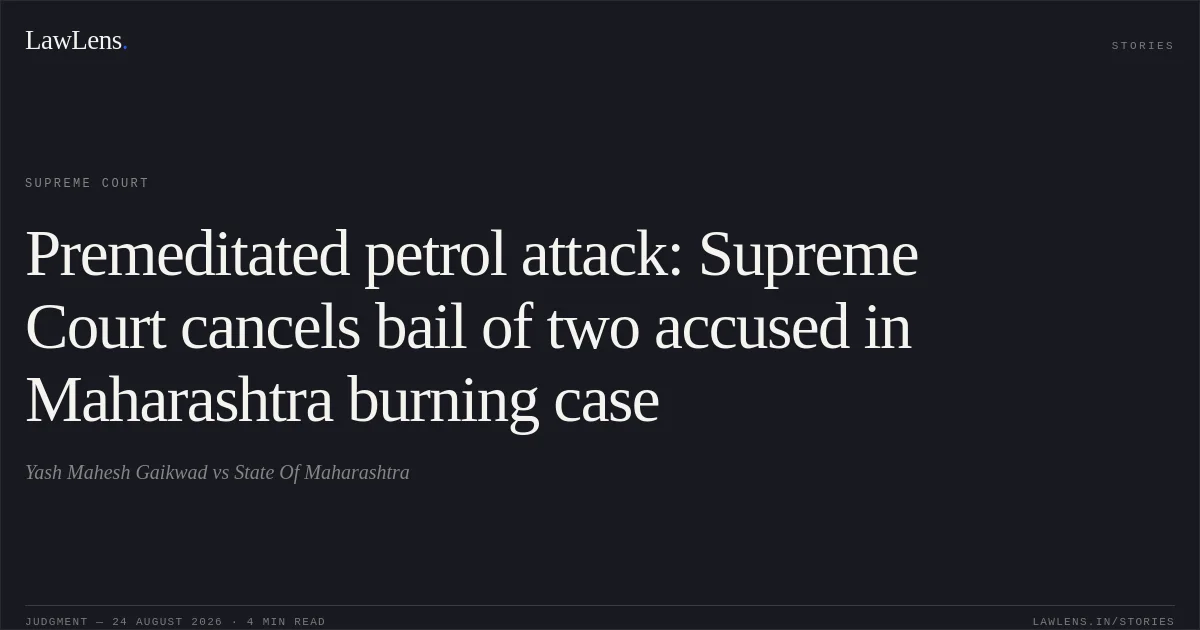
FIR No. 261 of 2024 was registered at Satara Taluka Police Station under Sections 302, 307, 323, 109, 504 and 506 read with Section 34 of the IPC, alleging that accused No. 1, accompanied by three unidentified persons later identified as accused Nos. 2–4, attacked Anil Madhukar Shinde at his residence after demanding an apology from his son.
Source reference: paras. 6–7, 11The group allegedly assaulted Shinde, threatened him, poured petrol over him and set him on fire; accused No. 4 allegedly recorded the incident, while accused No. 2 allegedly drove the vehicle and acted as a lookout.
Source reference: paras. 6–7, 11The High Court granted regular bail to accused No. 4-Jyotiraditya on the grounds that he had merely recorded the incident, was a young student with no antecedents, and had been incarcerated for over one year.
Source reference: para. 9Accused No. 5-Ranjit @ Dadaso was also granted bail because he was not physically present at the scene and the allegations of instigation were considered insufficient at that stage.
Source reference: para. 10Relying on parity with accused Nos. 4 and 5, the trial Court granted bail to accused No. 3-Pruthviraj.
Source reference: para. 8The High Court rejected accused No. 2-Yash’s bail application, finding that his alleged role in transporting the assailants, carrying petrol and facilitating their return prima facie disclosed common intention under Section 34 IPC.
Source reference: para. 11The State challenged the bail granted to accused Nos. 3–5, while accused No. 2 challenged the rejection of his bail.
Source reference: paras. 3–4Issues
Whether the orders granting regular bail to accused Nos. 3, 4 and 5 were legally sustainable when the material on record prima facie indicated a premeditated attack committed in furtherance of common intention?
Source reference: paras. 28–37Whether accused No. 2-Yash was entitled to regular bail despite the allegation that he facilitated the coordinated attack by transporting the assailants and acting as driver and lookout?
Source reference: paras. 11, 28–37Whether accused No. 5-Ranjit @ Dadaso’s bail warranted interference when he was admittedly absent from the place of occurrence and the case against him was substantially circumstantial?
Source reference: paras. 26–27Law Applied
The Court considered the offences alleged under Sections 302, 307, 323, 109, 504 and 506 read with Section 34 of the IPC.
Source reference: para. 6It applied the settled principle that bail in serious offences must be granted judicially and not mechanically, with reasons demonstrating prima facie consideration of the nature of the accusation, gravity of the offence, manner of commission, role attributed to the accused, criminal antecedents, possibility of witness intimidation or evidence tampering, likelihood of absconding, and the overall desirability of release.
Source reference: para. 32Relying on Ram Govind Upadhyay v. Sudarshan Singh, Mahipal v. Rajesh Kumar, and Ramesh Bhavan Rathod v. Vishanbhai Hirabhai Makwana, the Court held that an order granting bail in a serious offence must reflect proper application of mind and contain justifiable reasons.
Source reference: para. 32Under Shabeen Ahmad v. State of Uttar Pradesh and Ajwar v. Waseem, an unreasoned or perverse bail order may be set aside by a superior court even in the absence of post-release misuse of liberty, particularly where relevant material, the gravity of the offence or its societal impact has been ignored.
Source reference: para. 33Section 34 IPC was applied to the principle that acts done by several persons in furtherance of a common intention may attract joint criminal liability.
Source reference: para. 11Reasoning
The Court held that the foundational bail order in favour of accused No. 4, and the subsequent parity-based order in favour of accused No. 3, failed to consider the material facts disclosed in the FIR.
Source reference: paras. 29–31, 35–37The accused had allegedly arrived together at night, repeatedly attacked the complainant’s house, issued threats, carried petrol in the vehicle and executed the assault after a prior dispute; these circumstances prima facie indicated concerted action, preparation and common intention rather than a spontaneous quarrel.
Source reference: paras. 29–31, 35–37Accused No. 4’s alleged act of recording the incident did not, by itself, establish non-participation, and the High Court’s reasoning was found to be flimsy and legally inadequate.
Source reference: paras. 9, 34Since accused No. 3’s bail rested on parity with that unsustainable order, it also could not stand.
Source reference: paras. 29, 34Accused No. 2’s alleged role as driver and facilitator was treated as an integral part of the coordinated attack, and the High Court’s rejection of his bail was not shown to be erroneous.
Source reference: para. 11In contrast, accused No. 5 was admittedly absent when the complainant was set ablaze, and the material implicating him in the alleged conspiracy and supply of petrol was circumstantial; consequently, the Court found no sufficient basis to interfere with his bail.
Source reference: paras. 26–27Holding
The appeals filed by the State against the bail granted to accused No. 4-Jyotiraditya and accused No. 3-Pruthviraj were allowed.
The orders granting them bail were set aside, their bail was cancelled, and they were directed to surrender within three weeks, failing which the trial Court was directed to secure their arrest.
Source reference: para. 39The appeal filed by accused No. 2-Yash against rejection of bail was dismissed, and the State’s appeal against the bail granted to accused No. 5-Ranjit @ Dadaso was also dismissed; his bail was affirmed.
Source reference: paras. 27, 40The trial Court was directed to complete the trial within two years from presentation of the Supreme Court’s order, without being influenced by the prima facie observations made for the purpose of bail.
Source reference: para. 38Acts & Sections Cited
8 provisions across 2 statutes referred to in this judgment. Each provision opens on LawLens.
Indian Penal Code, 18607
Code of Criminal Procedure, 19731
Original Court PDF
Yash Mahesh GaikwadvsState Of Maharashtra
Click to open original judgment
Original judgment, available to read, download and summarize on LawLens.in