Facts
The petitioners invoked the High Court’s inherent jurisdiction under Section 482 of the Code of Criminal Procedure, 1973, seeking quashing of the criminal proceedings in Complaint Case No. 1186 of 2021 and the order dated 03.02.2022 taking cognizance of offences under Sections 467, 468, 471 and 120B of the Indian Penal Code, 1860
Source reference: para. 2The complainant alleged that Petitioners 1–3 had fraudulently sold land claimed by him to Petitioners 4–6, while Petitioner 7 drafted and Petitioner 8 scribed the sale deed
Source reference: para. 3The petitioners contended that they claimed ownership over the property and that the complainant was neither the purchaser nor a party to the sale deed. They also relied on mutation records, tax receipts and jamabandi documents to support their claim of ownership
Source reference: para. 6The complainant opposed the petition, alleging that the petitioners knowingly entered into a transaction concerning his property
Source reference: para. 7Issues
1. Whether the execution of a sale deed by persons claiming ownership over property, in favour of third-party purchasers, constitutes the making of a “false document” and forgery vis-à-vis a non-party claimant to the property?
Source reference: paras. 4, 8–92. Whether, in the absence of allegations of impersonation or forgery, offences under Sections 467, 468, 471 and 120B IPC were prima facie made out so as to justify continuation of the criminal proceedings?
Source reference: paras. 8–93. Whether the criminal proceedings and the order taking cognizance were liable to be quashed under Section 482 CrPC as an abuse of the process of law?
Source reference: paras. 2, 9–10Law Applied
The Court exercised its inherent jurisdiction under Section 482 CrPC to prevent abuse of process and secure the ends of justice
Source reference: para. 2It considered Sections 467, 468 and 471 IPC, which respectively concern forgery of valuable security or similar documents, forgery for the purpose of cheating, and using a forged document as genuine; Section 120B IPC concerning criminal conspiracy was also alleged
Source reference: paras. 2, 9Relying principally on Mohammed Ibrahim v. State of Bihar, (2009) 8 SCC 751, the Court held that when a person executes a sale deed claiming property to be his own, although the property may in fact belong to another, such execution does not by itself amount to making a false document or forgery against a third-party claimant; the transaction may, depending on the facts, give rise to a cheating claim by the purchaser
Source reference: para. 4The Court also considered Bibhash Chandra Panjiara @ Vibhash Panjiara v. State of Jharkhand, Cr.M.P. No. 637 of 2021, decided on 09.08.2023, where criminal proceedings were quashed in comparable circumstances involving an ownership dispute without impersonation
Source reference: para. 5Reasoning
The Court found that the complainant was a third party to the sale deed executed by Petitioners 1–3 in favour of Petitioners 4–6
Source reference: para. 9The petitioners claimed to be owners of the property and executed the deed in that asserted capacity; there was no allegation that any petitioner impersonated another person or fabricated the identity of an executant
Source reference: para. 9Applying the rule in Mohammed Ibrahim, the Court held that a disputed assertion of ownership in a sale deed, without more, does not constitute the making of a false document or forgery vis-à-vis a non-purchasing claimant.
Source reference: para. 9Since the foundational allegation of forgery was absent, the connected offences under Sections 467, 468 and 471 IPC could not be sustained, even with the aid of Section 120B IPC
Source reference: para. 9The continuation of the proceedings was therefore considered an abuse of the process of law
Source reference: para. 9Holding
The Court answered the issues in favour of the petitioners.
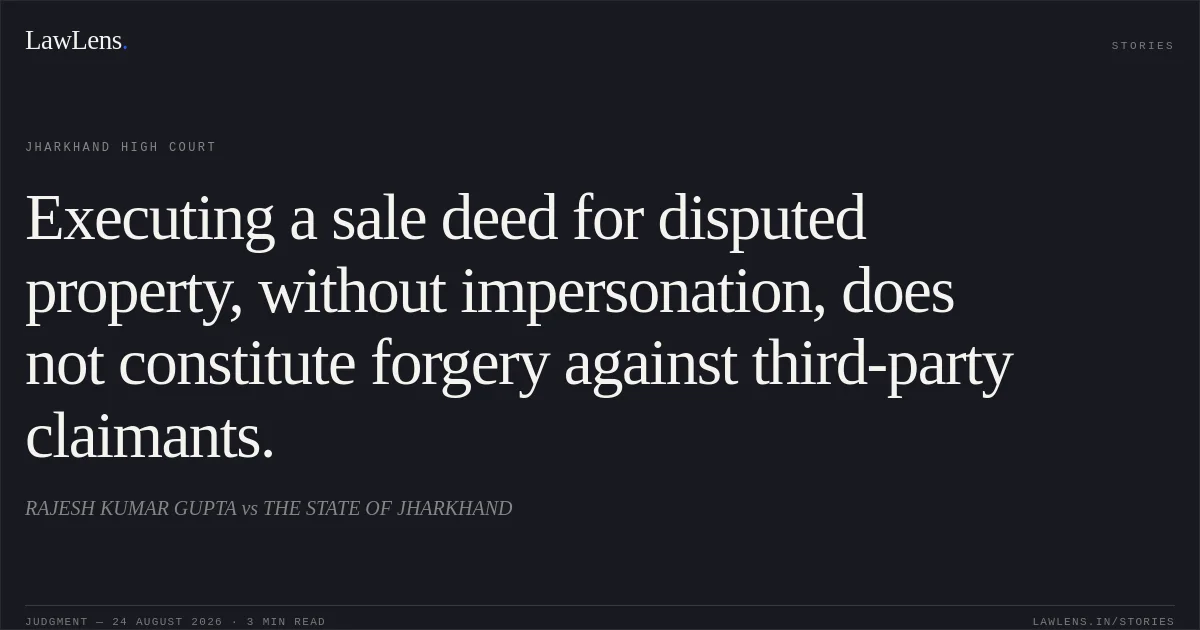
It held that the execution of the sale deed by persons claiming ownership, without any allegation of impersonation, did not amount to forgery against the complainant, who was a third party to the transaction
Source reference: para. 9Accordingly, the entire criminal proceedings in Complaint Case No. 1186 of 2021, including the order dated 03.02.2022 taking cognizance, were quashed and set aside against all petitioners
Source reference: paras. 9–11The criminal miscellaneous petition was allowed to that extent, and any pending interlocutory applications were disposed of as infructuous
Source reference: paras. 11–12Acts & Sections Cited
5 provisions across 2 statutes referred to in this judgment. Linked provisions open on LawLens.
Code of Criminal Procedure, 19731
Indian Penal Code, 18604
Original Court PDF
RAJESH KUMAR GUPTAvsTHE STATE OF JHARKHAND
Click to open original judgment
Original judgment, available to read, download and summarize on LawLens.in