Facts
On May 24, 2004, the two appellants allegedly took the deceased, Mohinder, from his home on a motorcycle
Source reference: p. 2The following morning, his body was discovered in a field with head injuries and signs of being dragged
Source reference: p. 2A damaged Yamaha motorcycle and the deceased's chappals were found nearby
Source reference: p. 3The prosecution alleged the motive was suspicion that the deceased was a police informant regarding the appellants' contraband trade
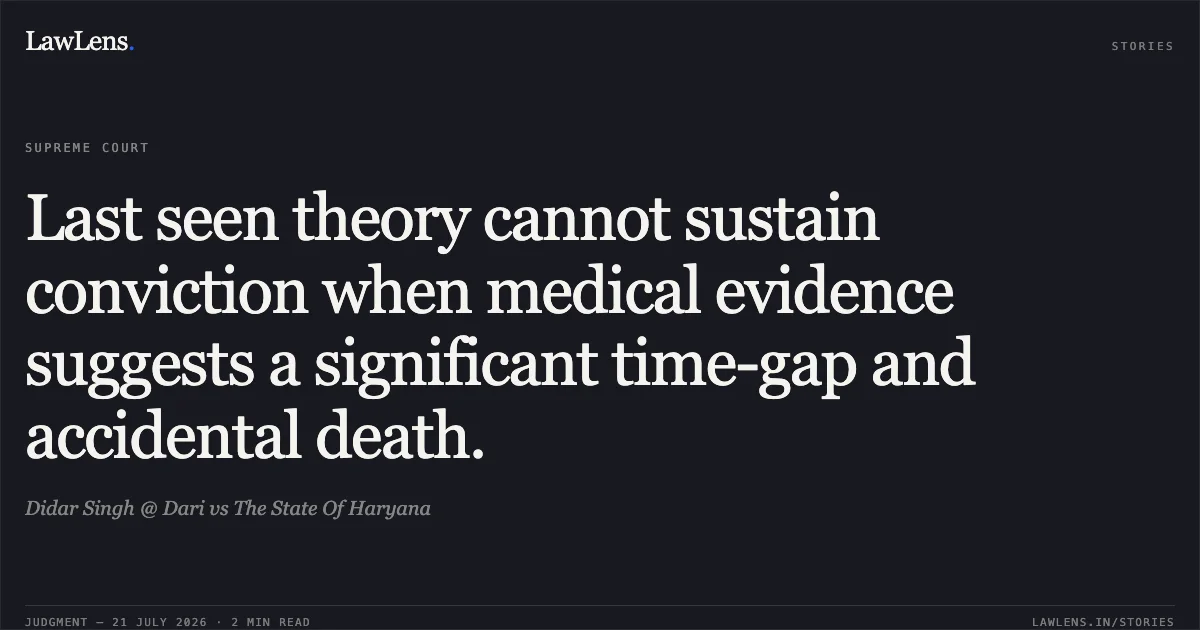
Source reference: p. 4The Trial Court and High Court convicted the appellants under Section 302/34 of the IPC, primarily based on the "last seen" theory and the appellants' failure to explain when they parted company with the deceased
Source reference: p. 5Issues
1. Whether the "last seen" circumstance was sufficiently established to sustain a conviction in a case based on circumstantial evidence
Source reference: p. 16/para. 162. Whether the medical evidence and recovery of the damaged motorcycle supported the hypothesis of a homicidal death versus a vehicular accident
Source reference: p. 14, 25/para. 14, 263. Whether the prosecution successfully established the motive and linked the recovered items (motorcycles) to the accused
Source reference: p. 26, 29/para. 27, 31Law Applied
The Court applied the five-fold "Panchsheel" principles of circumstantial evidence established in Sharad Birdhichand Sarda v. State of Maharashtra, requiring a complete chain of evidence excluding every hypothesis except guilt
Source reference: p. 11-12It interpreted Section 106 of the Indian Evidence Act, 1872, noting that the burden of proof shifts to the accused only after the prosecution establishes a prima facie case
Source reference: p. 17-18The Court further referenced Modi’s Medical Jurisprudence regarding the nature of injuries sustained by motorcyclists and the variables affecting the estimation of time of death via stomach contents
Source reference: p. 15, 20Reasoning
The Court found the prosecution's chain of evidence incomplete. First, the medical evidence (empty stomach and lack of fecal matter) suggested death occurred in the wee hours of the morning, creating a significant time gap from when the deceased was "last seen" at 8:00 PM, thereby allowing for third-party intervention
Source reference: p. 19-21Second, the Court noted that the injuries were consistent with a motorcycle accident, an inference bolstered by the discovery of a damaged motorcycle and human blood at a secondary spot
Source reference: p. 15, 25The Court criticized the "last seen" testimony of PW1 and PW4 as a likely post-discovery contrivance, noting they failed to mention the motorcycle's color in initial statements and that the FIR's description of "drag marks" appeared coached since no such marks were in the police site plans
Source reference: p. 23-26Furthermore, the prosecution failed to prove Ranjeet Singh’s ownership of the motorcycle or any direct link between the deceased’s role as an informant and the appellants
Source reference: p. 27-30Holding
The Court held that the prosecution failed to prove the incriminating circumstances beyond reasonable doubt and that the established facts strongly indicated an accidental death rather than homicide
The Supreme Court set aside the judgments of the Trial Court and High Court, flowingly acquitting the appellants of all charges. The Court ordered their immediate release and discharged their bail bonds
Source reference: p. 31/para. 34Acts & Sections Cited
5 provisions across 2 statutes referred to in this judgment. Each provision opens on LawLens.
Indian Penal Code, 18604
Code of Criminal Procedure, 19731
Original Court PDF
Didar Singh @ DarivsThe State Of Haryana
Click to open original judgment
Original judgment, available to read, download and summarize on LawLens.in