Facts
HIDCO and Rosedale Developer Pvt. Ltd. (RDPL) entered into a development agreement dated 24 February 2006 for developing a 16.32-acre bulk plot as a residential housing complex, with ancillary facilities including retail/commercial amenities for residents.
Source reference: para. 6, paras. 37–44HIDCO sanctioned a building plan on 27 August 2009 for residential towers, a club, senior-residence and servant-quarter facilities, and a retail building.
Source reference: paras. 9, 63–64Thereafter, RDPL submitted a modified plan to the New Town Kolkata Development Authority (NKDA), which sanctioned a revised plan on 26 April 2011 under the HIDCO Building Rules, 2006; the revised plan introduced an executive apartment and reduced or modified the retail and other facilities.
Source reference: paras. 10, 73–79On 19 May 2014, HIDCO and RDPL executed a conveyance in favour of Rosedale Plaza (RP), concerning approximately 18,218 square feet of retail/commercial space.
Source reference: para. 12NKDA issued a final occupancy certificate on 14 October 2015.
Source reference: para. 13In November 2018, following proceedings initiated by a flat owner, NKDA inspected the premises and found several deviations from the 26 April 2011 revised plan, including unauthorised commercial structures, fencing, altered roadways, roof additions, gas banks and relocated recreational facilities.
Source reference: paras. 14–17The Single Bench directed NKDA to initiate demolition proceedings, but NKDA subsequently permitted RDPL and RP to submit a fresh plan for regularising the deviations.
Source reference: paras. 18–20The Single Bench held that the original HIDCO plan dated 27 August 2009 was the operative plan, invalidated the NKDA revised plan, but declined to direct demolition.
Source reference: paras. 23–25The Association preferred the present intra-court appeal, principally seeking enforcement of the 26 April 2011 NKDA plan and demolition of constructions made contrary to it.
Source reference: para. 5Issues
1. Whether the development agreement restricted the bulk plot to a residential housing project and limited ancillary commercial facilities to those serving the residents.
Source reference: paras. 36(A), 37–562. Whether the HIDCO-sanctioned plan dated 27 August 2009 remained operative, or was superseded by the NKDA revised plan dated 26 April 2011.
Source reference: paras. 36(B)–(C), 57–793. Whether NKDA had authority to re-sanction or modify the earlier HIDCO plan under the applicable statutory and building-rule framework.
Source reference: paras. 65–794. What legal rights RP acquired under the conveyance dated 19 May 2014, particularly whether it could claim ownership or construction rights beyond 18,218 square feet or contrary to the NKDA revised plan.
Source reference: para. 36(D), paras. 80–905. Whether the unauthorised constructions, commercial-residential partition and constructions exceeding the sanctioned area were liable to be demolished.
Source reference: paras. 97–101Law Applied
The Court applied the development agreement dated 24 February 2006, particularly its provisions defining the “housing complex,” restricting the bulk plot to residential use, and permitting only ancillary facilities connected with residents’ enjoyment.
Source reference: paras. 37–44Under Sections 13 and 46 of the West Bengal Town and Country (Planning and Development) Act, 1979, the planning authority may prescribe land use and grant, condition or refuse development permission.
Source reference: paras. 57–60Section 10 of that Act governs withdrawal of a planning area and the continuing effect of notifications, rules and orders made under it.
Source reference: paras. 61–62The Court relied on Rule 4A(2) of the NKDA Building Rules, 2009, which permits re-sanctioning of an existing plan sanctioned under different rules and, where necessary, processing re-sanction under the rules governing the original plan.
Source reference: paras. 76–79It further applied the principles that town-planning legislation validly restricts land use in the public interest, as recognised in Chairman, Indore Vikas Pradhikaran v. Pure Industrial Coke & Chemicals Ltd., (2007) 8 SCC 705, and State of Gujarat v. Shantilal Mangaldas, (1969) 1 SCC 509.
Source reference: paras. 45–47The Court also relied on Vasundhara Vyapar Mandal v. U.P. Avas Evam Vikas Parishad, 2004 SCC OnLine All 2067, and P.V. Kapur v. Union of India, 2020 SCC OnLine Del 3054, for the principle that commercial or “convenience shopping” facilities in a residential project must remain ancillary to and consistent with the residential use, and cannot be commercially exploited in a manner that disrupts the residential scheme.
Source reference: paras. 49–56The distinction between territorial jurisdiction and inherent subject-matter jurisdiction, including the curable nature of territorial irregularity, was drawn from Hira Lal Patni v. Kali Nath, AIR 1962 SC 199, Hasham Abbas Sayyad v. Usman Abbas Sayyad, (2007) 2 SCC 355, and M/S Aarsuday Projects & Infrastructure (P) Ltd. v. Jogen Chowdhury, 2026 INSC 93.
Source reference: paras. 70–72Reasoning
The Court construed the development agreement as creating a singular residential project over the entire 16.32-acre plot.
Source reference: paras. 37–56Although the agreement contemplated retail and other non-residential facilities, those facilities were treated as ancillary amenities intended primarily for the benefit of residents, not as an independent commercial enclave accessible for unrestricted outside commercial exploitation.
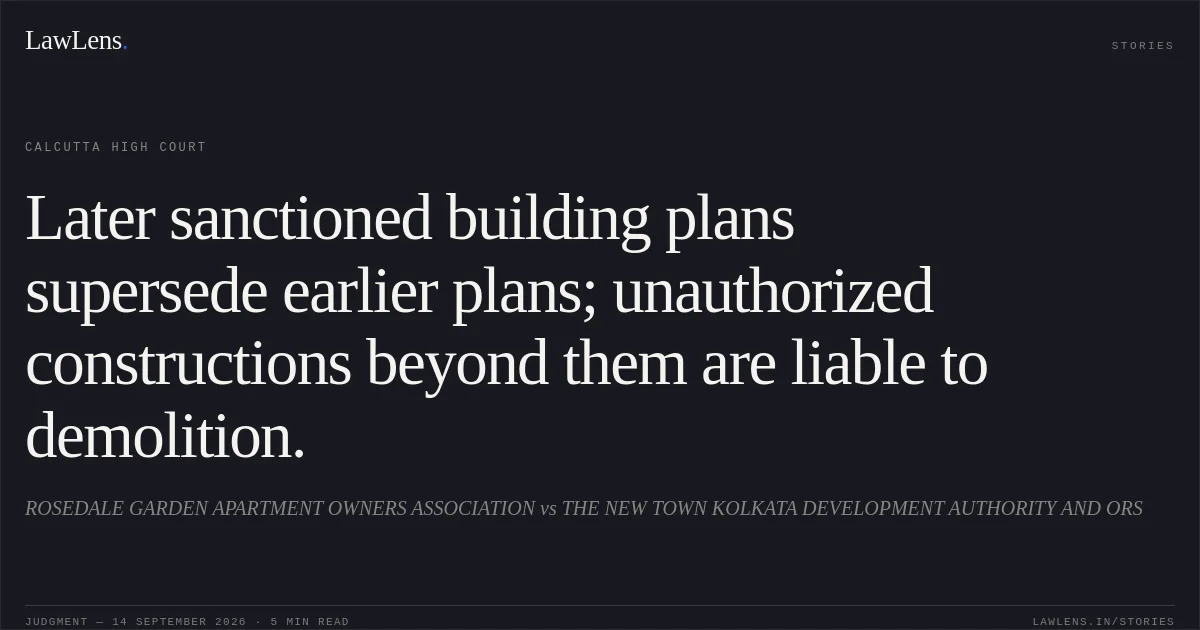
Source reference: paras. 37–56The Court held that HIDCO’s 27 August 2009 plan was valid when sanctioned, but that the NKDA revised plan dated 26 April 2011 superseded it.
Source reference: paras. 65–79NKDA’s action was supported by its statutory role in regulating the New Town area and by Rule 4A(2), which permitted re-sanctioning of an earlier plan under the applicable building rules.
Source reference: paras. 65–79The parties’ subsequent conduct—particularly RP’s reliance on and request for extension of the 2011 plan, the conveyance referring to the revised development, and the inspection conducted by reference to that plan—also demonstrated acceptance of the 2011 plan.
Source reference: para. 75The conveyance could not transfer an independent portion of the bulk plot in derogation of the development agreement.
Source reference: paras. 80–90At most, RP acquired the right to construct, operate and manage retail facilities over approximately 18,218 square feet, subject to the development agreement and the NKDA plan.
Source reference: paras. 80–90Consequently, RP could not claim the right to construct a G+1 retail building under the superseded HIDCO plan, nor could it retain constructions exceeding the area or configuration permitted by the 2011 plan.
Source reference: paras. 91–101The fencing and other works separating the retail space from the residential complex were likewise inconsistent with the integrated residential-cum-retail character of the project.
Source reference: paras. 91–101Holding
The Court held that the NKDA revised plan dated 26 April 2011 was the only valid operative sanction plan, and that the project constituted one integrated residential housing complex with ancillary retail facilities.
RP’s rights were restricted to construction and use of retail facilities within approximately 18,218 square feet, strictly in accordance with the NKDA revised plan and for the primarily intended benefit of the residents.
Source reference: paras. 92–95The NKDA’s order dated 27 February 2019 and its report dated 7 October 2020 absolving RP of unauthorised construction were set aside.
Source reference: para. 97NKDA was directed to ensure compliance with the development agreement and the 2011 revised plan, demolish constructions made beyond the 18,218-square-foot entitlement, remove the partition fence separating the residential and retail portions, and recover demolition costs from RP.
Source reference: paras. 98–100RP was permitted only limited access and demarcation necessary to protect its lawful area, without treating the retail portion as an independent commercial plot.
Source reference: para. 101The appeal and connected applications were disposed of without costs.
Source reference: paras. 102–103Acts & Sections Cited
10 provisions across 5 statutes referred to in this judgment. Each provision opens on LawLens.
New Town, Kolkata Development Authority Act, 20074
West Bengal Town And Country ( Planning And Development ) Act, 19793
West Bengal Building ( Regulation Of Promotion Of Construction And Transfer By Promoters ) Act, 19931
West Bengal Apartment Ownership Act, 19721
Code of Civil Procedure, 19081
Original Court PDF
ROSEDALE GARDEN APARTMENT OWNERS ASSOCIATIONvsTHE NEW TOWN KOLKATA DEVELOPMENT AUTHORITY AND ORS
Click to open original judgment
Original judgment, available to read, download and summarize on LawLens.in