01Facts
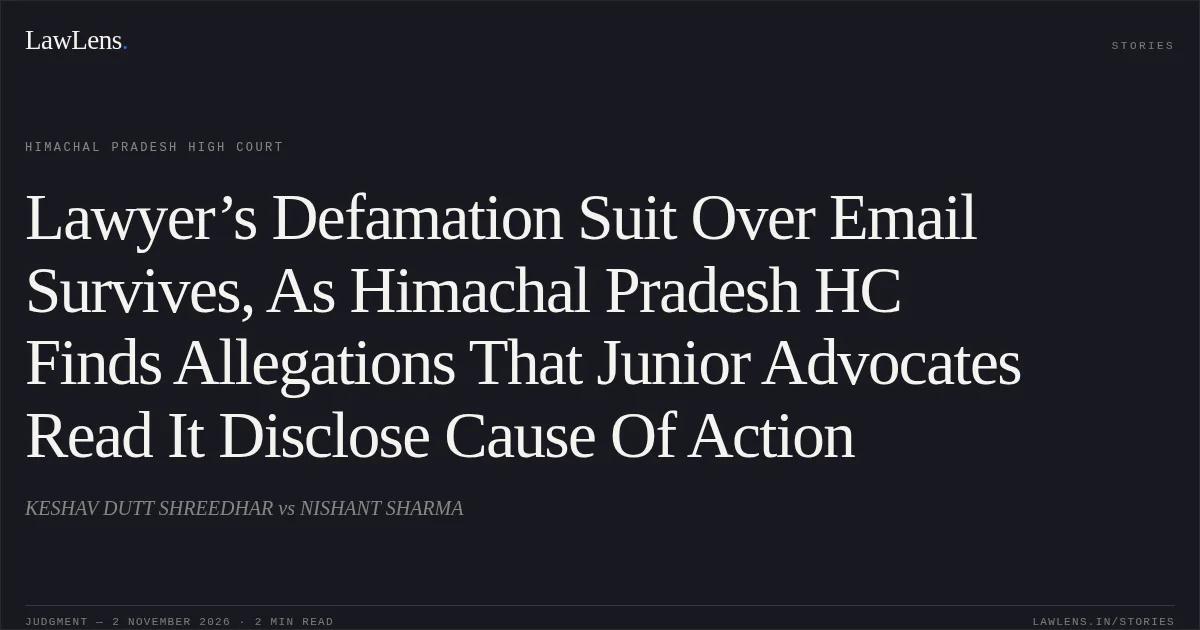
The plaintiff brought a defamation suit alleging that the defendant sent a false and defamatory email on 9 October 2023.
The plaint alleged that the email was accessed by junior advocates at the plaintiff’s Shimla office and was also forwarded to family members, causing reputational and personal harm
pp. 11–12The defendant applied under Order VII Rule 11 read with Section 151 CPC to reject the plaint, contending, among other things, that it disclosed no cause of action and that the alleged publication did not constitute actionable defamation
pp. 1–2The plaintiff opposed the application, asserting that the plaint pleaded the email, its publication, and the resulting injury
p. 302Issues
i.1. Whether the plaint disclosed a cause of action for defamation and was therefore liable to rejection under Order VII Rule 11(a) CPC
pp. 10–12ii.2. Whether the defendant’s objections concerning suppression, the plaintiff’s status, and the nature or sufficiency of the alleged publication could justify rejection of the plaint at this stage
pp. 1–2 · pp. 6–703Law Applied
Order VII Rule 11(a) CPC requires rejection of a plaint that does not disclose a cause of action.
In deciding an application under that provision, the court examines the plaint and its accompanying documents, taking the plaint’s averments as true; the defendant’s competing pleas and the likely success of the claim are not ordinarily considered
pp. 5–7A cause of action consists of material facts pleaded to obtain the relief claimed; the court need not assess the truth of those facts or whether they can ultimately be proved at the rejection stage
pp. 10–11The Court relied on Liverpool & London S.P. & I Association Ltd. v. M.V. Sea Success I, (2004) 9 SCC 512; Saleem Bhai v. State of Maharashtra, AIR 2003 SC 759; Popat and Kotecha Property v. State Bank of India Staff Association, (2005) 7 SCC 510; Sopan Sukhdeo Sable v. Asstt. Charity Commr., (2004) 3 SCC 137; and Azhar Hussain v. Rajiv Gandhi, AIR 1986 SC 1253, concerning the scope and purpose of Order VII Rule 11
pp. 6–9Provisions in the judgment · 1 · Linked ones open on LawLens
Code of Civil Procedure, 1908 Section 151
04Reasoning
The Court considered the plaint’s allegations on the assumption that they were true, rather than deciding the defendant’s objections on their merits
pp. 6–7 · pp. 10–11The plaint identified the allegedly defamatory email, alleged that it was accessed by named junior advocates at the plaintiff’s Shimla office and reached family members, and pleaded resulting reputational and personal harm
pp. 11–12Those averments sufficiently disclosed a cause of action for purposes of Order VII Rule 11(a).
pp. 11–12Whether the plaintiff could prove publication, defamation, and injury—and ultimately succeed—was a matter for trial, not determination on the application
p. 1205Holding
The Court held that the plaint disclosed a cause of action and could not be rejected under Order VII Rule 11(a) CPC
pp. 12–13The defendant’s application was dismissed as devoid of merit, with the parties left to bear their own costs
p. 13Original Court PDF
KESHAV DUTT SHREEDHARvsNISHANT SHARMA
Click to open original judgment
Original judgment, available to read, download and summarize on LawLens.in