01Facts
The petitioners challenged the Trial Court’s orders dated 7 and 13 October 2026, which deferred deciding their application for interim injunction and granted the respondents time to file a reply.
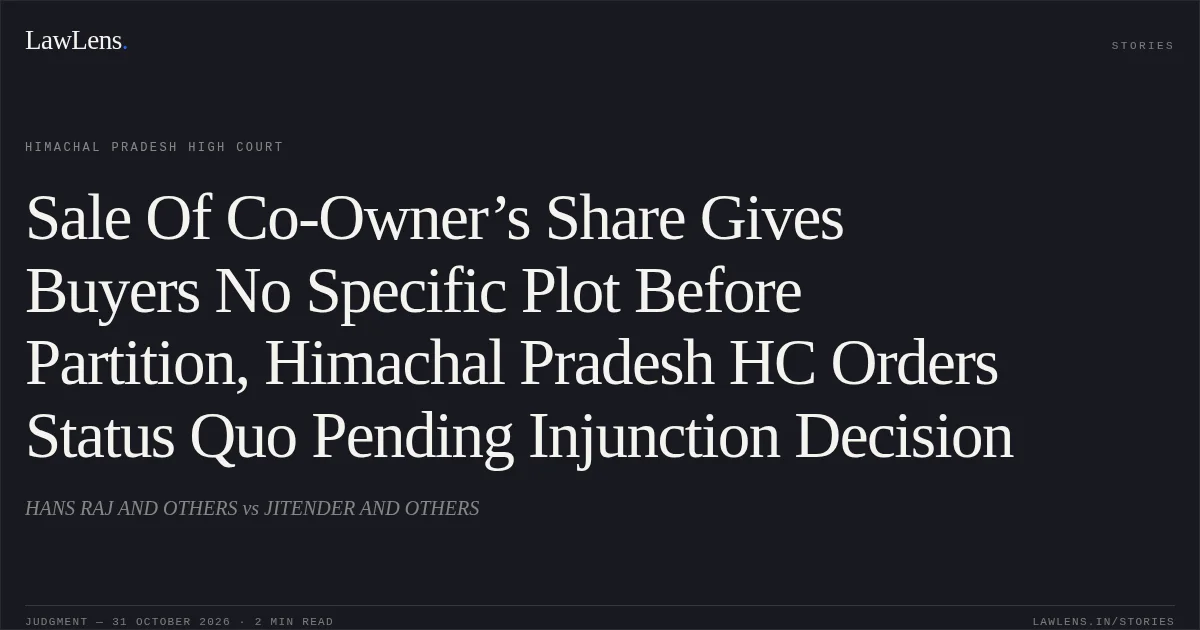
¶ 1The dispute concerned a sale by respondent No. 3 to respondents Nos. 1 and 2 of a 7/16 share, measuring 0-02-00 hectare, in jointly owned Khasra No. 287.
¶ 2–5The petitioners alleged that the sale and revenue entries suggested delivery of possession of a specific portion, creating a risk of interference or construction on the joint land.
¶ 8–11The High Court considered whether the Trial Court could defer interim relief pending the State’s reply, although the State had no substantive stake in the suit.
¶ 12–1702Issues
i.1. Whether the Trial Court erred by deferring a decision on the interim-injunction application until the State filed a reply, rather than deciding the application on the material then available.
¶ 17–21ii.2. Whether the circumstances warranted interim protection concerning the nature and use of the jointly owned land pending the Trial Court’s decision on the injunction application.
¶ 2203Law Applied
The Court stated that an interim or ad-interim injunction must be decided on the merits and on the material available to the court; filing of a defendant’s reply is not a prerequisite to such a decision. The court must consider whether there is a prima facie case, the likelihood of irreparable loss, and the balance of convenience.
¶ 18–20The Court also applied the principle that a purchaser of a co-sharer’s undivided share becomes a co-owner in the joint property and cannot claim exclusive possession of a specific portion merely by virtue of the sale; identification of a specific portion requires partition.
¶ 6–7, 9, 15No statutory provision or precedent was expressly cited.
04Reasoning
The Trial Court had deferred its decision because the State was a party and its representative sought time to file a reply. The High Court found that the State had no stake in the suit and that the application could, and should, have been assessed on its merits without awaiting that reply.
¶ 14–21The available revenue records and sale deed showed a transfer of respondent No. 3’s share, not a demarcated portion of Khasra No. 287; nevertheless, the mutation’s reference to delivery of possession created a reasonable apprehension of interference with the joint land.
¶ 6–11Given that material, the Court considered temporary protection appropriate while leaving the ultimate injunction question to the Trial Court.
05Holding
The High Court modified the Trial Court’s orders and directed the parties to maintain the status quo regarding the nature and use of the land until the interim-injunction application is decided.
¶ 22–23Respondents Nos. 1 and 2 retained the right to seek partition to identify the portion attributable to their purchased share, as did the petitioners and other co-sharers.
¶ 22, 24The Trial Court must decide the injunction application on the parties’ material and without being influenced by the High Court’s observations, which were based on limited material.
¶ 25The petition was disposed of accordingly.
¶ 26Original Court PDF
HANS RAJ AND OTHERSvsJITENDER AND OTHERS
Click to open original judgment
Original judgment, available to read, download and summarize on LawLens.in