Facts
The appellant, an advocate representing M/s Recon Copier System Pvt. Ltd. in a labour dispute, was alleged by the respondent to have assaulted, abused, and threatened him in the court premises after the respondent’s application was dismissed.
Source reference: paras. 3–4The respondent lodged police complaints and subsequently filed a complaint before the Bar Council of Delhi alleging professional misconduct.
Source reference: paras. 3–4The Bar Council of India ultimately allowed the complaint and suspended the appellant from practice for one year by order dated 21 July 2012.
Source reference: para. 1The appellant challenged that order under Section 38 of the Advocates Act, 1961.
Source reference: para. 1The Supreme Court had stayed the suspension by an interim order dated 15 October 2012.
Source reference: para. 2The appellant contended that he was denied a proper opportunity of hearing when his adjournment application, made on 7 July 2012, was rejected and the matter was taken up immediately.
Source reference: para. 5Although the complaint had earlier been dismissed on the ground that the appellant was opposing counsel rather than the complainant’s advocate, that order was recalled in review and the proceedings were revived.
Source reference: para. 6Issues
Whether the Bar Council of India violated the appellant’s right to a proper opportunity of hearing by rejecting his adjournment request and proceeding with the matter on the same day.
Source reference: paras. 5–7Whether indecent, abusive, or threatening conduct by an advocate toward an opposing party within court premises constitutes professional misconduct cognisable under the Advocates Act, 1961, even where the conduct is unrelated to the conduct of the case before the court.
Source reference: paras. 7–9Whether, in the circumstances of the case, the suspension imposed by the Bar Council of India should be sustained, or whether alternative relief should be granted considering the delay and procedural infirmity.
Source reference: paras. 7, 10Law Applied
The Court exercised appellate jurisdiction under Section 38 of the Advocates Act, 1961.
Source reference: para. 1It held that an advocate’s conduct within court premises may constitute professional misconduct even when the conduct does not concern the representation or proceedings in the underlying case; every advocate has a duty to behave decently toward clients, opposing counsel, and parties on the opposite side.
Source reference: para. 9At the same time, disciplinary proceedings must afford the advocate a proper opportunity of hearing, and rejection of an adjournment request in circumstances preventing meaningful participation may constitute a procedural infirmity.
Source reference: para. 7The Court also recognised that criminal culpability arising from an assault or threat may fall within the police and criminal justice process, but such conduct does not thereby become immune from disciplinary scrutiny where it also reflects indecent professional behaviour in court premises.
Source reference: paras. 8–9Reasoning
The Court found that the appellant had not been properly heard because his request for an adjournment was rejected and the matter was immediately taken up.
Source reference: para. 7Nevertheless, it declined to remand the proceedings because approximately 21 years had elapsed since the complaint was filed.
Source reference: para. 7The Court distinguished between the criminal aspect of the alleged assault and threats, which had already been reported to the police, and the professional-disciplinary aspect of indecent conduct by an advocate in court premises.
Source reference: paras. 8–9It held that the fact that the appellant was not representing the complainant, and that the alleged conduct did not occur during the actual conduct of the labour proceedings, did not by itself exclude the matter from the disciplinary jurisdiction of the Bar Councils.
Source reference: paras. 7, 9Considering the procedural defect, the long passage of time, and the nature of the alleged misconduct, the Court found it appropriate to replace the one-year suspension with a warning.
Source reference: para. 10Holding
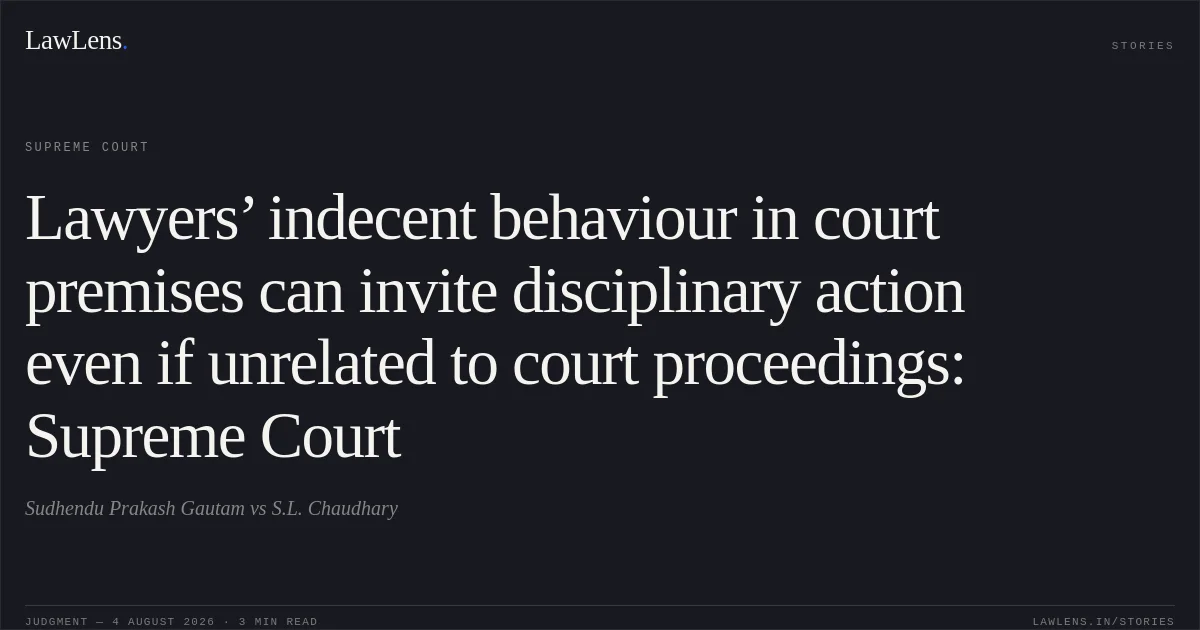
The Court held that indecent or threatening behaviour by an advocate in court premises can attract professional-misconduct jurisdiction, even if it is directed toward an opposing party and is unrelated to the merits or conduct of the pending case.
However, because the appellant was not afforded a proper opportunity of hearing and the complaint had remained pending for nearly 21 years, the Court declined to sustain the one-year suspension or remand the matter.
Source reference: para. 10The order of the Bar Council of India was modified, and the appellant, Sudhendu Prakash Gautam, was issued a warning to behave properly in court premises toward opposing lawyers, his own clients, and opposite parties.
Source reference: para. 10The appeal was disposed of accordingly.
Source reference: para. 11Original Court PDF
Sudhendu Prakash GautamvsS.L. Chaudhary
Click to open original judgment
Original judgment, available to read, download and summarize on LawLens.in