Facts
The respondent had instituted OA 423/2022 before the Central Administrative Tribunal (CAT) concerning refixation of pay and revision of pension and retiral dues.
Source reference: p.2, para. 2By order dated 4 October 2023, the CAT directed the Union of India to refix the respondent’s pay on the basis of the last basic pay drawn, revise the pension and other retiral dues, and pay simple interest at GPF rates on amounts found payable for the relevant period.
Source reference: p.2, para. 2The respondent subsequently initiated contempt proceedings in CP 818/2023, alleging non-compliance, particularly the failure to pay interest on delayed leave encashment.
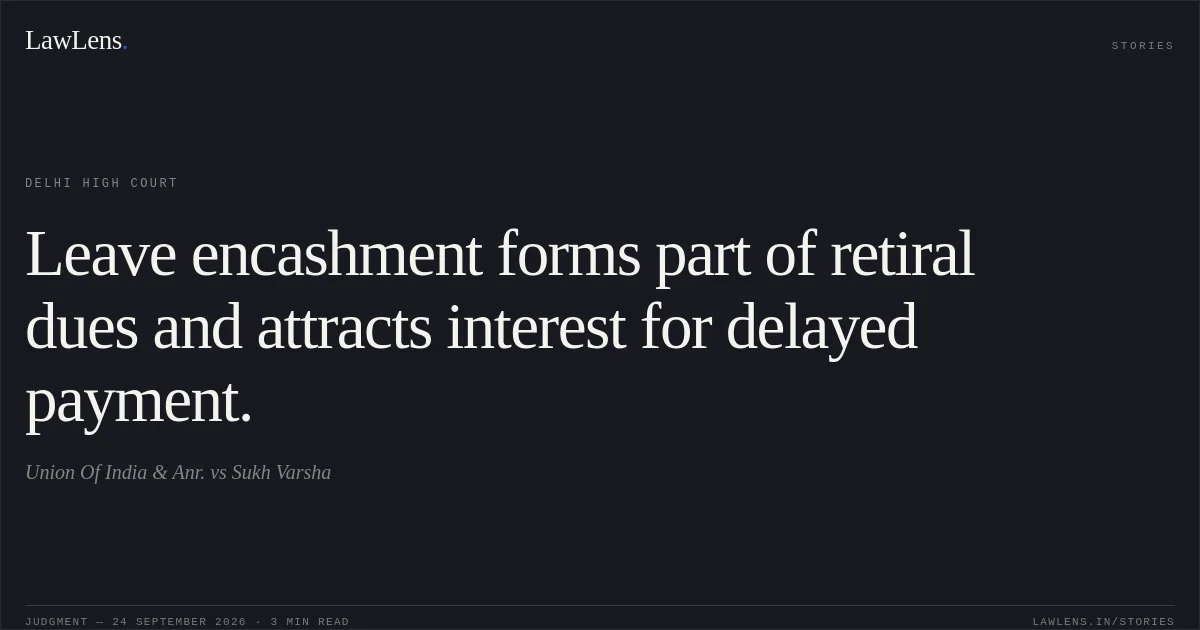
Source reference: p.2, paras. 4–5On 20 April 2026, the CAT held that leave encashment formed part of retiral dues and directed the petitioners to comply with the earlier order, including payment of applicable interest, failing which costs would be imposed.
Source reference: p.2–4, para. 5The Union of India challenged the CAT’s order before the Delhi High Court, although it had not challenged either the original order dated 4 October 2023 or the CAT’s order dated 20 April 2026.
Source reference: p.4, paras. 7–8Issues
Whether leave encashment constitutes “retiral dues” for the purposes of the CAT’s direction to pay interest at GPF rates on delayed retiral benefits
Source reference: p.4–5, paras. 6, 9–10Whether the High Court should interfere with the CAT’s direction requiring the petitioners to comply with the earlier order and pay interest on delayed leave encashment
Source reference: p.5, paras. 11–13Law Applied
The Court applied the principle that retiral dues include amounts payable to an employee upon retirement, including leave encashment.
Source reference: p.5, para. 9It further applied the compensatory-interest principle that inordinate delay in releasing retiral benefits may justify payment of interest, even in the absence of an express statutory provision specifically authorising interest on leave encashment.
Source reference: p.3, paras. 6–8The Court relied on Union of India v. Vijay Kumar Gupta, W.P. (C) 5537/2025, decided on 6 August 2025, for the proposition that delayed payment of leave encashment warrants interest.
Source reference: p.3, para. 7It also applied the rule that an unchallenged and operative judicial direction must be complied with in its letter and spirit.
Source reference: p.4, paras. 7–8Reasoning
The Court treated leave encashment as a payment accruing to the employee at retirement in respect of unavailed leave standing to the employee’s credit; it therefore fell squarely within the ordinary meaning of “retiral dues”.
Source reference: p.5, para. 9Since the CAT’s order dated 4 October 2023 directed revision of pension and other retiral dues with interest at GPF rates, the direction necessarily extended to delayed leave encashment.
Source reference: p.4, paras. 7–10The petitioners had neither challenged that order nor the CAT’s subsequent clarification dated 20 April 2026, and could not resist compliance by contending that the applicable rules contained no express provision for interest on leave encashment.
Source reference: p.4, paras. 7–10The High Court also noted that the CAT had not yet punished the petitioners for contempt; it had merely granted a final opportunity to comply with the existing direction.
Source reference: p.5, para. 11Accordingly, no ground for writ interference was made out.
Source reference: no citationHolding
The High Court held that leave encashment is a retiral due and that delayed payment thereof attracts interest in accordance with the CAT’s operative directions, including interest at GPF rates.
Finding no reason to interfere with the CAT’s order requiring compliance, the Court dismissed the writ petition.
Source reference: p.5, para. 13Original Court PDF
Union Of India & Anr.vsSukh Varsha
Click to open original judgment
Original judgment, available to read, download and summarize on LawLens.in