Facts
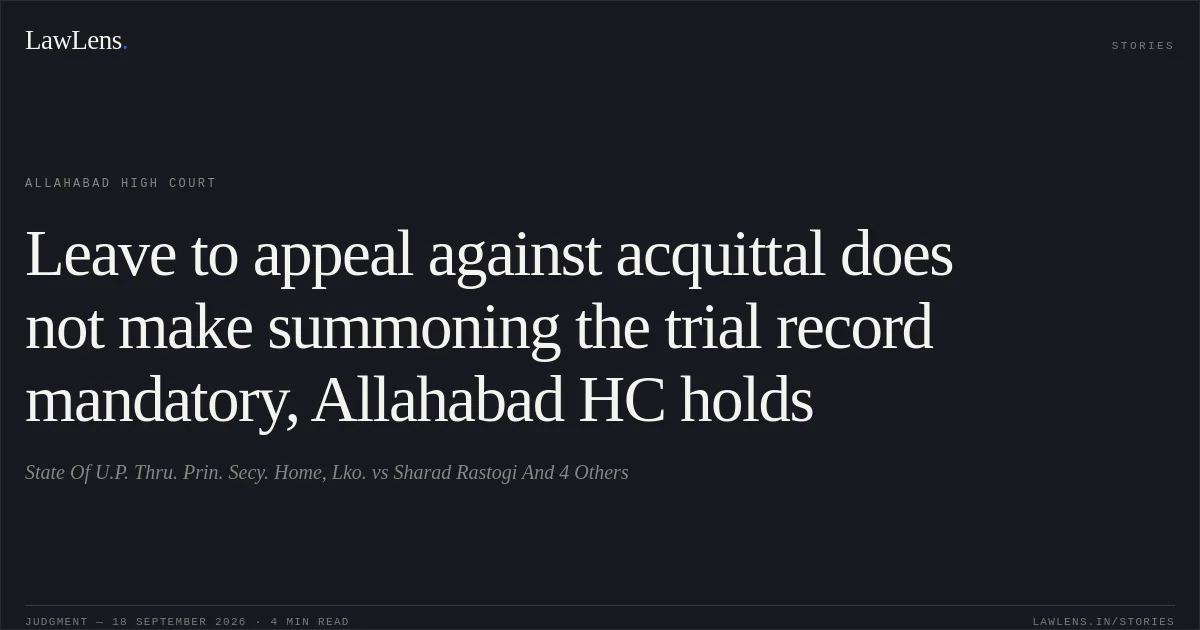
The State preferred an appeal against the judgment dated 29 July 2025 of the Special Judge, POCSO Act-I, Ayodhya, acquitting Sharad Rastogi of offences under Sections 376 and 506 IPC, Sections 3/4 of the POCSO Act, and Section 67 of the Information Technology Act.
Source reference: paras. 42–44The prosecution alleged that the accused, who had allegedly been in a relationship with the informant’s daughter, circulated or caused to be circulated photographs suggesting their marriage and retained obscene photographs of her online, thereby defaming her and contributing to her suicide attempt or death; the FIR was initially registered under Sections 354-D, 506 and 509 IPC.
Source reference: para. 45–46Following investigation, a charge-sheet was filed and the trial court framed charges under Sections 376 and 506 IPC, Sections 3/4 POCSO Act and Section 67 IT Act.
Source reference: paras. 47–50The trial court acquitted the accused, principally relying on delay in lodging the FIR, contradictions in the victim’s testimony, absence of medical and digital evidence, non-recovery of incriminating photographs, and a pre-existing tenancy dispute between the parties.
Source reference: paras. 52–54Issues
Whether, after leave to appeal against an order of acquittal has been granted under Section 378 Cr.P.C., the High Court is mandatorily required to summon the trial-court record before deciding the appeal, or whether it may summarily dismiss the appeal under Section 384 Cr.P.C. without summoning the record?
Source reference: paras. 4, 11–17, 39–41Whether the trial court’s acquittal was perverse, legally unsustainable, or based on a manifest misappreciation of evidence so as to warrant appellate interference?
Source reference: paras. 57–65Law Applied
Section 378(3) Cr.P.C. requires leave of the High Court before an appeal against acquittal can be entertained; however, the grant of leave does not automatically require a full hearing on the summoned record.
Source reference: paras. 7–10Section 384 Cr.P.C. empowers the appellate court to dismiss an appeal summarily after examining the appeal petition and the impugned judgment, and Section 384(2), by using the word “may,” makes summoning of the record discretionary at that stage.
Source reference: paras. 12–17, 22–25In contrast, Section 385(2) Cr.P.C. requires the record to be called for when the appeal is not dismissed summarily and is to be heard on merits.
Source reference: paras. 14–17, 20–24The Court relied on State of Maharashtra v. Sujay Mangesh Poyarekar, (2008) 9 SCC 475, Surya Baksh Singh v. State of U.P., (2014) 14 SCC 222, Sita Ram v. State of U.P., (1979) 2 SCC 656, Hanumat Das v. Vinay Kumar, AIR 1982 SC 1052, and Dagadu v. State of Maharashtra, (1981) 2 SCC 575, holding that summary dismissal after reasons can be made without summoning the record.
Source reference: paras. 18–32On appeals against acquittal, the appellate court has power to reappreciate evidence but must respect the strengthened presumption of innocence; where two reasonable views are possible, the acquittal should not be disturbed unless the trial court’s view is perverse, manifestly illegal, or wholly untenable, as stated in Chandrappa v. State of Karnataka, (2007) 4 SCC 415, Babu v. State of Kerala, (2010) 9 SCC 189, Jayamma v. State of Karnataka, (2021) 6 SCC 213, and Bannareddy v. State of Karnataka, (2018) 5 SCC 790.
Source reference: paras. 58–61Reasoning
The Court held that the statutory scheme distinguishes between summary dismissal under Section 384 and a full hearing under Section 385 Cr.P.C.
Source reference: paras. 20–25, 39–40Although leave under Section 378 had been granted, the appeal could still be examined summarily under Section 384; the word “may” in Section 384(2) conferred discretion to summon the record, whereas Section 385(2) became applicable only if the appeal was not summarily dismissed.
Source reference: paras. 20–25, 39–40The Court nevertheless examined the merits and found that the trial court had adopted a reasonable and possible view.
Source reference: no citationThe prosecution case was weakened by the substantial delay in lodging the FIR, material inconsistencies in the victim’s versions, the absence of medical evidence, failure to recover the alleged obscene or incriminating photographs, the Cyber Cell’s report finding no responsive record, and evidence of a pre-existing tenancy dispute.
Source reference: para. 64The victim’s testimony was therefore not considered sufficiently reliable or of such sterling quality as to sustain conviction without corroboration.
Source reference: no citationSince the trial court had carefully evaluated the evidence and its conclusions were neither perverse nor manifestly erroneous, the appellate court declined to substitute its own view merely because another view might also have been possible.
Source reference: paras. 62–65Holding
The preliminary objection was rejected: even after leave to appeal against acquittal is granted under Section 378 Cr.P.C., the High Court may summarily dismiss the appeal under Section 384 Cr.P.C. without summoning the trial record, provided reasons are recorded.
On the merits, the Court held that the acquittal was a reasonable and possible view supported by the evidence, and that no perversity, illegality, or manifest misappreciation justified interference.
Source reference: paras. 64–65Accordingly, the Government Appeal was dismissed summarily.
Source reference: paras. 66–67Acts & Sections Cited
17 provisions across 5 statutes referred to in this judgment. Each provision opens on LawLens.
Code of Criminal Procedure, 1973
Bharatiya Nagarik Suraksha Sanhita, 20231
Indian Penal Code, 18603
Information Technology Act, 20001
Original Court PDF
State Of U.P. Thru. Prin. Secy. Home, Lko.vsSharad Rastogi And 4 Others
Click to open original judgment
Original judgment, available to read, download and summarize on LawLens.in