Facts
The applicants (a gang leader, his son, and his daughter-in-law) were booked under Sections 2 and 3 of the U.P. Gangsters and Anti-Social Activities (Prevention) Act, 1986, via FIR No. 101 of 2023
Source reference: para. 2-3The gang chart was based on two financial/property dispute cases involving cheating and criminal intimidation
Source reference: para. 49The chart was approved by the Commissioner of Police (CP), Ghaziabad, following the establishment of the Commissionerate system
Source reference: para. 9Applicant No. 3 (Lalita Tyagi), a homemaker, was arrested and detained for 80 days despite no specific allegations in the base case charge sheets
Source reference: para. 7, 78The applicants challenged the FIR, alleging misuse of power and procedural non-compliance with Rule 5(3)(a) of the 2021 Rules
Source reference: para. 4Issues
1. Whether the invocation of the U.P. Gangsters Act was legally sustainable given the civil/financial nature of the base cases and the lack of evidence regarding "organized crime."
Source reference: para. 6, 692. Whether the approval of the gang chart by the Commissioner of Police, excluding the District Magistrate from a joint meeting, complied with Rule 5(3)(a) of the U.P. Gangsters Rules, 2021.
Source reference: para. 9, 213. Whether the arrest of Applicant No. 3 was arbitrary and constituted a misuse of police power.
Source reference: para. 73Law Applied
U.P. Gangsters and Anti-Social Activities (Prevention) Act, 1986, specifically Section 2(b) and (c) defining "gang" and "gangster" based on the objective of gaining temporal or pecuniary advantage through violence or coercion
Source reference: para. 2, 60U.P. Gangsters Rules, 2021, particularly Rule 5(3)(a) regarding the mandatory joint meeting for gang chart approval and Rule 16 regarding independent application of mind by authorities
Source reference: para. 4, 32Section 20 of the Cr.P.C. regarding the appointment of Executive Magistrates in Commissionerates
Source reference: para. 11, 54Precedents such as Vinay Kumar Gupta v. State of U.P. and Gorakhnath Mishra v. State of U.P. to emphasize procedural rigor and the prevention of administrative arbitrariness.
Source reference: para. 4, 72Reasoning
The Court observed that the base cases were essentially private financial disputes over land transactions and bounced cheques, failing to satisfy the threshold of "organized crime" or activities disrupting public order under Section 2(b)
Source reference: para. 69-70The Court criticized the "mechanical" approval of the gang chart, noting that the Commissioner of Police failed to provide empirical data or methodology to quantify the gang’s alleged illegal earnings as previously directed
Source reference: para. 71Regarding the Commissionerate system, the Court highlighted a systemic failure where police officers, exercising powers of Executive Magistrates, often bypass the "subjective satisfaction" and objective vetting traditionally provided by the District Magistrate, leading to the targeting of petty offenders while real syndicates remain untouched
Source reference: para. 16, 23.2The Court found the arrest of Lalita Tyagi (Applicant No. 3) particularly egregious, as no specific allegations existed against her in the base cases, rendering her 80-day detention a "patent illegality" and a "high-handed" exercise of power
Source reference: para. 73-74Holding
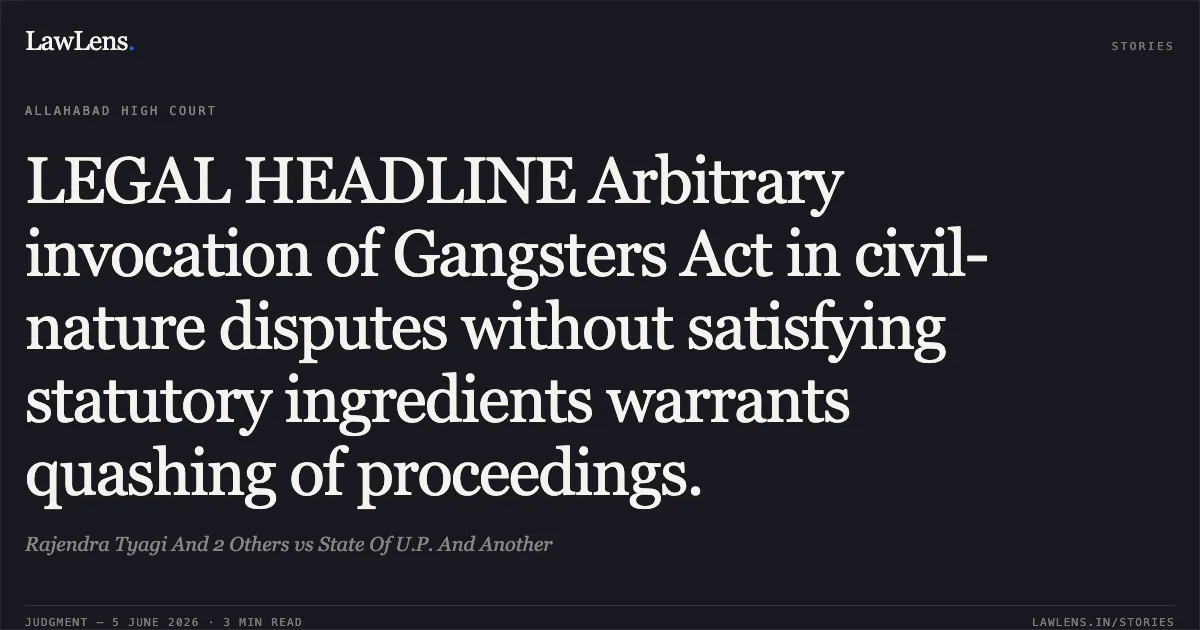
The Court held that the ingredients of the Gangsters Act were not met and the mandatory procedural safeguards were ignored.
The Court allowed the application and quashed the entire proceedings of Special Sessions Trial No. 3072 of 2023 arising from Case Crime No. 101 of 2023
Source reference: para. 77The Court issued a strong "lenient" warning to Shri Ajay Kumar Mishra (the then CP Ghaziabad) to be vigilant and circumspect in the future and observed the State Home Department must independently evaluate the suitability of officers for field postings.
Source reference: para. 76, 79Acts & Sections Cited
21 provisions across 2 statutes referred to in this judgment. Each provision opens on LawLens.
Code of Criminal Procedure, 1973
Indian Penal Code, 18604
Original Court PDF
Rajendra Tyagi And 2 OthersvsState Of U.P. And Another
Click to open original judgment
Original judgment, available to read, download and summarize on LawLens.in