01Facts
The appellant, Vinita Paberen Kujur, filed a claim petition seeking compensation for the death of her son, Raj Kujur, who died from injuries sustained in a motor accident on 21 March 2021 while riding a motorcycle owned by his father, Sushil Kumar Kujur.
¶ 4–5The claim petition was instituted under Section 164 of the Motor Vehicles Act, 1988, against the owner and Bajaj Allianz General Insurance Company Ltd.
¶ 4–5The Sixth Additional Motor Accidents Claims Tribunal, Bilaspur, dismissed the claim petition on an application under Order VII Rule 11 of the Code of Civil Procedure read with Section 169 of the Motor Vehicles Act.
¶ 6The appellant challenged the award under Section 173 of the Motor Vehicles Act.
¶ 1–302Issues
i.Whether the claim petition filed under Section 164 of the Motor Vehicles Act was maintainable in respect of an accident that occurred on 21 March 2021, before the provision came into force?
¶ 6ii.Whether the legal representatives of a deceased person who was driving a motorcycle owned by his father could maintain a claim under Section 163-A of the Motor Vehicles Act against the owner and insurer of that motorcycle?
¶ 6, 8–10iii.Whether the deceased was a third party entitled to claim compensation under the policy when no additional premium had been paid for coverage of the owner or driver?
¶ 903Law Applied
Section 164 of the Motor Vehicles Act, 1988, providing for compensation on a no-fault basis, was held by the Tribunal to be inapplicable because it came into force only with effect from 1 April 2022, after the relevant accident and filing of the claim.
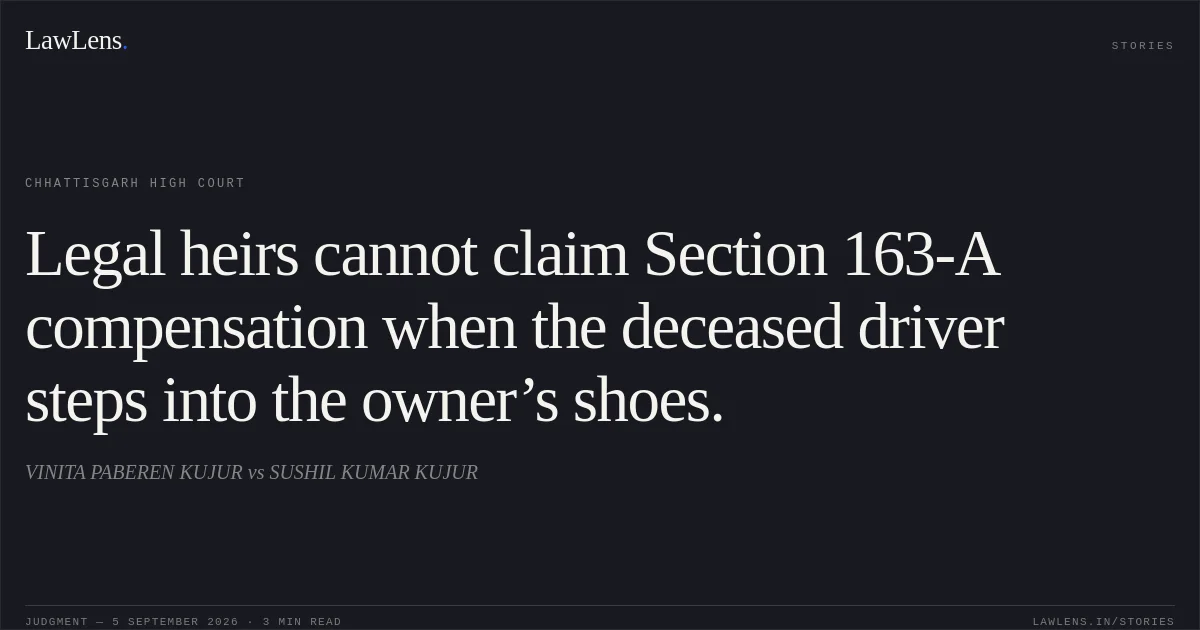
¶ 6Section 163-A creates a structured-formula remedy but does not apply where the deceased was himself the owner or had stepped into the shoes of the owner of the vehicle.
Relying on Ningamma v. United India Insurance Co. Ltd., (2009) 13 SCC 710, and Ramkhiladi v. United India Insurance Co. Ltd., (2020) 2 SCC 550, the Court applied the rule that the legal representatives of a deceased borrower-driver cannot claim compensation under Section 163-A against the owner or insurer of the same vehicle because the deceased is not a third party in relation to it.
¶ 8The absence of any premium for coverage of the owner or driver further excluded liability under the insurance policy.
¶ 9Provisions in the judgment · 5 · Linked ones open on LawLens
Motor Vehicles Act, 1988 Section 163Section 164Section 169Section 173
Code of Civil Procedure, 1908 Section 7
04Reasoning
The deceased was riding the motorcycle owned by his father and was therefore not a third party vis-à-vis the insured vehicle.
¶ 8Applying Ningamma and Ramkhiladi, the Court held that, by borrowing and driving the vehicle, the deceased had assumed the position of its owner for purposes of Section 163-A; consequently, his legal representatives could not claim compensation from the vehicle’s owner or insurer under that provision.
¶ 8The Court also noted that the policy did not include any premium for coverage of the driver or owner, providing an additional reason why the insurer could not be made liable.
¶ 9Since the claim under Section 164 was also unavailable on the relevant dates, the Tribunal correctly rejected the claim petition.
¶ 6, 1005Holding
The High Court condoned the 240-day delay in filing the appeal but dismissed the appeal at the admission stage.
¶ 1–3, 10–11It held that the claim was not maintainable under Section 164 because that provision was not applicable at the relevant time, and was also not maintainable under Section 163-A because the deceased-driver had stepped into the shoes of the owner and was not a third party.
¶ 6, 8–10No order as to costs was made.
¶ 10–11Original Court PDF
VINITA PABEREN KUJURvsSUSHIL KUMAR KUJUR
Click to open original judgment
Original judgment, available to read, download and summarize on LawLens.in