Facts
The plaintiffs obtained a preliminary decree for partition and allotment of a 1/6 share in 2010. The decree was affirmed in appeals by the Madras High Court in 2022 and by the Supreme Court in 2023.
Source reference: para. 4While the plaintiffs’ application for a final decree was pending, the petitioners sought impleadment under Order I Rule 10 CPC, claiming through two alleged wills executed by the deceased fifth defendant, Hamsa Bai.
Source reference: paras. 5–6, 8They had also filed a separate suit seeking, among other reliefs, a declaration that the earlier decree was not binding on them.
Source reference: paras. 5–6, 8The trial court dismissed the impleadment application, reasoning that the petitioners were neither necessary nor proper parties.
Source reference: para. 7Issues
Whether the petitioners, claiming through an alleged will of a party to the partition suit, should be impleaded in the pending final-decree proceedings.
Source reference: paras. 5–7, 9Whether impleadment permits the petitioners to raise independent claims or reopen matters determined by the preliminary decree in the final-decree proceedings.
Source reference: paras. 9–10Law Applied
Order I Rule 10(2) CPC permits the addition of a party where that person’s presence is appropriate for the effective adjudication of the matters before the court.
Source reference: para. 9In final-decree proceedings, the court cannot reopen findings that have attained finality in the preliminary decree; those proceedings are confined to working out the declared shares through division by metes and bounds.
Source reference: para. 9A person claiming under a will must prove it in accordance with the applicable law of evidence before being permitted to remain as a party on that basis.
Source reference: para. 10The judgment identifies Article 227 of the Constitution as the jurisdiction invoked, but cites no precedent.
Source reference: prayer; para. 1Reasoning
The petitioners’ asserted interest under Hamsa Bai’s alleged wills gave them a sufficient connection to the property for them to be treated as proper parties in the final-decree proceedings.
Source reference: para. 9Their presence could also prevent a later contention that the final decree was passed behind their back while their separate challenge to the preliminary decree remained pending.
Source reference: para. 9However, impleadment does not entitle them to relitigate matters settled by the preliminary decree or to pursue their independent title claims in the final-decree proceedings; those claims must be pursued in the separate suit.
Source reference: paras. 9–10Their continued participation on the basis of the wills is conditional on proving the wills.
Source reference: paras. 9–10Holding
The High Court set aside the order rejecting impleadment and allowed the revision on the stated terms.
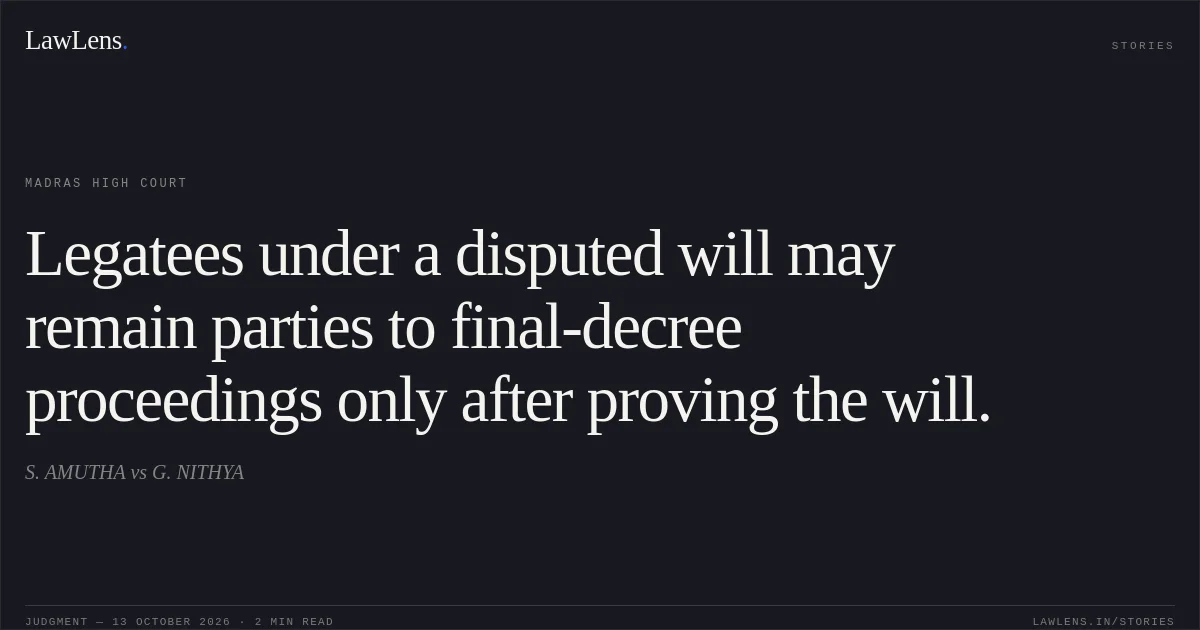
The petitioners may be impleaded as respondents in the final-decree proceedings, but may not agitate independent rights there and must prove the alleged wills to remain as parties on that basis.
Source reference: paras. 9–10The trial court was directed to dispose of the final-decree application within three months of receiving the order; no costs were awarded.
Source reference: paras. 9–12Original Court PDF
S. AMUTHAvsG. NITHYA
Click to open original judgment
Original judgment, available to read, download and summarize on LawLens.in