Facts
The Petitioner No. 1 is a charitable society that owned various portions of a building at 8, Camac Street, Kolkata
Source reference: para. 3-4In 1999, the Kolkata Municipal Corporation (KMC) retrospectively revised the property’s annual valuation back to 1984—a period of 15 years—and issued additional tax demands
Source reference: para. 5-6The Petitioners challenged this in Sahujain Charitable Society v. KMC (2018), where a Division Bench of the High Court read down the "at any time" provision in Section 179(2)(d) of the KMC Act, 1980, holding that retrospective revision could not exceed three years
Source reference: para. 15, 49This judgment attained finality after the Supreme Court dismissed KMC’s Special Leave Petitions
Source reference: para. 16-17Subsequently, the State enacted the KMC (Amendment) Act, 2022, which substituted Section 179(2)(d) to include a non-obstante clause overriding any judgment and a "validating clause" (sub-clause ii) to legalize revisions made beyond even a new six-year limit
Source reference: para. 18, 54Relying on this amendment, KMC issued a fresh demand of approximately ₹11.24 crores
Source reference: para. 18The Petitioners challenged the constitutionality of the 2022 Amendment
Source reference: para. 1, 19Issues
1. Whether Section 3 of the Kolkata Municipal Corporation (Amendment) Act, 2022, is unconstitutional and ultra vires for attempting to legislatively override a binding judicial pronouncement
Source reference: para. 1, 19, 462. Whether the Legislature can validate a statutory provision declared illegal by a Court without first removing the defect or cause of invalidity identified in the judgment
Source reference: para. 21, 633. Whether the tax demand dated 23.07.2024, issued on the basis of the amended provision, is legally sustainable
Source reference: para. 19, 87Law Applied
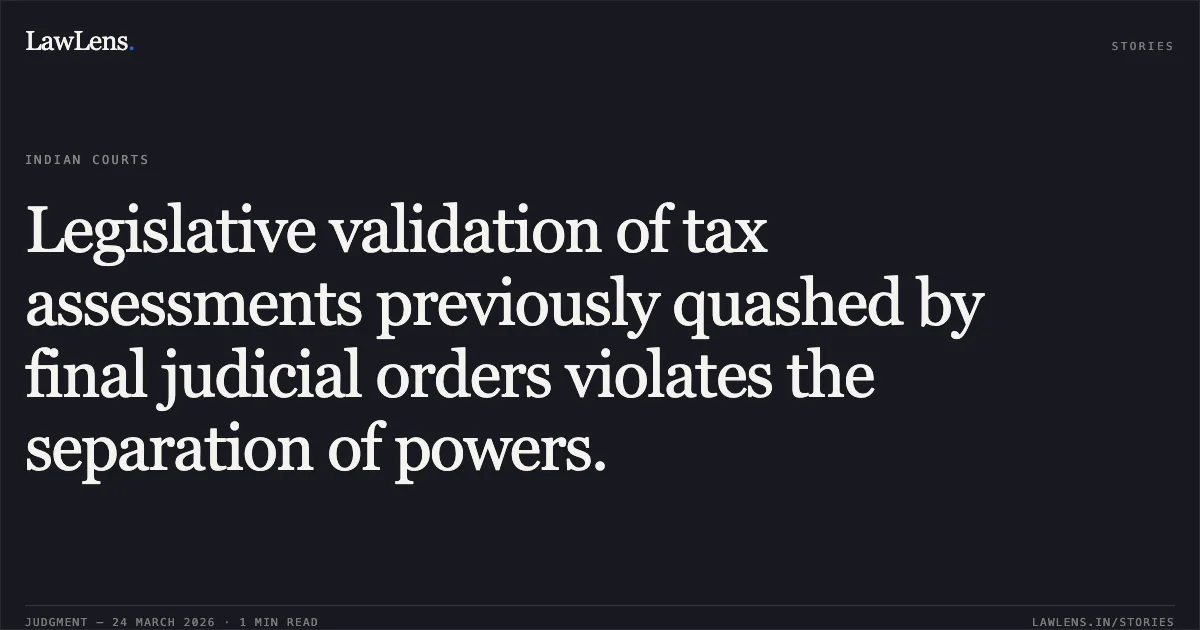
The court primarily applied the doctrine of separation of powers and the principles of validating legislation under Articles 14 and 300A of the Constitution of India
Source reference: para. 19, 61, 79It relied on Shri Prithvi Cotton Mills Ltd. v. Broach Borough Municipality, which establishes that while the Legislature can cure a defect in a law retrospectively, it cannot simply declare a court’s judgment ineffective without removing the ground of invalidity
Source reference: para. 21, 63It further cited Municipal Corporation of the City of Ahmedabad v. New Shrock Spinning & Weaving Co. Ltd., holding that a validating statute that leaves the foundational illegality untouched and seeks to retain illegally collected tax is an impermissible encroachment on judicial power
Source reference: para. 21, 25, 63The court also reaffirmed the principle that fiscal statutes cannot retrospectively create fresh liabilities or resurrect time-barred debts in an arbitrary manner
Source reference: para. 24, 68Reasoning
The court observed that the 2018 Division Bench judgment had identified the "at any time" clause as arbitrary and read it down to a three-year limit to satisfy Article 14
Source reference: para. 49-51The 2022 Amendment sought to override this by using a non-obstante clause ("notwithstanding any judgment...") and sub-clause (ii), which deemed revisions made beyond six years to be valid
Source reference: para. 54, 85The court reasoned that the Legislature cannot legislatively displace a binding interpretation of a Court by mere declaration; it must remove the constitutional infirmity (the unguided power)
Source reference: para. 63, 67While sub-clause (i) was found valid as it prescribed a finite six-year limit for future or non-finalized assessments, sub-clause (ii) and the non-obstante clause were held to be direct attempts to nullify a final judicial decision inter-partes without curing the underlying defect of arbitrariness
Source reference: para. 78, 79, 88Furthermore, the court noted the amendment was prospective (effective 09.06.2023) and could not reopen liabilities that had already attained finality between these specific parties under the 2018 judgment
Source reference: para. 86-88Holding
The court partly allowed the writ petition, declaring the non-obstante clause and sub-clause (ii) of the substituted Section 179(2)(d) unconstitutional and inoperative
Sub-clause (i), which allows revision within six years, was upheld for prospective applications but held inapplicable to the Petitioners whose liabilities were already settled
Source reference: para. 78, 89, 90The court quashed the demand letter dated 23.07.2024 and directed KMC to issue a revised demand strictly adhering to the 2018 judgment (the three-year retrospective limit)
Source reference: para. 90The Petitioners were held entitled to a refund of any excess amounts paid
Source reference: para. 90The ruling clarified that assessments which had already attained finality could not be reopened using the 2022 Amendment
Source reference: para. 91Acts & Sections Cited
1 provisions across 1 statute referred to in this judgment. Each provision opens on LawLens.
Central Excise Act, 19441
Original Court PDF
SAHUJAIN CHARITABLE SOCIETY AND ANR.vsTHE KOLKATA MUNICIPAL MUNICIPAL CORPORATION AND ORS.
Click to open original judgment
Original judgment, available to read, download and summarize on LawLens.in