Facts
On 09.06.2012, the appellant, working as a helper on a Hitachi machine, was injured when a truck (GJ-9-V-1692) reversed in a rash and negligent manner at a sand loading site on the Sabarmati riverbank.
Source reference: p. 2The Motor Accident Claims Tribunal awarded Rs. 54,040/- but exonerated the Insurance Company (Respondent No. 3) on two grounds: (i) the accident occurred at a "private place" (a lease site) not accessible to the public, and (ii) the vehicle had been sold to a new owner on 25.01.2012, but the insurance policy was not transferred to the transferee within the statutory 15-day period under Section 157 of the Motor Vehicles Act (MVA).
Source reference: p. 2-3The claimant appealed, seeking to hold the insurer liable.
Source reference: no citationIssues
1. Whether a riverbank sand mining site accessible to various workers and vehicles constitutes a "public place" under Section 2(34) of the MVA.
Source reference: p. 72. Whether the failure to transfer an insurance policy into the name of a transferee/new owner within 15 days of a vehicle sale exonerates the insurer from liability towards a third-party victim.
Source reference: p. 9Law Applied
Section 2(34) of the MVA, which defines "public place" as any place to which the public has a right of access, whether restricted or absolute.
Source reference: p. 7Registration of the vehicle transfer and the deemed transfer of insurance policy under Section 157 of the MVA.
Source reference: p. 10The precedent in G. Govindan v. New India Assurance Co. Ltd. (1999), which established that the legislature's intent is to protect third-party interests and that a failure to follow transfer procedures does not defeat a third party's right to recover from the insurer.
Source reference: p. 10The ratio in Askarali Hasanali v. Samjinanji Solanki (2019) to clarify that private properties used for commercial activities involving multiple personnel and vehicles function as public places under the Act.
Source reference: p. 8Reasoning
The Court reasoned that because the accident site was used for loading sand and was accessible to multiple trucks, tractors, drivers, and laborers, it possessed "limited access" sufficient to qualify as a "public place" under the MVA.
Source reference: p. 7-8The Court found the Tribunal’s restrictive interpretation of the site as a "private place" to be legally erroneous.
Source reference: p. 8-9The Court held that while the owner breached Section 157 by not intimating the insurer within 15 days, this statutory lapse cannot be used to penalize a third-party victim.
Source reference: p. 11Under the G. Govindan ratio, the insurance remains effective for third-party risks despite the non-transfer of the policy.
Source reference: p. 11The Court rejected the insurer's oral plea regarding a lack of a valid driving license, noting the insurer failed to raise this defense or lead evidence before the Tribunal.
Source reference: p. 11-12Holding
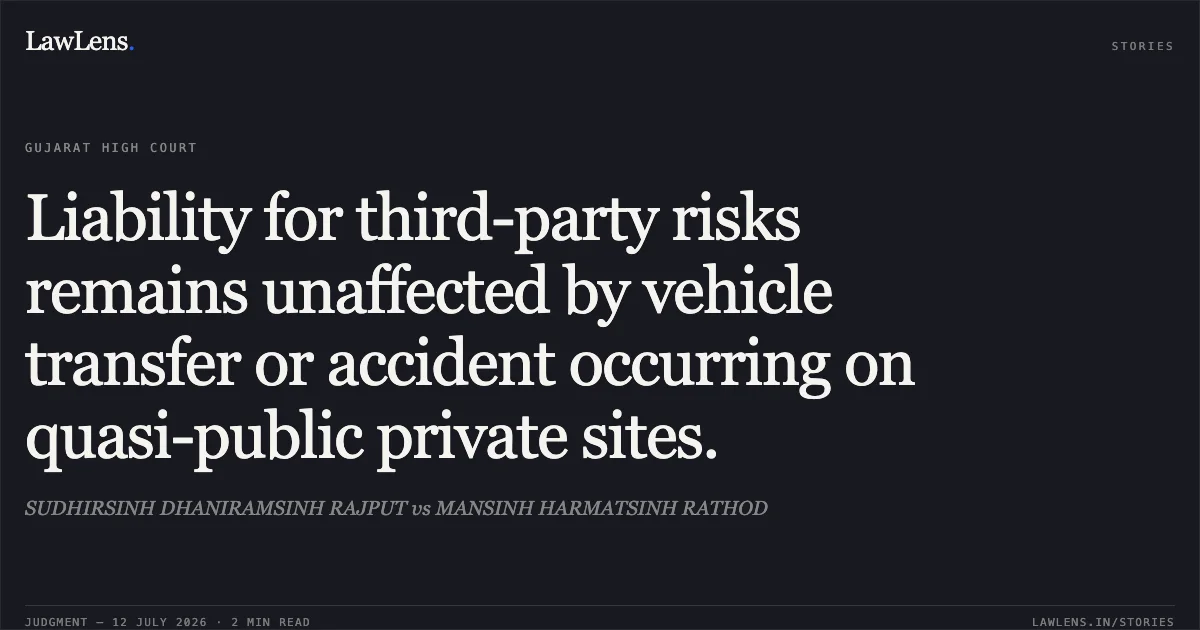
The Court held that (1) the site was a "public place" and (2) the insurer is liable to satisfy the award for a third party regardless of the policy transfer status.
The Court allowed the appeal and modified the Tribunal's award, setting aside the exoneration of the Insurance Company and directing the Insurance Company to deposit the awarded amount with 9% interest within four weeks.
Source reference: p. 12Acts & Sections Cited
3 provisions across 1 statute referred to in this judgment. Each provision opens on LawLens.
Motor Vehicles Act, 19883
Original Court PDF
SUDHIRSINH DHANIRAMSINH RAJPUTvsMANSINH HARMATSINH RATHOD
Click to open original judgment
Original judgment, available to read, download and summarize on LawLens.in