Facts
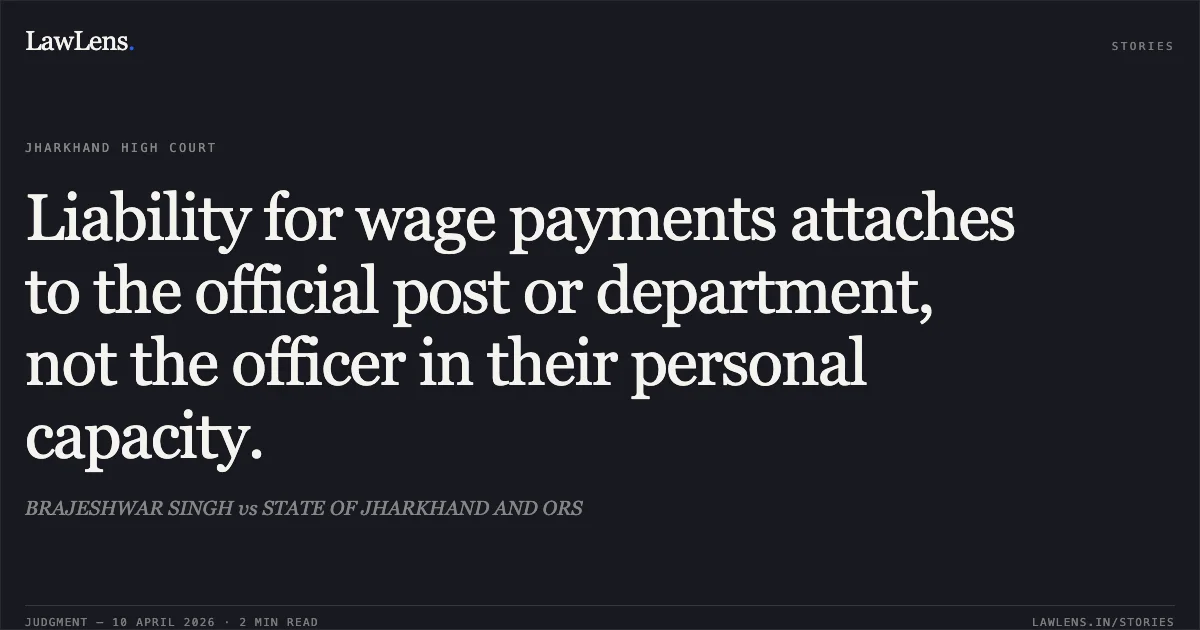
The petitioner approached the High Court under Article 226 of the Constitution of India seeking to quash an order dated 21.05.2012 passed by the Deputy Labour Commissioner-cum-Authorized Officer under the Payment of Wages Act, 1936 (Respondent No. 2).
Source reference: p. 3-4, para 1In P.W. Case No. 1 to 31 of 2009, Respondent No. 2 directed the petitioner to pay a total sum of Rs. 1,01,188.40 to thirty-one workmen (Respondent Nos. 4 to 34) as unpaid wages.
Source reference: p. 4, para 1-2The petitioner contended that he was being held liable in his personal capacity, despite the underlying dispute involving his official post and the Minor Irrigation Department.
Source reference: p. 4, para 3Issues
Whether the petitioner is personally liable to satisfy the wage claims of the workmen or if the liability rests with the official post and the concerned government department.
Source reference: p. 4, para 3Law Applied
The court primarily exercised its jurisdiction under Article 226 of the Constitution of India.
Source reference: p. 3, para 1It applied the principle of administrative liability, distinguishing between the personal liability of an individual and the official liability of a person holding a public office (specifically the Executive Engineer).
Source reference: p. 4, para 2-3The court further considered the remedial nature of the Payment of Wages Act, 1936, regarding the timely payment of wages to workmen.
Source reference: p. 4, para 2-3Reasoning
The court examined the impugned order and observed that while the direction for payment was issued against the petitioner, the liability arose from his official function.
Source reference: p. 4, para 3The court noted that the petitioner cannot be held personally liable for these dues because the direction was effectively issued against the office he occupied.
Source reference: p. 4, para 3Highlighting the socio-economic status of the "poor workmen" and the relatively small individual amounts (approximately Rs. 3,834/- per person), the court reasoned that the obligation to pay lies with the state entity.
Source reference: p. 4, para 3Consequently, it shifted the burden of payment from the petitioner’s personal capacity to the office of the Minor Irrigation Department, Bokaro.
Source reference: p. 4, para 3Holding
The High Court disposed of the writ petition by clarifying that the petitioner is not personally liable for the payment of the directed wages.
The court held that the office of the Minor Irrigation Department, Bokaro, is liable for the payment of Rs. 1,01,188.40 to the respondent workmen.
Source reference: p. 4, para 3-4No order was passed to quash the recovery itself, but the source of the liability was redirected to the department.
Source reference: p. 4, para 3-4Original Court PDF
BRAJESHWAR SINGHvsSTATE OF JHARKHAND AND ORS
Click to open original judgment
Original judgment, available to read, download and summarize on LawLens.in