Facts
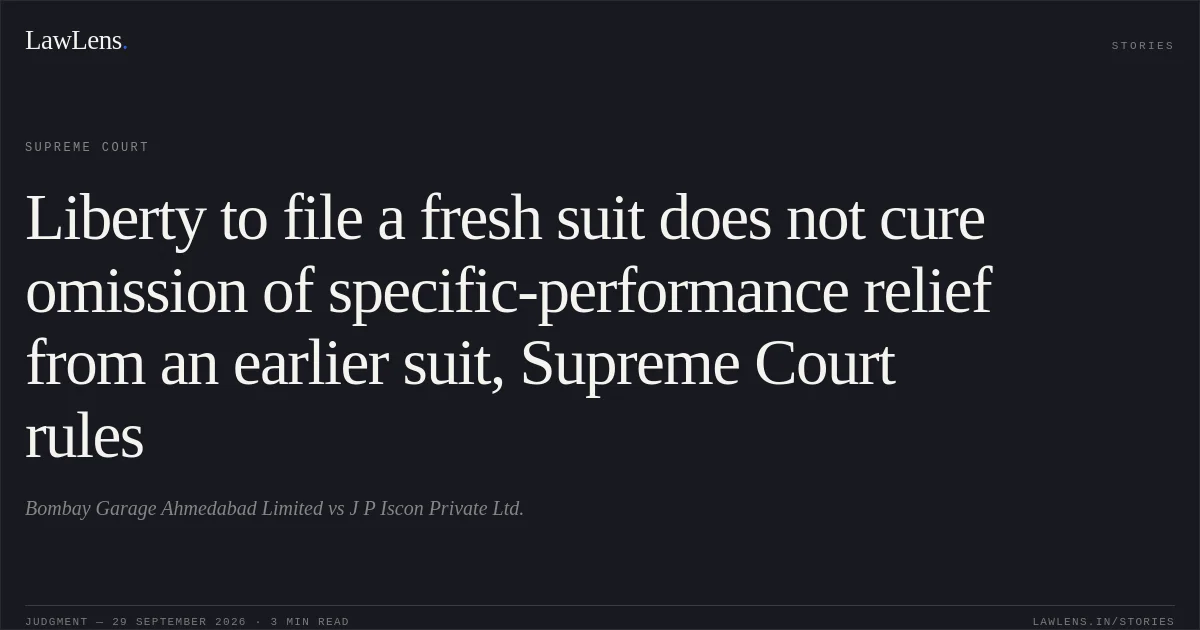
The respondents obtained concurrent decrees for specific performance of an alleged oral agreement to sell the appellants’ property.
Source reference: para. 4Before filing the specific-performance suit, the plaintiff had filed a suit for injunction based on the same alleged agreement and cause of action; that suit was withdrawn with a request to file afresh, but no leave to omit and later claim specific performance had been obtained when the first suit was instituted.
Source reference: para. 4, 24–27The appellants disputed both the maintainability of the second suit under Order II Rule 2 CPC and the existence of a concluded oral contract.
Source reference: para. 5–7The Supreme Court granted leave to appeal.
Source reference: para. 2, 5–7Issues
1. Whether the later suit for specific performance was barred by Order II Rule 2 CPC because the plaintiff had omitted that relief from the earlier injunction suit without obtaining leave.
Source reference: para. 8–10, 24–272. Whether the plaintiff proved a concluded oral agreement for sale sufficient to support a decree for specific performance.
Source reference: para. 2–3, 28–39Law Applied
Order II Rule 2 CPC requires a plaintiff to include the whole claim arising from a cause of action; where the plaintiff is entitled to multiple reliefs and omits one, a later suit for the omitted relief is barred unless the requisite leave is obtained.
Source reference: para. 8–9Under Gurbux Singh v. Bhooralal, the party invoking the bar must establish that the later suit concerns the same cause of action, that more than one relief was available on it, and that the plaintiff omitted a relief without leave.
Source reference: para. 8–9Withdrawal with leave under Order XXIII Rule 1(3) CPC does not cure a failure to obtain leave under Order II Rule 2 when the omitted relief was available at the time of the first suit.
Source reference: para. 25–27An agreement for sale of immovable property need not be written, but a plaintiff relying on an oral agreement bears a heavy burden to prove consensus ad idem and that the material terms were concluded; strict proof is required, and a concluded contract cannot rest on mere inference.
Source reference: para. 2–3Brij Mohan v. Smt. Sugra Begum and K. Nanjappa v. R.A. Hameed.
Source reference: para. 2–3Reasoning
The first plaint showed that the plaintiff knew of the alleged refusal to perform and could have sought specific performance when it filed the injunction suit; it sought neither that relief nor leave to reserve it.
Source reference: para. 24–27The request, when withdrawing the first suit, to file afresh could not remedy that omission, so the second suit was barred by Order II Rule 2 CPC.
Source reference: para. 24–27Independently, the plaintiff did not prove a concluded oral contract: the pleadings about the meetings and terms were inconsistent, material details were absent, the alleged Rs. 5 crore cheque was not shown to have been presented, and the testimony did not reliably establish the agreement or the authority of the alleged negotiator to bind the company.
Source reference: para. 31–39Evasive evidence by the defendants could not substitute for the plaintiff’s burden of proof.
Source reference: para. 31–39Holding
The Court held that the specific-performance suit was barred by Order II Rule 2 CPC and, independently, that the plaintiff had failed to establish a concluded oral contract.
It allowed the appeal, set aside the Trial Court and High Court orders, dismissed the suit, and directed the parties to bear their own costs.
Source reference: para. 39–41Acts & Sections Cited
1 provisions across 1 statute referred to in this judgment. Linked provisions open on LawLens.
Companies Act, 19561
Original Court PDF
Bombay Garage Ahmedabad LimitedvsJ P Iscon Private Ltd.
Click to open original judgment
Original judgment, available to read, download and summarize on LawLens.in