Facts
Navpreet Kaur married appellant Sandeep Singh Hora on 12.12.2009.
Source reference: paras. 2–5Her father alleged that, after the marriage, the appellant and his relatives subjected her to cruelty and harassment for additional dowry.
Source reference: paras. 2–5On 24/25.08.2010, within seven years of the marriage, the deceased died an unnatural death in her matrimonial home.
Source reference: paras. 2–5The appellant and other family members were charge-sheeted under Sections 304-B, 498-A and 406 IPC and Sections 3 and 4 of the Dowry Prohibition Act; an alternative charge under Section 302 IPC was also framed, but they were acquitted of that charge.
Source reference: paras. 2–5, 10The trial court convicted the appellant under Section 304-B IPC and awarded life imprisonment, besides sentences under Sections 498-A and 406 IPC and Sections 3 and 4 of the Dowry Prohibition Act, with the sentences directed to run concurrently.
Source reference: paras. 1, 10In appeal, the appellant did not challenge his conviction on merits and confined his challenge to the quantum of sentence.
Source reference: paras. 12, 18Issues
Whether the trial court was justified in awarding life imprisonment under Section 304-B IPC without recording cogent reasons and without properly balancing aggravating and mitigating circumstances.
Source reference: paras. 23–30Whether, considering the statutory scheme, the absence of direct evidence connecting the appellant with the death, his period of incarceration, conduct, age, and the lapse of time, the sentence under Section 304-B IPC should be reduced.
Source reference: paras. 31–33Law Applied
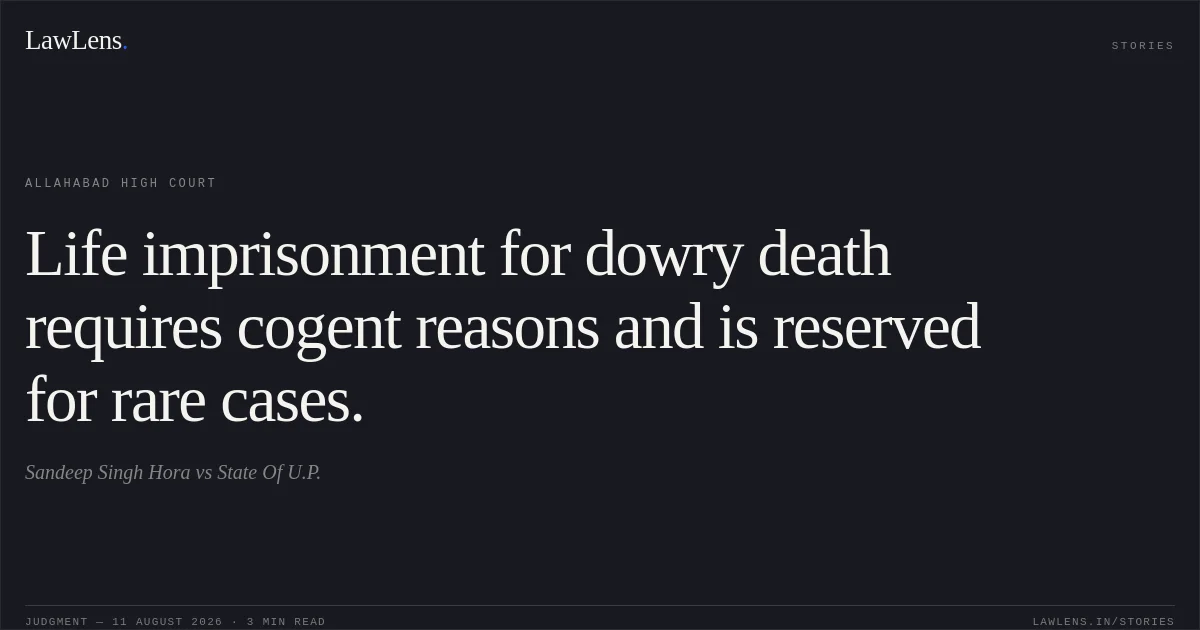
Section 304-B(2) IPC prescribes a minimum sentence of seven years’ imprisonment for dowry death, which may extend to imprisonment for life; the extreme sentence of life imprisonment should ordinarily be reserved for rare and exceptional cases.
Source reference: para. 24, citing Hem Chand v. State of HaryanaSection 113-B of the Evidence Act and Section 304-B IPC incorporate a presumption of dowry death where the statutory requirements, including cruelty or harassment for dowry soon before the death, are established.
Source reference: paras. 27, 31Under Section 354(3) CrPC, the court must state reasons when imposing a sentence of life imprisonment where the offence is punishable with life imprisonment or a term of years.
Source reference: para. 29Sentencing requires consideration of both aggravating and mitigating circumstances, including the manner of the offence, the accused’s age, likelihood of reformation, criminal antecedents, conduct in custody, and the circumstances surrounding the offence, as recognised in Madan v. State of U.P.
Source reference: para. 25In Hem Chand and G.V. Siddaramesh v. State of Karnataka, the Supreme Court held that life imprisonment in dowry-death cases should not be imposed routinely and reduced excessive life sentences where the circumstances did not justify the maximum punishment.
Source reference: paras. 27–28Reasoning
The High Court held that the trial court had merely characterised the offence as heinous and the death as unnatural, but had not provided substantive reasons for selecting life imprisonment over the statutory minimum or any intermediate sentence.
Source reference: paras. 26, 30Although the conviction under Section 304-B IPC was maintained on the basis of the statutory presumption arising from the proven dowry-related cruelty and unnatural death, there was no direct evidence connecting the appellant with the act causing the death.
Source reference: para. 31The Court further considered that the appellant had no adverse antecedent or conduct report, had undergone approximately six years and four months of actual imprisonment, was about 40 years old, and that the incident had occurred approximately 16 years earlier.
Source reference: para. 32Balancing these mitigating factors against the gravity of the dowry death, the Court concluded that the case did not fall within the category warranting the extreme sentence of life imprisonment.
Source reference: para. 33Holding
The appeal was allowed in part.
The appellant’s conviction under Section 304-B IPC was affirmed, but the sentence of life imprisonment was reduced to ten years’ rigorous imprisonment, with the period already undergone to be adjusted under Section 428 CrPC/Section 528 BNSS, 2023.
Source reference: para. 34The convictions and sentences under Sections 498-A and 406 IPC and Sections 3 and 4 of the Dowry Prohibition Act were confirmed.
Source reference: para. 35Acts & Sections Cited
13 provisions across 4 statutes referred to in this judgment. Each provision opens on LawLens.
Indian Penal Code, 18604
Code of Criminal Procedure, 19735
Bharatiya Nagarik Suraksha Sanhita, 20231
Original Court PDF
Sandeep Singh HoravsState Of U.P.
Click to open original judgment
Original judgment, available to read, download and summarize on LawLens.in