Facts
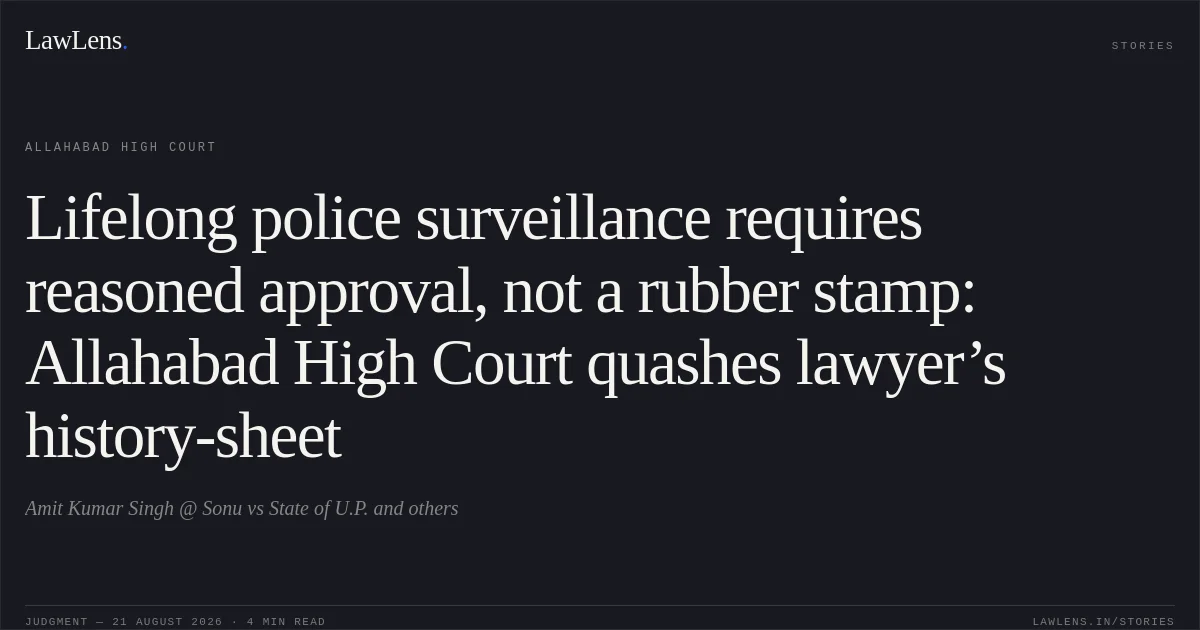
The petitioner, a practising advocate and member of the Allahabad High Court Bar Association, challenged the rejection of his representations seeking closure of Class-B History-Sheet No. B-19 maintained at Police Station Shivkuti, Prayagraj.
Source reference: pp. 2–5; paras. 2–7He alleged that the history-sheet had been opened to pressurise him in connection with the prosecution of his brother’s murder and due to personal animosity of respondent no. 4, an Additional Director General of Police.
Source reference: pp. 2–5; paras. 2–7The history-sheet was approved by the Senior Superintendent of Police, Prayagraj on 9 November 2022, on the basis of six criminal cases.
Source reference: pp. 5–6; para. 8The petitioner asserted that he had been acquitted or exonerated in all those cases, except for a pending cross-case involving minor offences under Sections 323, 504 and 506 IPC.
Source reference: pp. 5–6; para. 8The proposal for opening the history-sheet was initiated by the Station House Officer on 29 September 2022 and forwarded through the supervisory police officers.
Source reference: pp. 11–12; para. 16The Senior Superintendent of Police approved it by affixing a rubber stamp stating “approved” and signing it, without recording reasons or demonstrating application of mind.
Source reference: pp. 11–12; para. 16The Deputy Commissioner of Police subsequently rejected the petitioner’s representations by an order dated 10 July 2025, which the petitioner challenged in the present writ petition.
Source reference: pp. 15–16; paras. 21–23Issues
Whether the petitioner’s criminal history disclosed that he was a confirmed, professional or expert criminal so as to justify opening a Class-B history-sheet under the Uttar Pradesh Police Regulations, 1861?
Source reference: pp. 6–10, 14–15; paras. 10–13, 19–21Whether the approval of the Senior Superintendent of Police was vitiated by non-application of mind because it was merely rubber-stamped and unsupported by reasons or a properly recorded satisfaction?
Source reference: pp. 11–13; paras. 15–18Whether the continued surveillance contemplated by the history-sheet unlawfully infringed the petitioner’s rights to liberty, free movement and privacy under Articles 19 and 21 of the Constitution?
Source reference: pp. 12–15; paras. 17–20Whether the allegations of mala fides against respondent no. 4 were established?
Source reference: p. 16; para. 24Law Applied
Regulation 228 of the Uttar Pradesh Police Regulations, 1861 permits history-sheets to be opened only for persons who are or are likely to become habitual criminals or abettors; Class-B history-sheets concern confirmed and professional criminals committing miscellaneous professional crimes.
Source reference: p. 6; para. 10Regulation 229 distinguishes the classes according to the nature of criminal activity and the type and duration of surveillance required, while Regulation 232 provides that Class-B history-sheets ordinarily remain open until the subject’s death.
Source reference: pp. 7–8; para. 10Regulation 240 permits opening a history-sheet on suspicion, conviction or acquittal, but only upon the order of the Superintendent of Police and on the basis of a proper assessment of the relevant material.
Source reference: pp. 7–9; para. 10Regulations 236 and 238 prescribe surveillance measures, including reporting of movements, verification of absences and collection of information concerning conduct.
Source reference: pp. 12–13; para. 17The Court applied Articles 19 and 21 of the Constitution, holding that surveillance substantially affects liberty, freedom of movement and privacy and therefore requires careful, reasoned and constitutionally proportionate exercise of power.
Source reference: pp. 12–14; paras. 17–18It relied on Gobind v. State of M.P., (1975) 2 SCC 148, which limits surveillance to persons against whom reasonable material shows a determination to lead a life of crime posing a danger to public peace or community security.
Source reference: pp. 14–15; paras. 19–20K.S. Puttaswamy (Privacy-9J.) v. Union of India, (2017) 10 SCC 1, recognised privacy as a facet of Article 21.
Source reference: pp. 14–15; paras. 19–20Munna Lal Gupta v. State of U.P., 2016 SCC OnLine All 3023, held that a history-sheet unsupported by reasonable satisfaction and application of mind violates Articles 19(1)(d) and 21.
Source reference: pp. 14–15; paras. 19–20Reasoning
The Court found that the cases relied upon by the police did not establish that the petitioner was a professional or expert criminal.
Source reference: pp. 9–10; paras. 12–14They involved different allegations and circumstances, and did not disclose any consistent criminal specialisation or professional method of committing offences.
Source reference: pp. 9–10; paras. 12–14Most of the cases had ended in acquittal or exoneration, while the only surviving matter was a cross-case concerning minor violence; the overall record therefore did not justify treating the petitioner as a person requiring continuous surveillance.
Source reference: pp. 9–10; paras. 12–14Although Regulation 240 permits a history-sheet to be opened even after acquittal, that provision does not dispense with the requirement that the material must reasonably demonstrate habitual or professional criminality.
Source reference: pp. 11–14; paras. 15–18The Court further held that the SSP’s rubber-stamped approval did not show that he had considered whether the stringent consequences of a Class-B history-sheet were justified.
Source reference: pp. 11–14; paras. 15–18Since such a history-sheet ordinarily continues until death and permits intrusive surveillance, the approval required a careful and intelligible application of mind.
Source reference: pp. 11–14; paras. 15–18The Deputy Commissioner’s rejection order was similarly mechanical: it recited facts but failed to address the petitioner’s specific objections or independently disclose application of mind.
Source reference: p. 15; paras. 21–23The Court did not accept the petitioner’s allegation that respondent no. 4 had acted with mala fides, observing that his communications could have been issued in the discharge of official duties and did not, by themselves, prove personal animosity.
Source reference: p. 16; para. 24Holding
The Court held that the petitioner’s criminal profile did not satisfy the regulatory requirement of a confirmed, professional or expert criminal and that the opening and continuation of the Class-B history-sheet were unsupported by proper application of mind.
The order dated 10 July 2025 passed by the Deputy Commissioner of Police (City), Prayagraj, rejecting the petitioner’s representations, was quashed.
Source reference: pp. 15–16; paras. 21–23The writ petition was allowed, and the impugned History-Sheet No. B-19 was quashed.
Source reference: p. 16; para. 27The judgment records the history-sheet date as 1 October 2025, although the preceding discussion refers to its approval on 9 November 2022.
Source reference: p. 16; para. 27The order was directed to be communicated to the Commissioner of Police, Prayagraj, the Deputy Commissioner of Police (City), and the Station House Officer, Police Station Shivkuti.
Source reference: p. 16; para. 28Acts & Sections Cited
11 provisions across 1 statute referred to in this judgment. Each provision opens on LawLens.
Original Court PDF
Amit Kumar Singh @ SonuvsState of U.P. and others
Click to open original judgment
Original judgment, available to read, download and summarize on LawLens.in