Facts
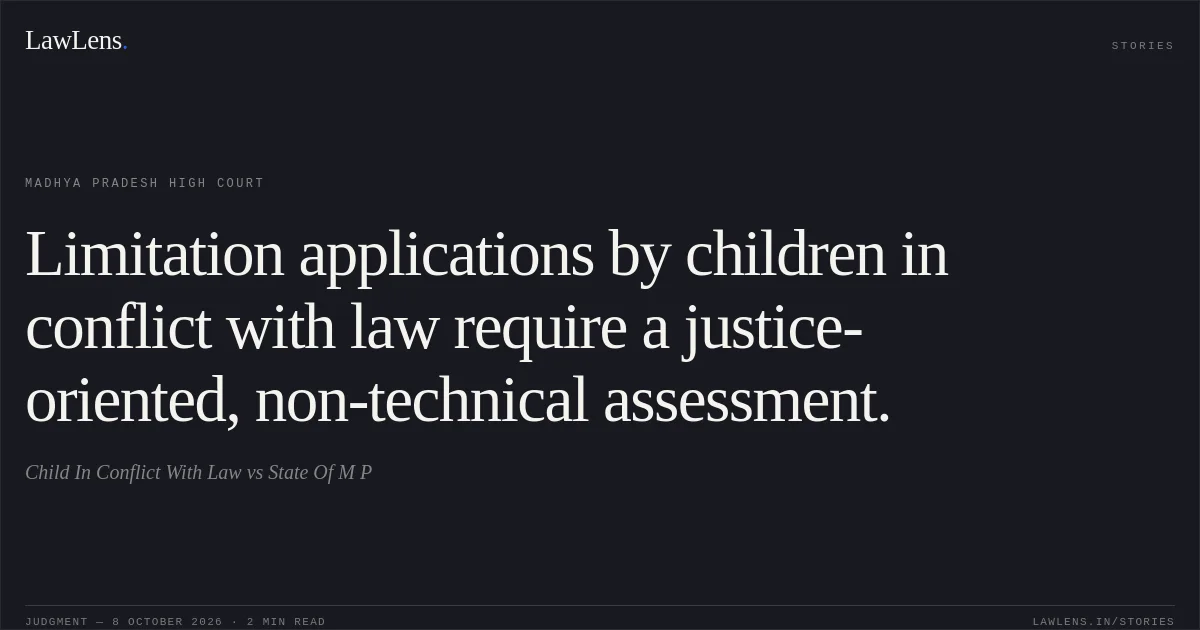
The Juvenile Justice Board, after conducting a preliminary assessment under Section 15(1) of the Juvenile Justice (Care and Protection of Children) Act, 2015 (“JJ Act”), ordered transfer of the petitioners’ case to the Special Court (POCSO) on 14 March 2026.
Source reference: para. 1–5The petitioners appealed under Section 101 of the JJ Act and sought condonation of delay under Section 5 of the Limitation Act.
Source reference: para. 1–5Their guardians attributed the approximately 75-day delay to lack of legal awareness, late information about the order, and absence from home for labour work.
Source reference: para. 1–5The Sessions Court rejected the condonation application and dismissed the appeal as time-barred, noting that the petitioners’ advocate had been aware of the matter.
Source reference: para. 1–5The petitioners challenged that order in revision under Section 102 of the JJ Act.
Source reference: para. 1–5Issues
Whether the Sessions Court adopted an unduly rigid approach in rejecting the application for condonation of delay in the children’s appeal
Source reference: para. 9–10Whether the impugned order should be set aside and the appeal restored for consideration on merits
Source reference: para. 10–12Law Applied
Section 101 of the JJ Act provides for an appeal against an order of the Juvenile Justice Board, while Section 102 empowers the High Court to exercise revisional jurisdiction.
Source reference: para. 1Section 5 of the Limitation Act permits condonation of delay where sufficient cause is shown.
Source reference: para. 9The Court stated that procedure is the “handmaid of justice,” not its mistress, and that the JJ Act’s object is the care, protection, treatment and rehabilitation of children in conflict with law.
Source reference: para. 9In considering condonation, the sufficiency of the cause—not the length of the delay alone—is the guiding consideration.
Source reference: para. 9No precedent was cited.
Source reference: para. 9Reasoning
The Court considered that the appellants were children and that their guardians had explained the delay by reference to poverty, lack of legal knowledge and absence for livelihood.
Source reference: para. 5–6, 9–12Although the Sessions Court relied on the advocate’s awareness of the order, the High Court concluded that rejecting the application on that basis reflected an unduly rigid approach in the circumstances.
Source reference: para. 5–6, 9–12It considered that the interests of justice would be better served by allowing the appeal to be heard on merits, while leaving the condonation application to be reconsidered after hearing both sides.
Source reference: para. 5–6, 9–12Holding
The revision was allowed and the Sessions Court’s order dated 21 September 2026 was set aside.
The Section 5 application was revived; the Appellate Court was directed to reconsider condonation afresh after hearing both sides and then proceed to decide the appeal on merits expeditiously, preferably within eight weeks from the parties’ appearance.
Source reference: para. 11–13The High Court did not itself finally condone the delay.
Source reference: para. 11–13Acts & Sections Cited
7 provisions across 3 statutes referred to in this judgment. Each provision opens on LawLens.
Juvenile Justice (Care and Protection of Children) Act, 2015.3
Bharatiya Nyaya Sanhita, 20233
Limitation Act, 19631
Original Court PDF
Child In Conflict With LawvsState Of M P
Click to open original judgment
Original judgment, available to read, download and summarize on LawLens.in