Facts
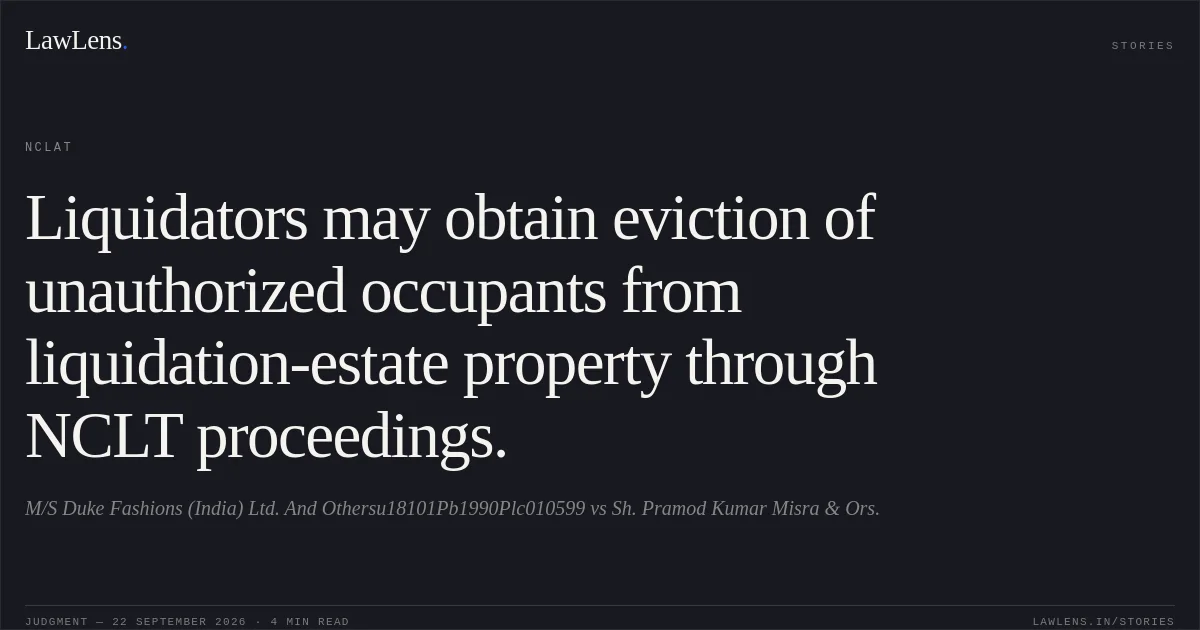
The appeals arose from a common order dated 11 June 2026 passed by the NCLT, Chandigarh in IA Nos. 1975 and 1991 of 2023 in CP (IB) No. 66/CHD/PB/2019.
Source reference: [paras. 1–5]In Company Appeal No. 1462 of 2026, M/s Duke Fashions (India) Ltd. occupied the “Karabara Property”; in Company Appeal No. 1475 of 2026, M/s UV & W Products Pvt. Ltd. occupied the “Hussainpura Property”.
Source reference: [paras. 1–5]Both appellants claimed tenancy rights under lease deeds allegedly executed for 30 years and challenged the direction requiring them to vacate within two weeks.
Source reference: [paras. 1–5]The proceedings had initially been instituted by the Resolution Professional under Sections 18, 25 and 60(5) of the Insolvency and Bankruptcy Code, 2016 (“IBC”) for recovery of possession of properties owned by Venus Garments (India) Ltd.
Source reference: [paras. 6–9]After the Corporate Debtor was ordered to be liquidated on 22 July 2025, the Liquidator was substituted and continued the pending applications.
Source reference: [paras. 6–9]The NCLT found that the properties were owned by the Corporate Debtor, formed part of the liquidation estate, and were being wrongfully occupied.
Source reference: [paras. 10–12, 18–22]It further found that the alleged 30-year lease deeds were unregistered, that the occupants were related to the suspended directors, and that no rent had been paid.
Source reference: [paras. 10–12, 18–22]Issues
Whether the Liquidator could continue an application originally filed by the Resolution Professional after commencement of liquidation, without filing a fresh application under Section 35 of the IBC?
Source reference: [paras. 6–9]Whether the Resolution Professional or Liquidator could obtain possession and seek eviction of occupants from properties owned by the Corporate Debtor under Sections 18, 35, 36 and 60(5) of the IBC?
Source reference: [paras. 6, 8–11, 19]Whether the appellants were required to be evicted exclusively through proceedings under the East Punjab Urban Rent Restriction Act, 1949, notwithstanding Section 238 of the IBC?
Source reference: [paras. 13–21]Law Applied
The Tribunal applied Sections 18(1)(f), 25, 35(1)(b), (d), (e), (k) and (l), 36, 60(5)(c) and 238 of the IBC.
Source reference: [paras. 8–11]Sections 18 and 35 impose duties and confer powers on the Resolution Professional and Liquidator, respectively, to take custody, control, protect, preserve and realise the Corporate Debtor’s assets, including assets not in its physical possession.
Source reference: [paras. 8–11]Section 36 includes assets over which the Corporate Debtor has ownership rights within the liquidation estate.
Source reference: [para. 11]Section 60(5)(c) gives the NCLT jurisdiction to adjudicate questions of fact or law arising in relation to the insolvency or liquidation of the Corporate Debtor.
Source reference: [paras. 10, 19]Under Section 238, the IBC prevails over inconsistent provisions of other laws.
Source reference: [paras. 16, 20]The Tribunal relied on *Gujarat Urja Vikas Nigam Ltd. v. Amit Gupta* for the principle that the NCLT may adjudicate disputes having a direct nexus with insolvency, while cautioning against usurping the jurisdiction of other fora where the dispute is unrelated to insolvency.
Source reference: [para. 10]It also relied on *Jhanvi Rajpal Automotive Pvt. Ltd. v. Resolution Professional*, affirmed by the Supreme Court, and *Adinath Jewellery Exports v. Brijendra Kumar Mishra*, for the proposition that an RP or Liquidator may seek eviction before the NCLT where the Corporate Debtor owns the property and the occupation is wrongful or the lease has expired.
Source reference: [paras. 11, 14–15]The Tribunal distinguished *Vishal N. Kalsaria v. Bank of India* because that decision concerned the SARFAESI Act, a blameless rent-paying tenant and a different statutory scheme.
Source reference: [paras. 17–18]An unregistered lease deed requiring compulsory registration could not be relied upon to establish its contents under Section 49 of the Registration Act, 1908.
Source reference: [para. 12]Reasoning
The Tribunal held that the Liquidator could continue the pending proceedings because the substance of the application concerned recovery and protection of the Corporate Debtor’s assets; substitution of the Liquidator did not render the proceedings infructuous.
Source reference: [paras. 7–9]In any event, the Liquidator possessed substantially corresponding powers under Section 35, and pursuing the application was part of his statutory duty to secure and realise the liquidation estate.
Source reference: [paras. 7–9]The properties were recorded as assets of the Corporate Debtor and therefore vested in the liquidation estate under Section 36.
Source reference: [para. 11; paras. 18–20 of the NCLT order reproduced in the judgment]The dispute had arisen directly from the insolvency and liquidation of the Corporate Debtor, giving the NCLT jurisdiction under Section 60(5)(c).
Source reference: [para. 11; paras. 18–20 of the NCLT order reproduced in the judgment]The appellants’ alleged leases were unregistered, no rent had been paid, and the occupants were related parties of the suspended directors.
Source reference: [para. 12]These circumstances supported the finding that the occupation was unauthorised and designed to obstruct liquidation and auction proceedings.
Source reference: [para. 12]Accordingly, the Rent Act did not require the Liquidator to institute separate eviction proceedings before the Rent Controller.
Source reference: [paras. 16–18]The Tribunal further held that *Vishal N. Kalsaria* was inapplicable because it protected an unrelated, rent-paying tenant against enforcement under SARFAESI, whereas the present dispute concerned related-party occupants and recovery of assets in liquidation under the IBC.
Source reference: [paras. 16–18]Holding
The NCLAT answered both principal issues against the appellants.
It held that the Liquidator was entitled to continue the applications filed by the Resolution Professional and that the NCLT possessed jurisdiction under Sections 35, 36 and 60(5)(c) of the IBC to direct recovery of possession from the appellants.
Source reference: [paras. 7–23]The appellants could not insist upon separate proceedings under the East Punjab Urban Rent Restriction Act, 1949, particularly when the alleged leases were unregistered, rent had not been paid and the occupation was found to be unauthorised.
Source reference: [paras. 7–23]Both appeals were dismissed, the NCLT’s eviction directions were upheld, and all pending applications were disposed of.
Source reference: [paras. 23–24]Acts & Sections Cited
10 provisions across 3 statutes referred to in this judgment. Each provision opens on LawLens.
Insolvency and Bankruptcy Code, 2016.8
Securitisation and Reconstruction of Financial Assets and Enforcement of Security Interest Act, 20021
Registration Act, 19081
Original Court PDF
M/S Duke Fashions (India) Ltd. And Othersu18101Pb1990Plc010599vsSh. Pramod Kumar Misra & Ors.
Click to open original judgment
Original judgment, available to read, download and summarize on LawLens.in