Facts
The appellant, owner of a Tata Magic Cab bearing registration No. GJ 06 XX 890, challenged the judgment and award dated 30 September 2023 passed by the Motor Accident Claims Tribunal, Bharuch, in Motor Accident Claim Petition No. 257 of 2017.
Source reference: para. 1The Tribunal had directed the insurer to pay the compensation and recover it from the driver-cum-owner on the ground that the driver did not possess a valid and effective licence to drive the offending vehicle on the date of the accident, i.e., 9 March 2017.
Source reference: para. 7In appeal, the owner relied upon the driver’s licence, which was valid for non-transport LMV vehicles from 2 January 2010 to 28 February 2029, and the vehicle’s unladen weight of 1,000 kg as recorded in the registration certificate.
Source reference: p. 2; para. 8The Insurance Company supported the Tribunal’s award.
Source reference: para. 6Issues
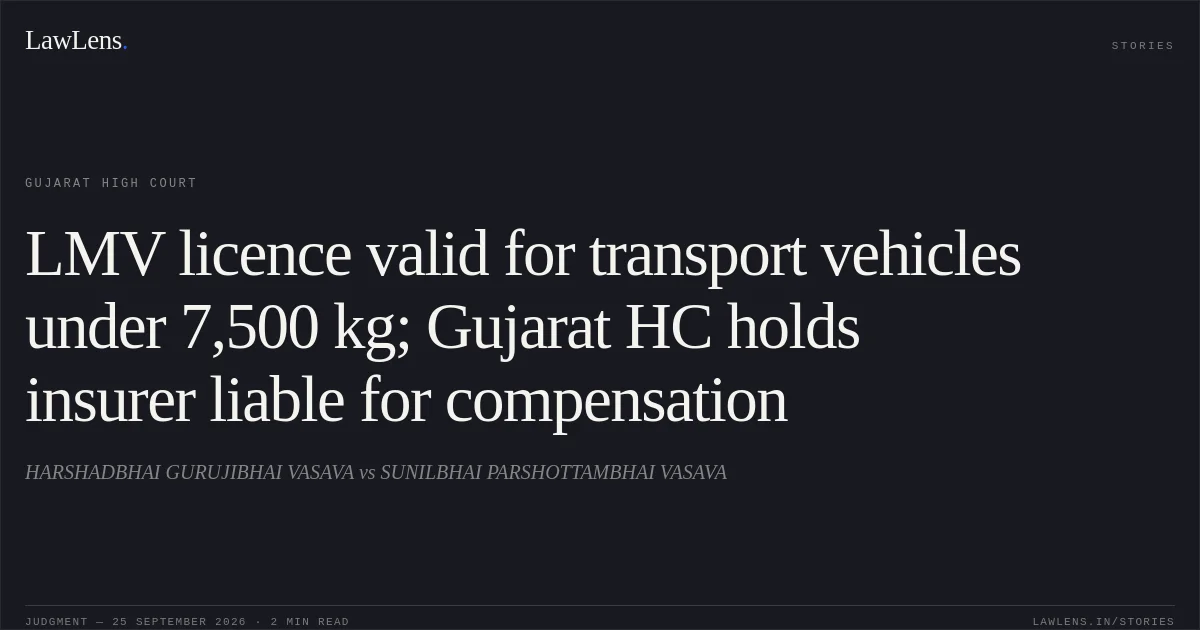
Whether a driver holding a licence to drive a Light Motor Vehicle (LMV) could lawfully drive the Tata Magic transport vehicle, whose weight was within 7,500 kg, without a separate transport-vehicle authorisation?
Source reference: paras. 3, 5, 8Whether the Tribunal was justified in directing the insurer to pay the compensation and recover it from the owner on the ground of absence of a valid and effective driving licence?
Source reference: para. 7Law Applied
The Court applied Sections 2(21), 3(1), and 10(2)(d) and (e) of the Motor Vehicles Act, 1988, concerning the definition of “Light Motor Vehicle” and the classes of vehicles for which a driving licence may be issued.
Source reference: paras. 8, 8.1It relied principally on the Constitution Bench decision in Bajaj Allianz General Insurance Co. Ltd. v. Rambha Devi & Ors., 2025 (3) SCC 95, which held that a person holding an LMV licence may drive a transport vehicle with a gross vehicle weight not exceeding 7,500 kg without obtaining an additional authorisation under Section 10(2)(e); the additional eligibility requirements apply to heavier transport vehicles and specified categories such as vehicles carrying hazardous goods.
Source reference: paras. 8, 8.1; pp. 4–5The appeal was maintainable under Section 173 of the Motor Vehicles Act, 1988.
Source reference: para. 1Reasoning
The Court found that the Tribunal had overlooked the validity period of the driver’s licence, which extended up to 28 February 2029 for non-transport LMV vehicles.
Source reference: para. 8The registration certificate showed that the Tata Magic had an unladen weight of 1,000 kg, well below the statutory threshold of 7,500 kg.
Source reference: para. 8Applying the Constitution Bench’s ruling in Rambha Devi, the Court held that an LMV licence was sufficient to authorise the driver to operate the vehicle even though it was used as a transport vehicle; no separate transport endorsement was required.
Source reference: paras. 8–8.1Consequently, the basis for the Tribunal’s pay-and-recover direction—that the driver lacked a valid and effective licence—was legally unsustainable.
Source reference: para. 7Holding
The First Appeal was allowed.
The impugned judgment and award were modified, and the insurer was held jointly and severally liable along with the driver and owner to pay compensation of ₹3,84,075 with interest at 9% per annum.
Source reference: para. 9The direction permitting the insurer to recover the amount from the owner was thereby displaced.
Source reference: para. 9The ₹15,000 deposited by the owner was ordered to be refunded.
Source reference: para. 9.1Acts & Sections Cited
4 provisions across 1 statute referred to in this judgment. Each provision opens on LawLens.
Motor Vehicles Act, 19884
Original Court PDF
HARSHADBHAI GURUJIBHAI VASAVAvsSUNILBHAI PARSHOTTAMBHAI VASAVA
Click to open original judgment
Original judgment, available to read, download and summarize on LawLens.in