01Facts
The petitioner and his wife, Mitti Ghosh, obtained a loan of Rs. 25,00,000 from the complainant, Mrs. Chandra Prabha (Opposite Party No. 2), to invest in a business, and did not repay it as promised.
¶ 4On the complainant's complaint, her statement on solemn affirmation, and the statement of an inquiry witness, the Judicial Magistrate 1st Class-XXI, Ranchi found a prima facie case under Section 406 of the Indian Penal Code (IPC) and issued summons by order dated 14.02.2023 in Complaint Case No. 10424 of 2022.
¶ 2 · ¶ 5The petitioner sought quashing of the entire proceedings, including that order, under Section 528 of the Bharatiya Nagarik Suraksha Sanhita (BNSS), 2023.
¶ 2Despite valid service, Opposite Party No. 2 did not appear.
¶ 3The petitioner relied on Mukesh Sao @ Mukesh Shaw v. State of Jharkhand (Cr.M.P. No. 115 of 2024, decided 27.01.2026) and, through it, on Satish Chandra Ratan Lal Shah v. State of Gujarat (2019) 9 SCC 148, and contended that a loan cannot be "property entrusted" under Section 405 IPC.
¶ 6 · ¶ 7The State, through the Special P.P., opposed quashing, submitting that the material disclosed an offence under Section 406 IPC.
¶ 802Issues
i.1. Whether a loan amount advanced by the complainant to the petitioner constitutes "property entrusted" within the meaning of Section 405 IPC, so as to attract Section 406 IPC.
¶ 7 · ¶ 10ii.2. Whether, even accepting the complainant's allegations as true, the ingredients of Section 406 IPC are made out, such that continuation of the criminal proceedings amounts to abuse of process warranting quashing under Section 528 BNSS.
¶ 7 · ¶ 12 · ¶ 1303Law Applied
Section 405 IPC defines criminal breach of trust as dishonest misappropriation or conversion of property "entrusted" to a person, and Section 406 IPC prescribes its punishment.
¶ 7 · ¶ 10Ram Narayan Popli v. CBI (2003) 3 SCC 641 sets out the settled ingredients of Section 406: (i) an entrustment, and (ii) misappropriation or conversion to one's own use, or use in violation of a legal direction or contract.
¶ 11Anil Mahajan v. Bhor Industries Ltd. (2005) 10 SCC 228 holds that a mere failure to honour a financial commitment, even if deliberate, does not constitute cheating or criminal breach of trust absent dishonest intention from the inception of the transaction.
¶ 9As quoted in Mukesh Sao, Satish Chandra Ratan Lal Shah (2019) 9 SCC 148 holds that the mere inability to repay a loan cannot give rise to criminal prosecution for cheating unless fraudulent or dishonest intention is shown at the outset.
¶ 6Section 528 BNSS, invoked for quashing, was applied on the "abuse of process" standard.
¶ 2 · ¶ 13Provisions in the judgment · 5 · Linked ones open on LawLens
Bharatiya Nagarik Suraksha Sanhita, 2023 Section 528
Indian Penal Code, 1860 Section 406Section 415Section 420Section 405
04Reasoning
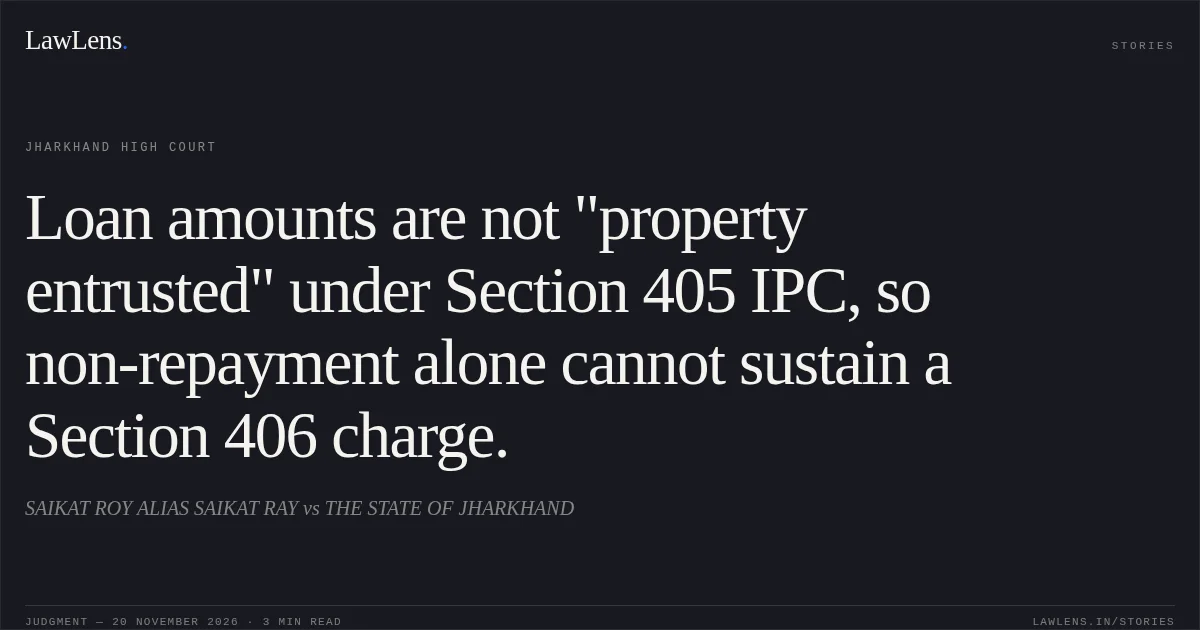
On disbursement, ownership of the money passes to the borrower, who may use it freely without the lender's approval. Section 405 requires property to be entrusted under a fiduciary obligation to hold, manage, or apply it in a specific manner for the owner. No such obligation arose here, and therefore a loan is not "property entrusted" under Section 405 IPC.
¶ 10Because the first ingredient of entrustment was absent, the Section 406 offence could not be made out even if the complaint's allegations were taken at face value.
¶ 11 · ¶ 12The Court did not separately adjudicate the cheating aspect, although the petitioner's reliance on Satish Chandra Ratan Lal Shah and Anil Mahajan on the absence of dishonest intention at inception was recorded.
¶ 6 · ¶ 9The Court's reasoning rests on the failure of the entrustment element. Having found that element absent, it treated continuation of the proceedings as an abuse of process.
¶ 1305Holding
Issue 1 is answered in the negative: a loan advanced by the complainant is not "property entrusted" under Section 405 IPC.
¶ 10Issue 2 is answered in the affirmative: the ingredients of Section 406 IPC are not made out on the allegations, and continuing the proceedings would abuse the process of law. The petition is allowed to that extent, and the entire criminal proceedings in Complaint Case No. 10424 of 2022, including the Magistrate's order dated 14.02.2023 issuing summons, are quashed and set aside qua the petitioner.
¶ 12 · ¶ 13 · ¶ 14 · ¶ 15The relief is confined to the petitioner, and the judgment does not expressly address the position of co-accused Mitti Ghosh.
Original Court PDF
SAIKAT ROY ALIAS SAIKAT RAYvsTHE STATE OF JHARKHAND
Click to open original judgment
Original judgment, available to read, download and summarize on LawLens.in