Facts
The plaintiffs, heirs of K.R. Arumugam, sought declaration of title, recovery of possession and mesne profits in respect of property their father had purchased in 1986.
Source reference: p. 2–4; p. 11–12They claimed the defendant, a relative, entered into permissive possession in 2000; the defendant claimed that Arumugam had agreed to sell the property to him in 1988, delivered possession, and that he had acquired title by adverse possession.
Source reference: p. 2–4; p. 11–12The trial court dismissed the suit, finding for the defendant; the first appellate court reversed and decreed the suit.
Source reference: p. 1; p. 5–6The defendant appealed under Section 100 of the Code of Civil Procedure.
Source reference: p. 1; p. 5–6Issues
1. Whether the first appellate court was right to set aside the trial court’s decree when the defendant had been in possession under the 1988 document
Source reference: p. 6; para. 172. Whether the plaintiffs remained entitled to declaration and recovery of possession despite the defendant’s possession for more than 12 years
Source reference: p. 6; paras. 17–183. Whether the defendant’s possession was adverse to the plaintiffs and had matured into title
Source reference: p. 6; paras. 17–18Law Applied
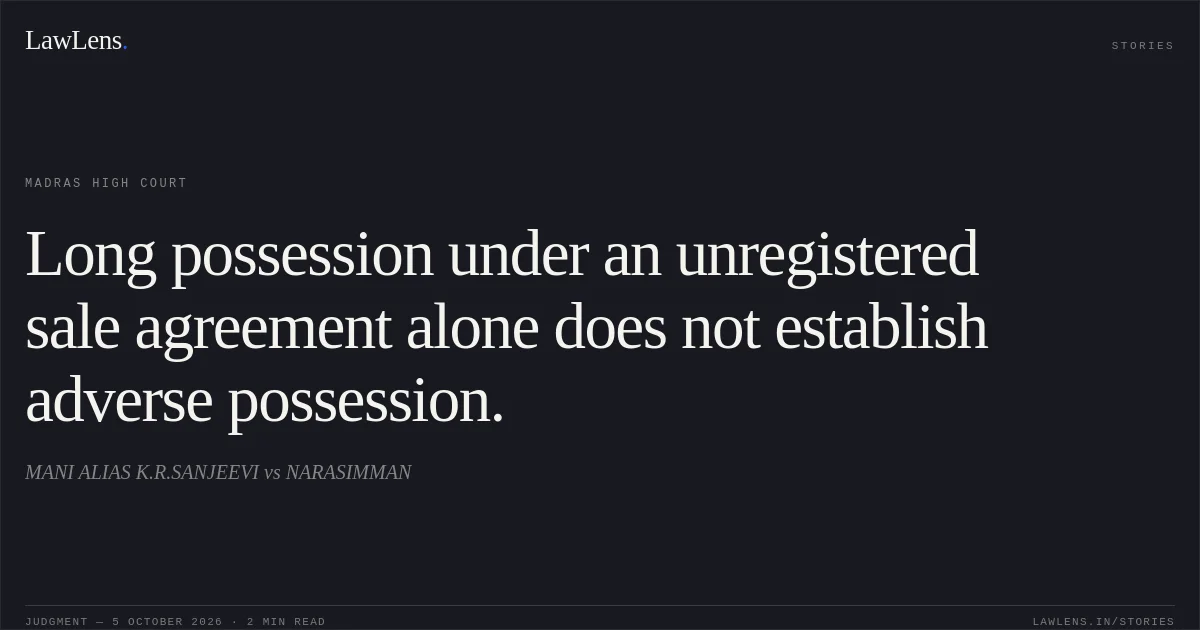
The Court applied the principle that long-term possession alone does not establish adverse possession: the claimant must prove possession that is nec vi, nec clam, nec precario—without force, secrecy or permission—and establish its adverse character
Source reference: p. 17; para. 18It also held that the 1988 document, being an unregistered sale agreement rather than a sale deed, did not convey title to the defendant.
Source reference: p. 12–13; para. 17The judgment identifies Section 100 CPC as the basis for the second appeal but cites no specific statutory provision or precedent governing transfer of title or adverse possession.
Source reference: p. 1; p. 6Reasoning
The plaintiffs’ father’s title and the plaintiffs’ status as his legal heirs were established and not disputed.
Source reference: p. 11–13; p. 16; para. 17The defendant’s document was only an agreement providing for payment of the balance and execution of a sale deed within one month; no deed was executed, and the defendant took no steps to obtain one during the father’s lifetime.
Source reference: p. 11–13; p. 16; para. 17The Court therefore found that the agreement did not confer ownership and that the defendant had not proved the requisite adverse possession.
Source reference: p. 17; para. 18His continued possession, by itself, was insufficient to defeat the plaintiffs’ established title.
Source reference: p. 17; para. 18Holding
The Court answered the substantial questions of law against the defendant and in favour of the plaintiffs.
The Court upheld the first appellate court’s decree for declaration and recovery of possession, and dismissed the second appeal.
Source reference: p. 17–18; paras. 18–20No costs were awarded, and the connected miscellaneous petition was closed.
Source reference: p. 17–18; paras. 18–20Acts & Sections Cited
1 provisions across 1 statute referred to in this judgment. Each provision opens on LawLens.
Code of Civil Procedure, 19081
Original Court PDF
MANI ALIAS K.R.SANJEEVIvsNARASIMMAN
Click to open original judgment
Original judgment, available to read, download and summarize on LawLens.in