01Facts
The petitioner was appointed in 2003 as a Data Entry Operator on a contractual basis and claimed to have continuously served the respondent department for approximately 23 years.
pp. 1–2 · p. 6He sought regularisation from the date of initial appointment, grant of the regular pay scale, arrears, and consequential benefits.
pp. 1–2 · p. 6In an earlier round of litigation, the High Court directed the respondents to decide his representation by a reasoned and speaking order.
pp. 1–2The representation was rejected by order dated 22 June 2015, and the respondents subsequently defended that rejection by order dated 6 December 2023.
pp. 1–2 · p. 8The petitioner challenged both orders under Article 226 of the Constitution, contending that his prolonged engagement in perennial work could not be continued under a contractual arrangement without considering regularisation.
pp. 1–2 · p. 602Issues
i.Whether the respondents’ rejection of the petitioner’s claim for regularisation and regular pay-scale, without properly considering his long and continuous contractual service, was legally sustainable
p. 2 · pp. 6–7ii.Whether the petitioner’s claim was required to be reconsidered in light of the Madhya Pradesh General Administration Department Circular dated 7 October 2016 and the Supreme Court decisions concerning prolonged contractual or outsourced employment in perennial work
pp. 6–7iii.Whether the earlier rejection orders dated 22 June 2015 and 6 December 2023 could be relied upon while reconsidering the petitioner’s claim
pp. 1–2 · p. 803Law Applied
The High Court exercised jurisdiction under Article 226 of the Constitution and directed reconsideration of the petitioner’s claim in accordance with the General Administration Department Circular dated 7 October 2016.
p. 1 · p. 8It relied on Jaggo v. Union of India, 2024 SCC OnLine SC 3826, and Shripal v. Nagar Nigam Ghaziabad, 2025 SCC OnLine SC 221, for the principle that outsourcing or contractual engagement cannot be used as a shield to perpetuate precarious employment or avoid fair engagement practices where the work is perennial.
p. 2It further relied on Dharam Singh v. State of U.P., Civil Appeal No. 8558 of 2018, which emphasised that the State is a constitutional employer and must organise recurring public work through lawful establishment and engagement practices consistent with Articles 14, 16 and 21.
pp. 2–5The Court also referred to Bhikhani Devi v. Union of India, 2026 SCC OnLine SC 1055, concerning continuing causes of action and the treatment of service and retiral claims arising from prolonged temporary employment.
pp. 5–6The final direction additionally required consideration of Sukhendu Bhattacharjee v. State of Assam, 2026 LiveLaw (SC) 528, and Bhola Nath v. State of Jharkhand, Civil Appeal No. 657 of 2026.
p. 804Reasoning
The Court noted that the petitioner had performed the duties of Data Entry Operator continuously since 2003 and had completed approximately 23 years of contractual service.
p. 2 · p. 5Against this background, the rejection order dated 22 June 2015 was found to have relied essentially on the assertion that the Court had not expressly directed grant of a regular pay-scale and had not adequately examined the petitioner’s claim in light of the applicable legal principles.
p. 6The Court considered that prolonged engagement in recurring departmental work raised the constitutional concerns identified in Jaggo, Shripal, and Dharam Singh, namely, whether the State had used temporary or contractual labels to avoid lawful regular engagement.
pp. 2–5However, rather than itself granting regularisation or arrears, the Court directed the competent authorities to reconsider the claim under the 7 October 2016 Circular and the cited Supreme Court decisions.
p. 8The reconsideration was to be undertaken independently, without being influenced by the earlier rejection orders.
p. 805Holding
The petition was disposed of without granting immediate regularisation, regular pay, or arrears.
p. 8The respondents were directed to reconsider the petitioner’s claim for regularisation in accordance with law, the General Administration Department Circular dated 7 October 2016, and the principles laid down in Jaggo, Shripal, Dharam Singh, Sukhendu Bhattacharjee, and Bhola Nath.
p. 8The reconsideration was to be completed within two months from receipt of the certified copy of the order, and the authorities were directed not to be influenced by the previous orders dated 22 June 2015 and 6 December 2023.
p. 8Original Court PDF
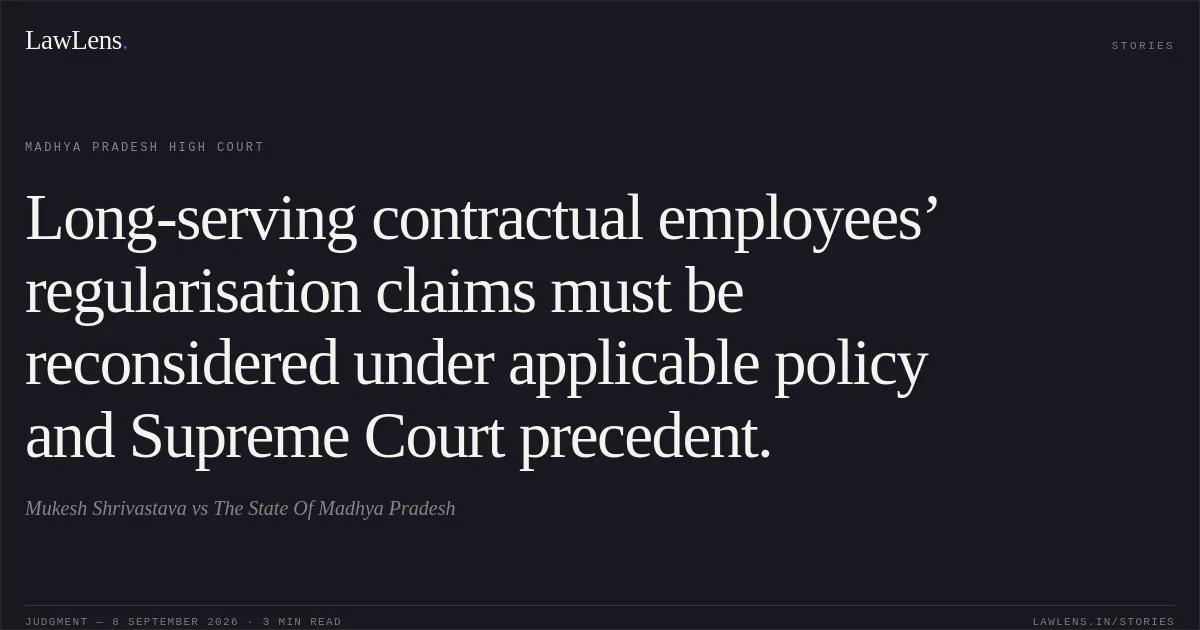
Mukesh ShrivastavavsThe State Of Madhya Pradesh
Click to open original judgment
Original judgment, available to read, download and summarize on LawLens.in