Facts
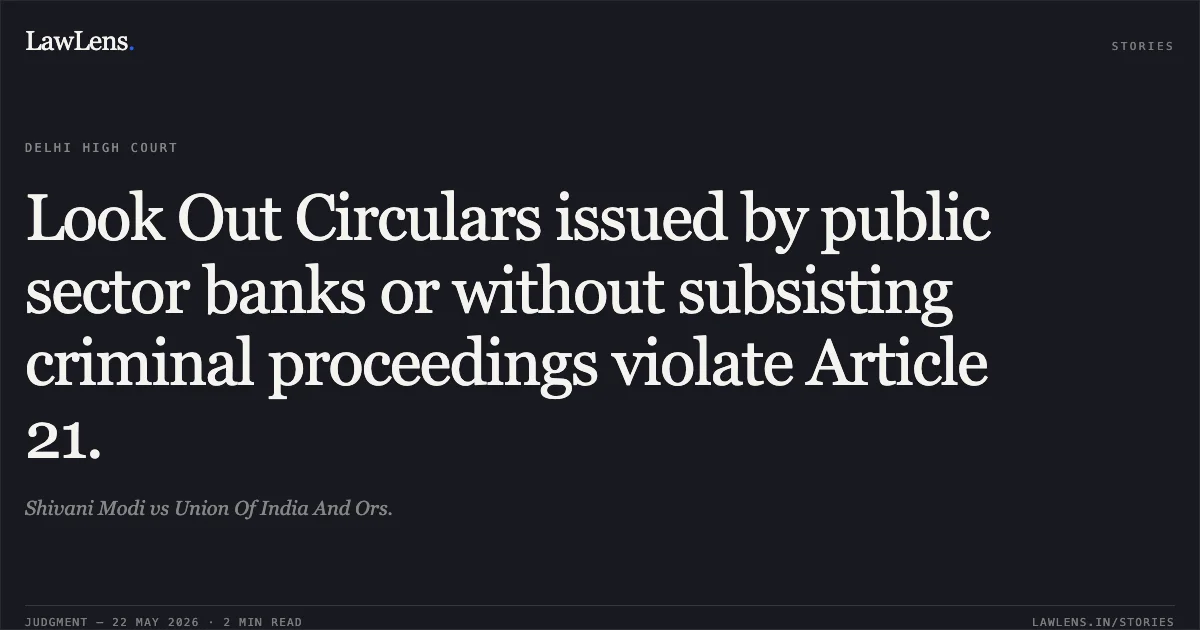
The High Court of Delhi heard a batch of eight writ petitions challenging the issuance and continuation of Look Out Circulars (LOCs).
Source reference: p. 5The petitioners fell into three categories: (A) those facing LOCs issued at the behest of Public Sector Banks for loan defaults; (B) those under investigation by authorities like the SFIO, Income Tax Department, or MCA; and (C) those whose LOCs originated from specific judicial or statutory orders.
Source reference: p. 6, 32In several cases, petitioners had previously been granted permission to travel by courts and had consistently returned to India, showing no flight risk.
Source reference: p. 23, 26, 30Issues
1. Whether the Chairman or CEOs of Public Sector Banks possess the legal authority to seek the issuance of an LOC.
Source reference: p. 10/para. 172. Whether the "economic interest of India" clause in the 2021 Office Memorandum can be invoked for routine commercial defaults or business failures.
Source reference: p. 11/para. 19-203. Whether the continuation of an LOC is justifiable when a subject has cooperated with investigations and demonstrated no risk of absconding.
Source reference: p. 12/para. 22Law Applied
Article 21 of the Constitution, establishing the right to travel abroad as a fundamental facet of personal liberty.
Source reference: p. 7The principle from Maneka Gandhi v. Union of India, requiring procedures depriving liberty to be fair and non-arbitrary.
Source reference: p. 8The mandate in Sumer Singh Salkan v. Asst. Director, that LOCs be coercive measures of last resort only for cognizable offences.
Source reference: p. 9The decision in Viraj Chetan Shah v. Union of India, which struck down Clause 6(B)(xv) of the 2021 OM, thereby stripping Bank officials of the power to request LOCs.
Source reference: p. 10International standards from the ICCPR (Article 12) regarding freedom of movement.
Source reference: p. 13Reasoning
The court reasoned that an LOC is an extraordinary measure, not a routine recovery tool for banks.
Source reference: no citationRegarding Category A, the court applied the Viraj Chetan Shah precedent to hold that banks lack the statutory anchor to restrict travel.
Source reference: p. 10, 20For Category B, the court analyzed the "proportionality" of the restrictions; it found that where petitioners—such as Shivani Modi or Harmandeep Kandhari—had joined investigations and returned from multiple court-sanctioned foreign trips, the "flight risk" justification vanished.
Source reference: p. 23-26The court held that "economic interest" must involve a grave threat to the national economy, and individual defaults do not meet this threshold.
Source reference: p. 11, 17For Category C, the court applied the principle of "institutional primacy," determining that if an LOC was born of a specific pending criminal case, the petitioner must first seek rescission from the court seized of that underlying matter.
Source reference: p. 33-34Holding
The court quashed the LOCs for Category A and B petitioners (Shivani Modi, Harmandeep Singh Kandhari, Samir Sharma, Hu Liu, M. Thiagarajan, and Atul Punj), holding that the originating agencies failed to justify necessity and legality.
These petitioners were permitted to travel subject to notifying the agencies 48 hours in advance.
Source reference: p. 21, 31For Category C (Amrit Dujari), the court declined to quash the LOC but granted liberty to approach the competent Trial Court for relief.
Source reference: p. 36-37The Court reaffirmed that the burden of proof to sustain an LOC lies squarely on the State.
Source reference: p. 17/para. 38Acts & Sections Cited
6 provisions across 4 statutes referred to in this judgment. Each provision opens on LawLens.
Code of Civil Procedure, 19081
Prevention of Corruption Act, 19881
Companies Act, 20133
Insolvency and Bankruptcy Code, 2016.1
Original Court PDF
Shivani ModivsUnion Of India And Ors.
Click to open original judgment
Original judgment, available to read, download and summarize on LawLens.in