Facts
The petitioners were co-owners and possessors of properties in Kottuvally Village, Paravur Taluk, which continued to be classified as “Nilam” in the Basic Tax Register, although the lands were not included in the Data Bank under the Kerala Conservation of Paddy Land and Wetland Act, 2008 and had allegedly been reclaimed before the Act came into force.
Source reference: paras. 2–3Their predecessor-in-interest had submitted applications under Clause 6 of the Kerala Land Utilisation Order, 1967 (“KLU Order”) on 1 November 2014.
Source reference: paras. 3–4In an earlier judgment in W.P.(C) No. 32936 of 2014, the High Court directed the competent authority to consider the applications and indicated that permission could be granted for non-agricultural use after obtaining a report from the Agricultural Officer.
Source reference: paras. 3–4, 13The Agricultural Officer and Village Officer subsequently submitted reports stating that the lands were reclaimed before 2008, were not included in the Data Bank, and were unsuitable for paddy cultivation.
Source reference: paras. 4, 14–15The petitioners later submitted Form-A applications seeking reassessment/correction of the land classification. The Tahasildar rejected or declined to process the applications on the ground that the petitioners had not obtained an order permitting conversion under the KLU Order.
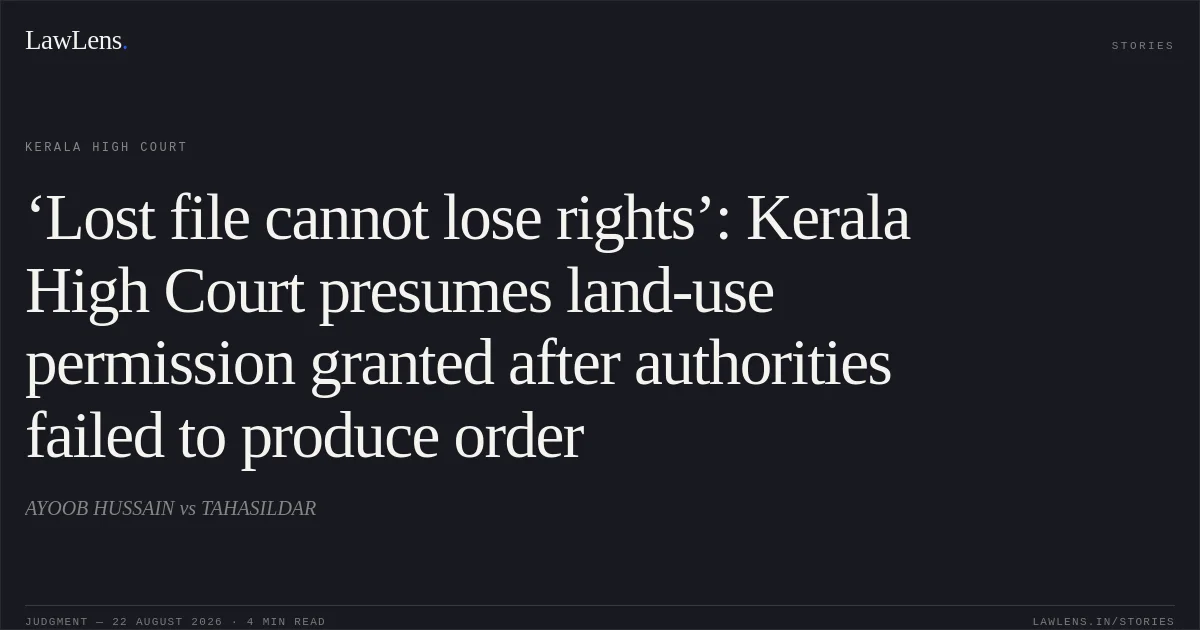
Source reference: para. 5During the writ proceedings, the Revenue Divisional Officer contended that the original files were missing, although the dispatch register indicated that orders had been issued and dispatched pursuant to the earlier judgment. The authorities could not state whether those orders had allowed or rejected the KLU applications.
Source reference: paras. 8–12Issues
Whether the respondents could rely on the loss of the original administrative file to avoid giving effect to the binding directions issued in the earlier judgment under Clause 6 of the KLU Order.
Source reference: paras. 9–12, 16–18Whether, in light of the earlier judgment and the reports of the Agricultural Officer and Village Officer, the KLU applications should be presumed to have been allowed.
Source reference: paras. 13–18Whether the petitioners, as successors-in-interest, were entitled to pursue the KLU applications originally filed by their predecessor-in-interest.
Source reference: paras. 22–23Whether the Tahasildar was required to reconsider the petitioners’ Form-A applications in accordance with the law declared in Tahasildar v. Renjith George.
Source reference: paras. 5, 7, 23Law Applied
The Court applied Clause 6 of the Kerala Land Utilisation Order, 1967, under which the competent authority may grant permission to utilise agricultural land for other purposes; the Collector under the KLU Order includes the Revenue Divisional Officer.
Source reference: para. 13Praveen K. v. Land Revenue Commissioner, holding that a KLU application cannot be rejected without an enquiry into whether the land is paddy land or wetland and that, if it is not so found, the application must be considered under the KLU Order.
Source reference: para. 13Sunil v. Killimangalam Panjal 5th Ward, recognising that Clause 6 permission may be granted for construction and other purposes; and Joseph John v. Land Revenue Commissioner, holding that prior reclamation or conversion does not bar consideration of a Clause 6 application.
Source reference: para. 13Tahsildar v. Renjith George, which held that applications filed before 30 December 2017 and remaining pending are governed by the unamended statutory regime.
Source reference: paras. 5, 23Constitutional courts may mould relief to do complete justice, as recognised in Adani Power Ltd. v. Union of India, and the State must act as a fair and model litigant rather than benefit from its administrative failures.
Source reference: para. 12A successor-in-interest may continue proceedings initiated by the predecessor, as held in Firoz V.A. v. State of Kerala.
Source reference: para. 22Delay and laches are flexible principles dependent on the facts and circumstances, relying on Shankara Co-op. Housing Society Ltd. v. M. Prabhakar and Mizo Chief Council Mizoram v. Union of India.
Source reference: paras. 19–21Reasoning
The earlier judgment did not merely require a fresh administrative consideration; it expressly stated that permission could be granted for non-agricultural use after obtaining the Agricultural Officer’s report.
Source reference: para. 13The subsequent Agricultural Officer’s report supported the petitioners’ case by recording that the property had the character of a residential plot, was not in the Data Bank, and contained no paddy fields, wetlands, or watercourses.
Source reference: para. 14The Village Officer’s report similarly stated that the land had been reclaimed before 2008 and was unsuitable for paddy cultivation.
Source reference: para. 15In these circumstances, the Court held that an order rejecting the KLU applications would have been inconsistent with the earlier binding judgment and could potentially amount to contempt.
Source reference: para. 17The State could not derive an advantage from its inability to preserve or trace the file, particularly when its own records showed that an order had been issued and dispatched.
Source reference: paras. 16–18The Court therefore presumed that the consequential order had allowed the applications.
Source reference: paras. 16–18It also rejected the objections based on delay and non-joinder of the predecessor-in-interest, holding that the State could not rely on its own administrative lapse and that the petitioners, as successors-in-interest, had the right to continue the proceedings.
Source reference: paras. 20–23Holding
The writ petitions were allowed.
The Court declared that, in light of the earlier judgment and the Agricultural Officer’s and Village Officer’s reports, the applications filed under Clause 6 of the KLU Order were to be presumed to have been allowed.
Source reference: para. 23The communications issued by the Tahasildar requiring the petitioners to obtain a fresh conversion order were set aside.
Source reference: para. 23The Tahasildar was directed to reconsider the petitioners’ Form-A applications in accordance with Tahasildar v. Renjith George and to take a decision within thirty days from receipt of the judgment.
Source reference: para. 23Acts & Sections Cited
1 provisions across 1 statute referred to in this judgment. Each provision opens on LawLens.
Transfer of Property Act, 18821
Original Court PDF
AYOOB HUSSAINvsTAHASILDAR
Click to open original judgment
Original judgment, available to read, download and summarize on LawLens.in