Facts
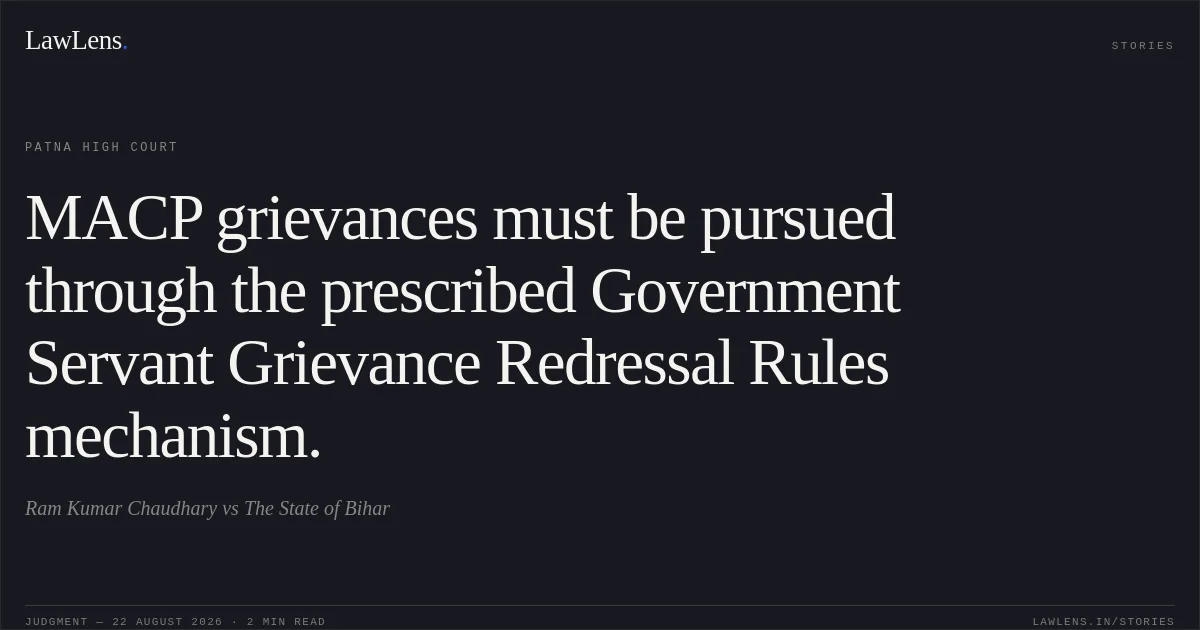
The petitioner, a government employee/retired government employee, filed the writ petition seeking financial upgradation under the Modified Assured Career Progression Scheme (M.A.C.P.) with effect from 1 February 2005, along with 15% interest.
Source reference: p.2, para. 2He also sought directions for identification and disciplinary action against officials allegedly responsible for non-grant of M.A.C.P., and exemplary damages of ₹5 lakhs for breach of public-law and constitutional duties.
Source reference: pp.2–3, para. 2The petitioner appeared in person but remained absent despite repeated calls, whereas the State was represented.
Source reference: p.1, para. 1The State submitted that the Bihar Government Servant Grievance Redressal Rules, 2019 provide a specific mechanism for raising service-related grievances, including claims concerning promotion, A.C.P. and M.A.C.P.
Source reference: p.3, para. 3Issues
Whether the petitioner’s grievance concerning grant of M.A.C.P. could be pursued through the complaint mechanism under the Bihar Government Servant Grievance Redressal Rules, 2019.
Source reference: pp.3–5, paras. 3–4.1Whether the writ petition should be disposed of with liberty to the petitioner to approach the competent authority under the 2019 Rules, rather than having the merits of the M.A.C.P. claim adjudicated directly in the writ proceeding.
Source reference: p.5, para. 5Law Applied
The Court applied the Bihar Government Servant Grievance Redressal Rules, 2019.
Source reference: p.3–4, para. 4Rule 2(c) defines “complaint” to include service and retirement-benefit matters, expressly covering promotion, A.C.P. and M.A.C.P.-related grievances, while excluding matters relating to disciplinary or departmental action, transfer/posting/deputation, and matters already under consideration before a court.
Source reference: p.3–4, para. 4Rule 3(a) permits serving or retired State Government employees to file complaints online regarding service matters or retirement benefits, and Rule 3(b) requires a separate complaint for each subject.
Source reference: pp.4–5, para. 4.1The precedents cited in the petitioner’s prayers—Girija Nandan Singh v. State of Bihar, Superintending Engineer, Public Health, U.T. Chandigarh v. Kuldeep Singh, Salem Advocate Bar Association v. Union of India and United Air Travel Service v. Union of India—were not substantively examined or applied by the Court.
Source reference: pp.2–3, para. 2Reasoning
The Court noted that the petitioner’s principal grievance—non-grant of M.A.C.P.—fell squarely within Rule 2(c), which specifically includes M.A.C.P.-related service complaints.
Source reference: p.3–4, para. 4Since the 2019 Rules provide an available and specific administrative remedy, the Court considered it appropriate for the petitioner first to invoke that mechanism.
Source reference: p.5, para. 5The Court did not adjudicate the petitioner’s entitlement to M.A.C.P., interest, damages, or disciplinary action on merits.
Source reference: p.5, para. 5Instead, it directed the petitioner to submit a complaint before the competent authority, leaving the grievance to be decided in accordance with the procedure and time frame prescribed under the Rules.
Source reference: p.5, para. 5Holding
The Court disposed of the writ petition without deciding the merits of the petitioner’s M.A.C.P. claim.
The petitioner was granted liberty and directed to file a complaint under the Bihar Government Servant Grievance Redressal Rules, 2019 within 30 days from 18 August 2026.
Source reference: p.5, para. 5The concerned authority was directed to decide the complaint strictly within the time prescribed by the Rules.
Source reference: p.5, para. 5No separate relief regarding interest, damages, or disciplinary action was granted.
Source reference: p.6, para. 6Original Court PDF
Ram Kumar ChaudharyvsThe State of Bihar
Click to open original judgment
Original judgment, available to read, download and summarize on LawLens.in