Facts
On 6 October 2021, a scooter driven by Pulkit, with Ranjeet as pillion rider, collided with truck No. DL-1MA-2953, resulting in Ranjeet’s death.
Source reference: para. 3Proceedings were initiated before the MACT on the basis of a Detailed Accident Report, which implicated only Pulkit and arrayed the scooter’s owner as a respondent.
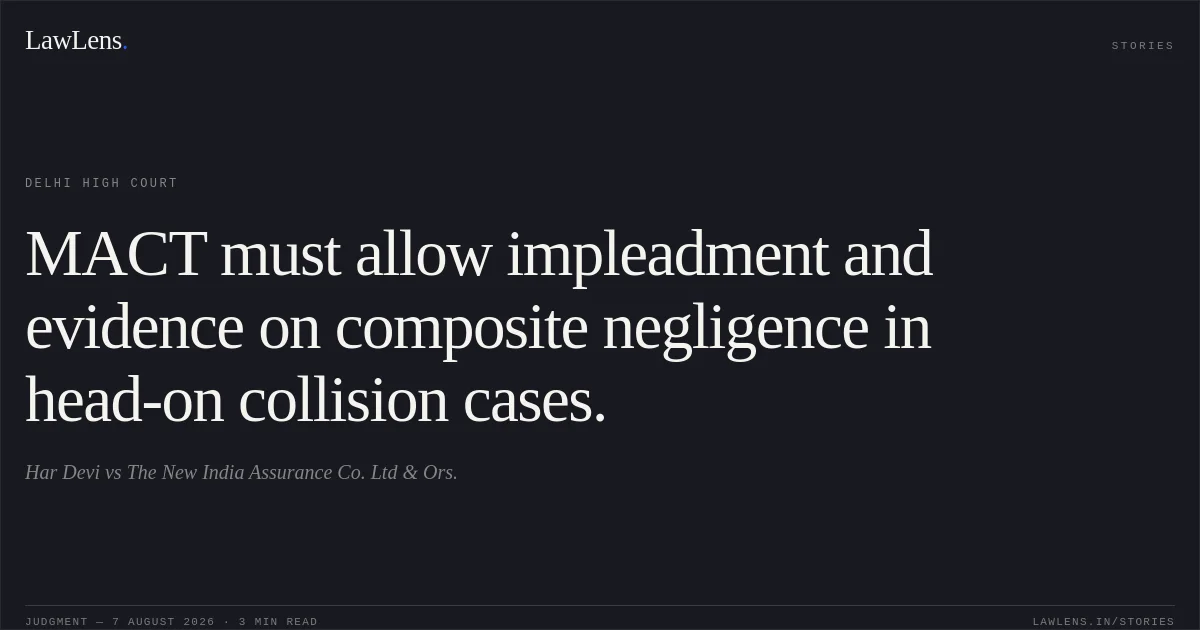
Source reference: paras. 4–5Ranjeet’s mother, Har Devi, applied under Order I Rule 10 CPC for impleadment of the truck’s driver, owner, and insurer, contending that the head-on collision raised a possible case of composite negligence.
Source reference: para. 6The MACT dismissed the application, relying on the police investigation, charge-sheet, and the statement of the truck’s helper, which attributed the accident solely to Pulkit and exonerated the truck driver.
Source reference: paras. 7–8Har Devi challenged that order before the Delhi High Court.
Source reference: no citationIssues
Whether the MACT erred in refusing to implead the truck’s driver, owner, and insurer at the preliminary stage, despite the allegation of composite negligence arising from a head-on collision?
Source reference: paras. 6–8, 12–15Whether the MACT could conclusively determine, without recording substantive evidence and permitting cross-examination, that the accident was solely attributable to the scooter driver?
Source reference: paras. 12–14Law Applied
The Court applied Order I Rule 10 CPC, which permits the impleadment of parties whose presence is necessary for the effective and complete adjudication of the dispute.
Source reference: no citationIt relied on the principle of composite negligence stated in T.O. Anthony v. Karvarnan, (2008) 3 SCC 748, under which negligence of two or more persons causing injury makes each wrongdoer jointly and severally liable, and the claimant may proceed against any or all of them; the claimant need not establish the precise share of negligence of each wrongdoer.
Source reference: para. 9The Court further applied the MACT standard of adjudication—preponderance of probabilities—and held that conclusions regarding negligence should ordinarily follow consideration of substantive evidence and an opportunity to cross-examine relevant witnesses.
Source reference: paras. 13–14Reasoning
The High Court held that the MACT prematurely treated the police investigation, charge-sheet, and the truck helper’s statement as conclusive proof that the scooter driver alone was negligent.
Source reference: paras. 7–8, 13Since the accident involved a head-on collision, the possibility of negligence on the part of the truck driver could not be excluded at the impleadment stage.
Source reference: para. 12The deceased’s legal representative was therefore entitled to lead evidence and cross-examine the relevant witnesses, including the truck’s helper, whose account had been relied upon by the MACT without a full evidentiary inquiry.
Source reference: para. 14The Court emphasized that the question of composite or exclusive negligence had to be determined after proper adjudication, rather than by prematurely excluding potentially liable parties.
Source reference: no citationHolding
The petition was allowed to the extent that the MACT’s order dated 19 April 2023 was set aside, and the Tribunal was directed to restart the inquiry in accordance with law.
The legal representatives of Pulkit, who had died, and the truck’s driver, owner, and insurer were directed to be impleaded as parties before the MACT.
Source reference: para. 16The MACT was directed to adjudicate the issue of negligence afresh after recording appropriate evidence.
Source reference: no citationThe High Court expressly clarified that it had not expressed any opinion on the merits of the claim and had confined its decision to whether the petitioner had been prematurely non-suited.
Source reference: para. 18The petition was accordingly disposed of, and pending applications were rendered infructuous.
Source reference: para. 19Original Court PDF
Har DevivsThe New India Assurance Co. Ltd & Ors.
Click to open original judgment
Original judgment, available to read, download and summarize on LawLens.in