01Facts
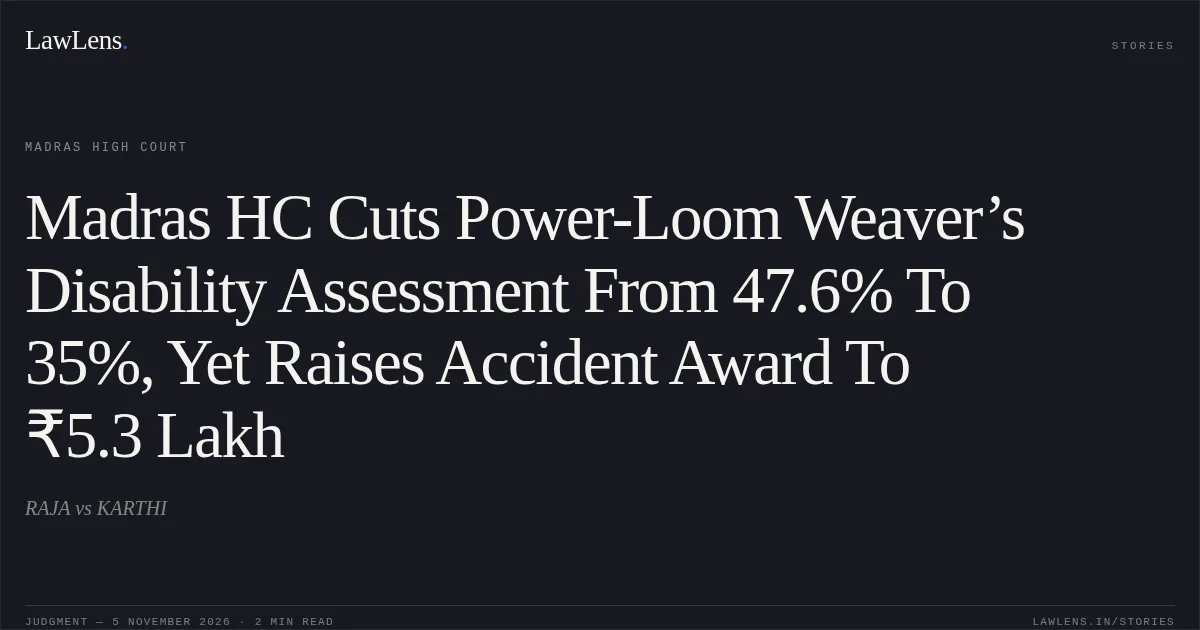
Raja, aged about 45, claimed that a motorcycle struck him from behind while he was walking on 29 September 2018. He sustained fractures, including a fracture of the right proximal tibia.
pp. 2–5 · ¶ 3–9The Motor Accident Claims Tribunal found the motorcycle rider solely responsible and awarded compensation of Rs.4,20,883, including compensation for 47.6% permanent disability assessed by the claimant’s treating doctor.
pp. 2–5 · ¶ 3–9Raja appealed, seeking enhancement, contending that his disability affected his work as a power-loom weaver and that his monthly income had been assessed too low.
pp. 2–5 · ¶ 3–9The Insurance Company opposed enhancement, including on the grounds that the disability had not been assessed by a Medical Board and that functional loss of earning capacity had not been established.
pp. 5–6 · ¶ 12–1302Issues
i.1. Whether the treating doctor’s assessment of 47.6% permanent disability could be accepted in full, and whether compensation should be calculated by the percentage method or the multiplier method.
pp. 5–7 · ¶ 10, 12, 14–16ii.2. Whether the Tribunal’s assessment of the claimant’s monthly income and loss of income during treatment required enhancement.
p. 5, 8 · ¶ 11, 1803Law Applied
The appeal was brought under Section 173 of the Motor Vehicles Act, 1988, against an award on a claim under Section 166.
p. 1, Prayer · p. 2 · ¶ 2The Court relied on Chinnathambi v. Deepa, 2020 (1) TNMAC 617, which the Tribunal had applied in awarding compensation per percentage of disability; the High Court considered the appropriate per-percentage amount in light of the injuries and accident date.
p. 7 · ¶ 17The judgment does not identify a separate statutory or precedential test for converting physical disability into functional disability or for applying the multiplier method.
Provisions in the judgment · 2 · Linked ones open on LawLens
Motor Vehicles Act, 1988 Section 173Section 166
04Reasoning
The Court accepted that the fractures had malunited and permanently restricted the claimant’s right-leg movements, but found that the 47.6% assessment in Ex.P8 was made by the treating doctor, not a Medical Board, and therefore did not accept it in full.
pp. 6–7 · ¶ 15–16Having regard to the injuries and medical evidence, it fixed permanent disability at 35%.
pp. 6–7 · ¶ 15–16It retained the percentage method and, applying the approach in Chinnathambi, increased the rate from Rs.3,000 to Rs.6,000 per percentage, resulting in Rs.2,10,000 for permanent disability.
p. 7 · ¶ 17The Court did not adopt the multiplier method sought by the claimant.
p. 7 · ¶ 17Finding the Tribunal’s Rs.8,000 monthly income too low, it fixed notional income at Rs.15,000 and allowed six months for treatment and recovery, awarding Rs.90,000 for loss of income.
p. 8 · ¶ 18It left the other heads undisturbed.
p. 8 · ¶ 1905Holding
The appeal was partly allowed.
pp. 9–10 · ¶ 20–21The total compensation was enhanced from Rs.4,20,883 to Rs.5,30,000, with interest at 7.5% per annum from the date of the claim petition until deposit, excluding any period of default.
pp. 9–10 · ¶ 20–21The Insurance Company was directed to deposit the amount, less any sum already deposited, within six weeks; the claimant was permitted to withdraw it in accordance with the Tribunal’s directions.
p. 10 · ¶ 21Original Court PDF
RAJAvsKARTHI
Click to open original judgment
Original judgment, available to read, download and summarize on LawLens.in