01Facts
The batch of thirteen writ petitions was filed by real estate associations, builders, resident welfare associations, trusts and private patta landowners.
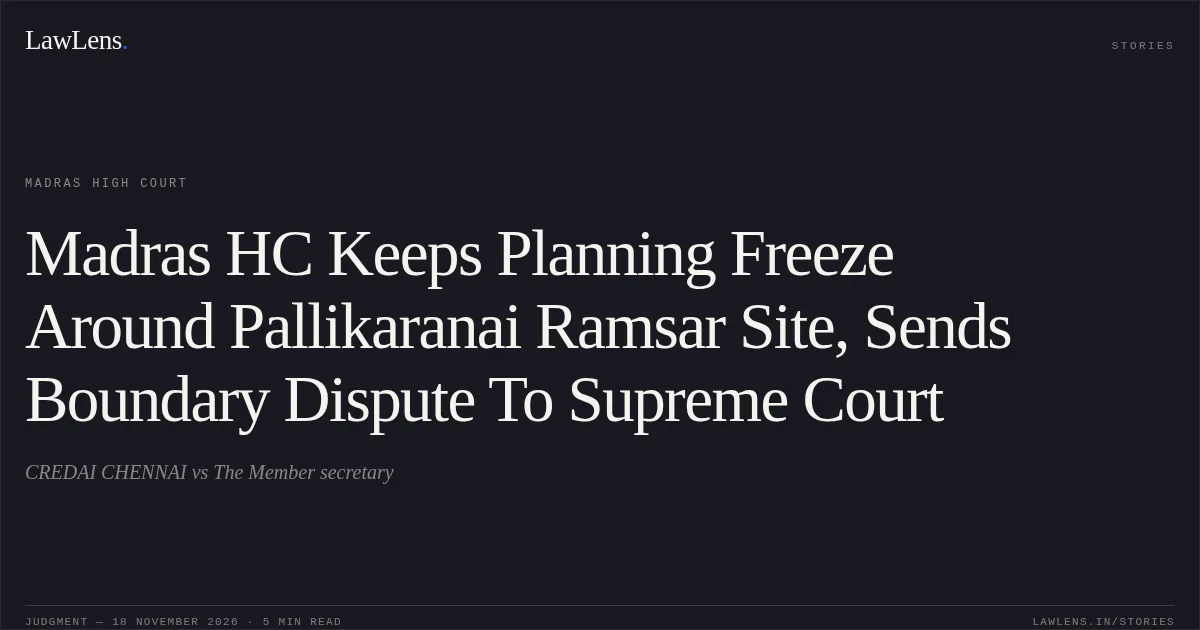
¶ 3 · p. 25(i) The NGT (Southern Zone) order dated 24.09.2025 in O.A. No. 91 of 2023, which directed CMDA not to grant approvals within the Pallikaranai Ramsar Site and its one-kilometre Zone of Influence until an Integrated Management Plan is finalised.
¶ 3(i) · pp. 25-26(ii) CMDA Office Order No. 07/2025 dated 09.10.2025, issued to comply with the NGT order, which imposed a total freeze on planning approvals across the Ramsar site and a uniform one-kilometre buffer shown on an annexed map.
¶ 3(ii) · p. 26 · ¶ 6 · pp. 27-28(iii) NCSCM proceedings dated 18.08.2026 in W.P. No. 37598, alleged to have wrongly included private patta land within the marshland boundary.
¶ 3(iii) · p. 26The Pallikaranai Marshland was designated a Ramsar Site on 08.04.2022.
¶ 4 · p. 26The NGT initiated suo motu proceedings after a 2023 media report on debris dumping at Perumbakkam.
¶ 4 · pp. 26-27The TNSWA and WRD indicated that NCSCM was preparing a scientific revised plan under the Wetlands (Conservation and Management) Rules, 2017.
¶ 5 · p. 27Petitioners argued that the NGT exceeded its powers under Sections 14-15 of the NGT Act, 2010 without hearing affected landowners, and that a Zone of Influence must be scientifically determined under the 2017 Rules.
¶ 7(i)-(ii) · pp. 28-29CMDA stated that it acted solely to comply with the NGT order; about 84.2% of the ~3,474-hectare zone was already built up.
¶ 8 · p. 30TNSWA's revised status report dated 01.10.2026 scaled the interim zone down to 36 survey numbers covering 128.19 hectares, subject to regulated construction and NOCs.
¶ 9.2 · pp. 31-3202Issues
i.1. Whether writ petitions under Articles 226/227 are maintainable against NGT orders when a statutory appeal lies to the Supreme Court under Section 22 of the NGT Act, 2010.
¶ 10-12 · pp. 32-34ii.2. Whether this Court should quash the one-kilometre planning freeze, permit development in accordance with the Master Plan, or adopt TNSWA's revised interim Zone of Influence of 128.19 hectares.
¶ 13 · pp. 34-35iii.3. Whether this Court should adjudicate survey-number-specific boundary disputes and carve out exceptions while the Supreme Court is seized of the wetland demarcation exercise.
¶ 17 · pp. 38-39iv.4. Whether the petitioners can be denied relegation to the Supreme Court because of the prolonged pendency of these writs before this Court.
¶ 18-19 · pp. 39-4003Law Applied
The Court held that the availability of an appeal under Section 22 of the NGT Act does not oust the writ jurisdiction under Articles 226 and 227, relying on Madhya Pradesh High Court Advocates Bar Association v. Union of India (2022 SCC OnLine SC 639), which treats judicial review by High Courts as part of the basic structure and holds that NGT orders remain amenable to writ scrutiny.
¶ 11 · pp. 32-34It applied L. Chandra Kumar v. Union of India (1997) 3 SCC 261 and Whirlpool Corporation v. Registrar of Trade Marks (1998) 8 SCC 1, under which an alternative statutory remedy does not bar a writ where the authority acts without jurisdiction or breaches natural justice.
¶ 12 · p. 34On the merits, the Court relied on the Wetlands (Conservation and Management) Rules, 2017, under which the Zone of Influence is measured outward from the notified wetland boundary, and Rule 7(1) on ground-truthing.
¶ 15-16 · pp. 35-38It also relied on the Supreme Court's order dated 12.10.2026 in Anand Arya v. Union of India (W.P.(C) No. 304 of 2018), connected with M.K. Balakrishnan v. Union of India (W.P.(C) No. 230 of 2001), which took on record Tamil Nadu's ground-truthing methodology, directed all States to complete ground-truthing within four months, and required compliance affidavits.
¶ 15 · pp. 35-37The doctrine of judicial discipline, under which a High Court must not pass parallel or conflicting orders on a matter under the Supreme Court's active monitoring, was applied.
¶ 17 · pp. 38-39Provisions in the judgment · 4 · Linked ones open on LawLens
National Green Tribunal Act, 2010 Section 14Section 15Section 22
Code of Civil Procedure, 1908 Section 100
04Reasoning
On maintainability, the Court held that the Section 22 appeal lies only on limited CPC-type grounds, and that none of the petitioners was a party before the NGT, which passed a sweeping order affecting landowners across fifteen villages without notice. CMDA, the issuing authority, is within this Court's territorial jurisdiction, so the petitions were held maintainable.
¶ 11-12 · pp. 33-34On the merits, the Court held that the Zone of Influence cannot be fixed in isolation from the core wetland boundary. Until the boundary is verified on the ground and finalised under the Supreme Court's supervision, any interim buffer, exclusion of survey numbers, or dilution of the freeze would overlap with and contradict that monitoring.
¶ 16 · p. 38TNSWA's revised 128.19-hectare proposal was itself tentative, and its final notification depends on ground-truthing.
¶ 17 · pp. 38-39Several petitioners disputed whether their specific survey numbers lie inside the core boundary; adjudicating such disputes was held improper while the demarcation is sub judice.
¶ 17 · p. 39The delay argument failed because pendency before the High Court cannot confer jurisdiction to pass orders that preempt the Supreme Court's supervision.
¶ 18-19 · pp. 39-40The Court did not decide the petitioners' challenges to the NGT's jurisdiction under Sections 14-15 or the scientific-validity challenges to the buffer; those were left open.
05Holding
The writ petitions are maintainable notwithstanding the Section 22 NGT Act appeal.
¶ 11-12 · pp. 33-34The Court declined to quash the NGT order or Office Order No. 07/2025, to adopt the revised interim Zone of Influence, or to permit building approvals in the disputed zone, since doing so would trench on the matter sub judice in W.P.(C) No. 230 of 2001.
¶ 20 · p. 40Petitioners are granted liberty to move applications in W.P.(C) No. 230 of 2001, or file fresh proceedings before the Supreme Court, seeking clarification, modification or permission to implement the revised interim Zone of Influence.
¶ 21(i) · pp. 40-41TNSWA, the Directorate of Survey and Settlement, and NCSCM are directed to complete ground-truthing, boundary demarcation and statutory notification in strict compliance with the 2017 Rules and the Supreme Court's directions.
¶ 21(ii) · p. 41No order as to costs is made. Connected miscellaneous petitions are closed.
p. 41Effectively, the one-kilometre freeze under the NGT order and Office Order No. 07/2025 remains in force pending the boundary exercise.
Original Court PDF
CREDAI CHENNAIvsThe Member secretary
Click to open original judgment
Original judgment, available to read, download and summarize on LawLens.in