01Facts
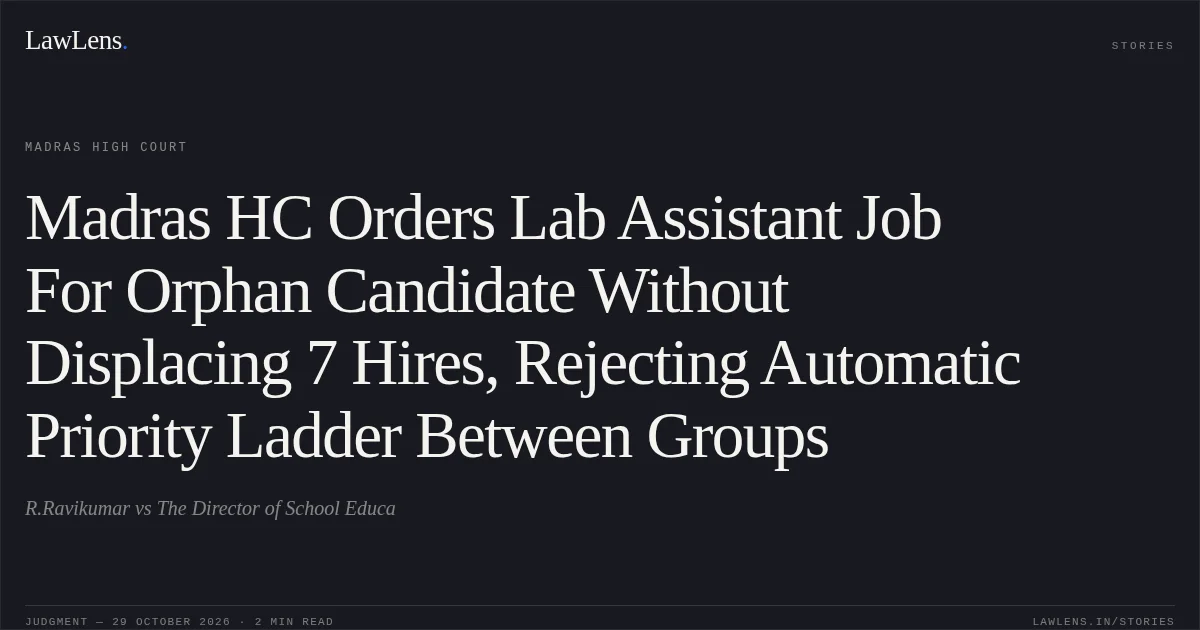
The petitioner, an MBC candidate claiming orphan priority (Group III), challenged a provisional selection list dated 14 April 2017 for Laboratory Assistant posts.
pp. 3–4He had secured 120 marks; the private respondents, also MBC candidates, had secured between 64 and 76 marks and were selected under Group II priority as an Ex-Serviceman and Destitute Widows.
pp. 3–4The selection filled 108 vacancies under the 200-point roster.
pp. 3–4The petitioner sought to quash their selections and obtain appointment; at the hearing, the department stated that 28 Laboratory Assistant vacancies remained in Tirunelveli district.
pp. 6–802Issues
i.Whether, under G.O.Ms. No. 188 dated 28 December 1976, a Group III priority candidate could be considered only after exhausting available Group II priority candidates.
pp. 6–7ii.Whether the petitioner could be granted appointment against an available vacancy without disturbing the private respondents’ appointments.
pp. 8–903Law Applied
G.O.Ms. No. 188, Personnel and Administrative Reforms Department, dated 28 December 1976, identified categories of priority candidates across Groups I to IV, but, as the Court read it, did not prescribe a waterfall mechanism requiring exhaustion of one group before consideration of the next.
pp. 6–7G.O.Ms. No. 122, Human Resources Management Department, dated 2 November 2021, later introduced changes to the consideration of priority groups, but came into effect after the selection at issue.
p. 5The Court held that, absent a prescribed group-exhaustion rule, candidates in later priority groups could not be denied consideration merely because candidates in an earlier group were available.
p. 804Reasoning
The Court found that the petitioner and private respondents belonged to the same community and claimed priority status, but under different groups: the petitioner was in Group III, while the private respondents were in Group II.
pp. 6–7Although the department had selected the Group II candidates on the basis that Group III candidates need not be considered while Group II candidates were available, the Court found no such requirement in the applicable 1976 Government Order.
pp. 7–9It therefore held the selection method legally defective, while declining to unsettle the private respondents’ long-standing appointments.
pp. 7–9In light of the stated vacancies, the Court considered appointment of the petitioner an appropriate remedy.
pp. 7–905Holding
The Court rejected the petitioner’s request to quash the private respondents’ selections but held that the Government’s method of filling vacancies without adopting a cyclical approach among Groups I to IV was unlawful.
p. 9It directed respondents 1 to 3 to appoint the petitioner as a Laboratory Assistant against an available vacancy in Tirunelveli district within eight weeks of receiving the order.
p. 9The private respondents’ appointments were not to be disturbed, and the petitioner’s service was to count from the date he joined.
p. 9Original Court PDF
R.RavikumarvsThe Director of School Educa
Click to open original judgment
Original judgment, available to read, download and summarize on LawLens.in