01Facts
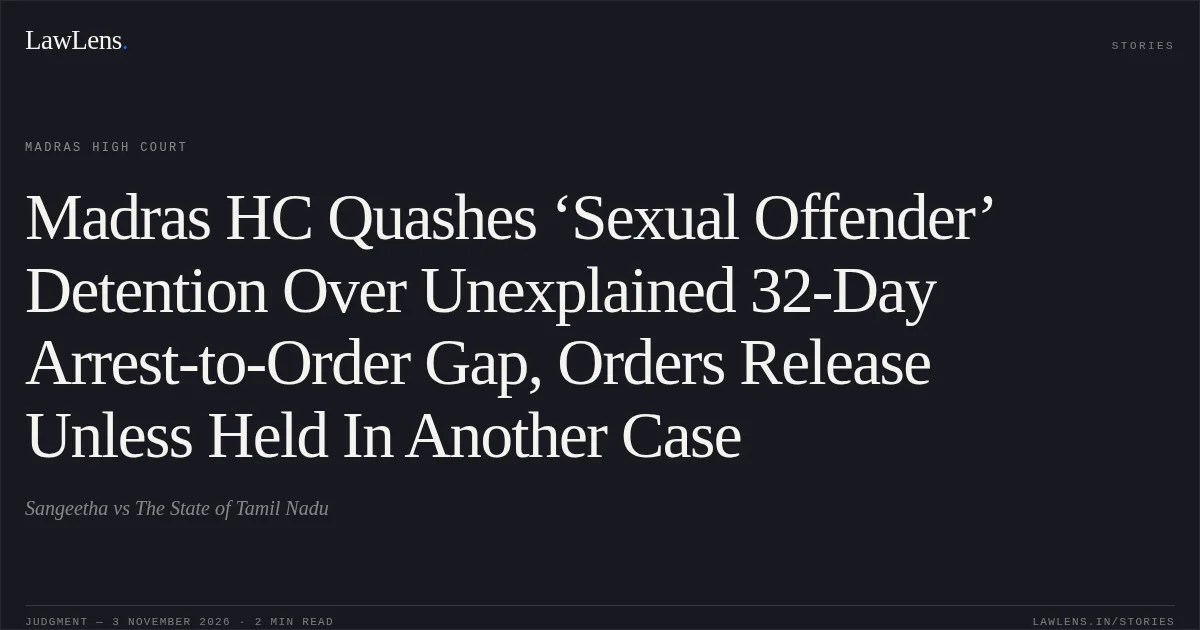
The petitioner, wife of Sathis, challenged the District Collector and District Magistrate’s order dated 11 March 2026 detaining him as a “Sexual Offender” under Section 2(ggg) of the Tamil Nadu Act 14 of 1982.
pp. 2–3 · ¶ 1, 3–4The detenu had been arrested in the ground case on 7 February 2026; the detention order followed 32 days later.
pp. 2–3 · ¶ 1, 3–4The State attributed the delay to the collection of details.
pp. 2–3 · ¶ 1, 3–4The petitioner argued that the delay was unexplained and had severed the live and proximate link between the alleged conduct and the need for detention.
pp. 2–3 · ¶ 1, 3–402Issues
i.1. Whether the 32-day interval between the detenu’s arrest and the detention order was satisfactorily explained
pp. 3–4 · ¶ 3–5, 7ii.2. Whether the unexplained delay snapped the live and proximate link and rendered the detention order invalid
pp. 3–5 · ¶ 5–703Law Applied
Section 2(ggg) of the Tamil Nadu Act 14 of 1982 provides for detention of a person classified as a “Sexual Offender”.
p. 2 · ¶ 1The Court applied the principle in Sushanta Kumar Banik v. State of Tripura, 2022 SCC OnLine SC 1333, that unreasonable delay between relevant stages—including the proposal and detention order, or the detention order and arrest—may cast doubt on the detaining authority’s subjective satisfaction and invalidate detention if the delay is not satisfactorily explained; whether delay is unreasonable depends on the facts and circumstances of the case.
pp. 4–5 · ¶ 6Provisions in the judgment · 1
Tamil Nadu Act 14 of 1982 Section 2
04Reasoning
The Court found that the detenu had been arrested on 7 February 2026, but the detention order was not made until 11 March 2026.
pp. 3–5 · ¶ 5–7Although the State referred to the collection of details, the adverse cases were from the same police station, and the Court considered the delay both inordinate and unexplained.
pp. 3–5 · ¶ 5–7It therefore concluded that the live and proximate link between the arrest and the need for preventive detention had snapped, undermining the detention order.
pp. 3–5 · ¶ 5–705Holding
The Court held that the unexplained delay vitiated the detention order.
p. 5 · ¶ 7–8It allowed the habeas corpus petition, and set aside the order dated 11 March 2026.
p. 5 · ¶ 7–8It directed that Sathis be released forthwith unless required in connection with another case.
p. 5 · ¶ 7–8Original Court PDF
SangeethavsThe State of Tamil Nadu
Click to open original judgment
Original judgment, available to read, download and summarize on LawLens.in