01Facts
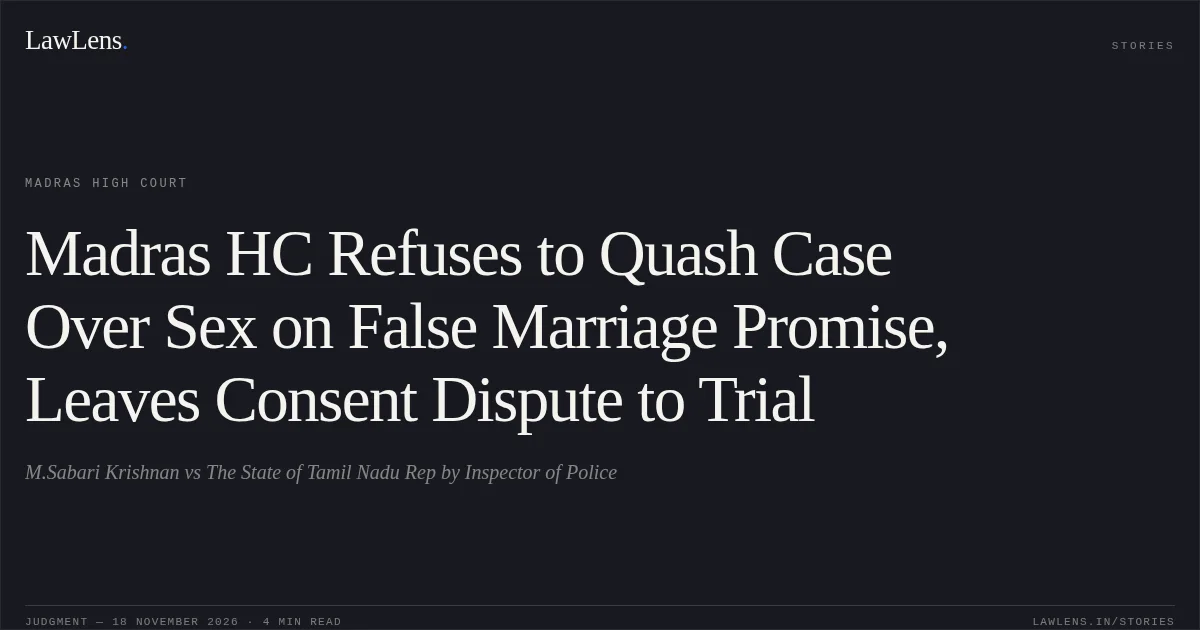
The petitioner, the sole accused, sought quashing under Section 528 BNSS of S.C. No. 620 of 2026 pending before the Sessions Judge, Mahalir Neethimandram, Allikulam, Chennai.
p. 1On the second respondent's complaint, the first respondent registered Crime No. 10 of 2025 under Section 69 BNS, alleging that the petitioner had sexual intercourse with the complainant on a false promise of marriage, then discontinued communication and refused to marry her. The police filed a final report, which the trial court took cognizance of.
p. 2 · ¶ 2The petitioner contended that the parties were in a consensual relationship, that he never promised marriage, that they mutually parted and married others, and that the complaint was lodged only when his marriage was arranged. He relied on Kunal Rameshbhai Kalyani v. State of Gujarat (SLP (Crl.) No. 11526 of 2026).
pp. 2–3 · ¶ 3 · pp. 3–4 · ¶ 3The prosecution's version, drawn from witness statements, was that the accused pressed the complainant into physical intimacy despite her initial refusal, induced it by promising marriage, and later refused to marry her because they had already been physically intimate.
p. 4 · ¶ 402Issues
i.1. Whether the allegations in the final report and witness statements disclose the ingredients of an offence under Section 69 BNS, 2023, so as to warrant continuation of the proceedings.
pp. 4–5 · ¶ 5ii.2. Whether the High Court, exercising powers under Section 528 BNSS, can appreciate disputed facts, evaluate the consistency of witness statements, or determine the veracity of the defence.
pp. 5–6 · ¶ 6–7 · pp. 6–7 · ¶ 8iii.3. Whether the question of malicious initiation of the criminal proceedings can be decided at the quashing stage.
p. 7 · ¶ 903Law Applied
The court relied on Section 69 BNS, which penalises deceitful means or a promise of marriage made without any intention of fulfilling it, and treated it as a distinct offence carved out from rape.
pp. 3–4The court drew on the Supreme Court's observation in Kunal Rameshbhai Kalyani that the BNS requires the promise to have been made with an intention never to fulfil it, unlike the IPC position where a bona fide promise later broken for unavoidable reasons was not necessarily deceitful.
pp. 3–4The court applied Devendra Prasad Singh v. State of Bihar (2019) 4 SCC 351, holding that the High Court cannot appreciate witness statements or record findings on inconsistencies at the quashing stage; that is for the trial court or appellate court, including under Section 180 BNSS.
p. 5The court followed CBI v. Arvind Khanna (2019) 10 SCC 686, holding that High Courts cannot record findings on disputed facts and that the defence must be tested during trial.
pp. 5–6The court also applied M. Jayanthi v. K.R. Meenakshi (Crl. A. No. 1817 of 2019, dated 02.12.2019), holding that the court at the quashing stage examines only whether the allegations, taken at face value, constitute the offence, whether cognizance preconditions are met, and not the validity of the evidence.
pp. 6–7 · ¶ 8Provisions in the judgment · 5 · Linked ones open on LawLens
Bharatiya Nagarik Suraksha Sanhita, 2023 Section 528Section 180
Bharatiya Nyaya Sanhita, 2023 Section 69
Indian Penal Code, 1860 Section 375Section 90
04Reasoning
The court held that the prosecution material, particularly the complainant's statements, contained specific allegations that the accused induced physical intimacy on a false promise of marriage and then refused to marry her.
p. 4 · ¶ 4 · p. 5 · ¶ 5Those allegations, if accepted, prima facie satisfy the deceitful-conduct ingredient of Section 69 BNS, read with the Kunal formulation that the promise must have been made without intention to fulfil it.
p. 5 · ¶ 5The petitioner's contentions, namely consensuality, absence of any promise, mutual separation and malicious prosecution, were treated as disputed questions of fact. Under Devendra Prasad Singh, Arvind Khanna and M. Jayanthi, these could not be resolved by weighing evidence or assessing witness credibility at this stage.
pp. 5–7 · ¶ 6–9The court distinguished Kunal Rameshbhai Kalyani on facts, holding that its ratio did not apply where specific allegations of a deceitful promise existed.
p. 5 · ¶ 5The court also declined to decide whether the prosecution was malicious, reasoning that this required full appreciation of the facts available only at the end of trial.
p. 7 · ¶ 905Holding
The court answered the first issue in the affirmative, holding that the allegations prima facie attract Section 69 BNS, and answered the second and third issues by holding that disputed facts, witness-statement inconsistencies and malice cannot be adjudicated under Section 528 BNSS at the quashing stage.
pp. 5–7 · ¶ 5–9The court declined to quash S.C. No. 620 of 2026 and dismissed the Criminal Original Petition, with connected miscellaneous petitions closed.
p. 7 · ¶ 10–11The petitioner was granted liberty to raise all grounds before the trial court, and the trial court was directed to complete the trial within six months from receipt of the order.
p. 7 · ¶ 10Original Court PDF
M.Sabari KrishnanvsThe State of Tamil Nadu Rep by Inspector of Police
Click to open original judgment
Original judgment, available to read, download and summarize on LawLens.in