01Facts
The plaintiff, C.R. Chinnasamy, sued in O.S. No. 847 of 2007 (Principal District Munsif Court, Erode) for a declaration of title by adverse possession and a permanent injunction.
p. 1The suit property was originally owned by his father, Ramasamy Gounder, under a sale deed dated 07.05.1952.
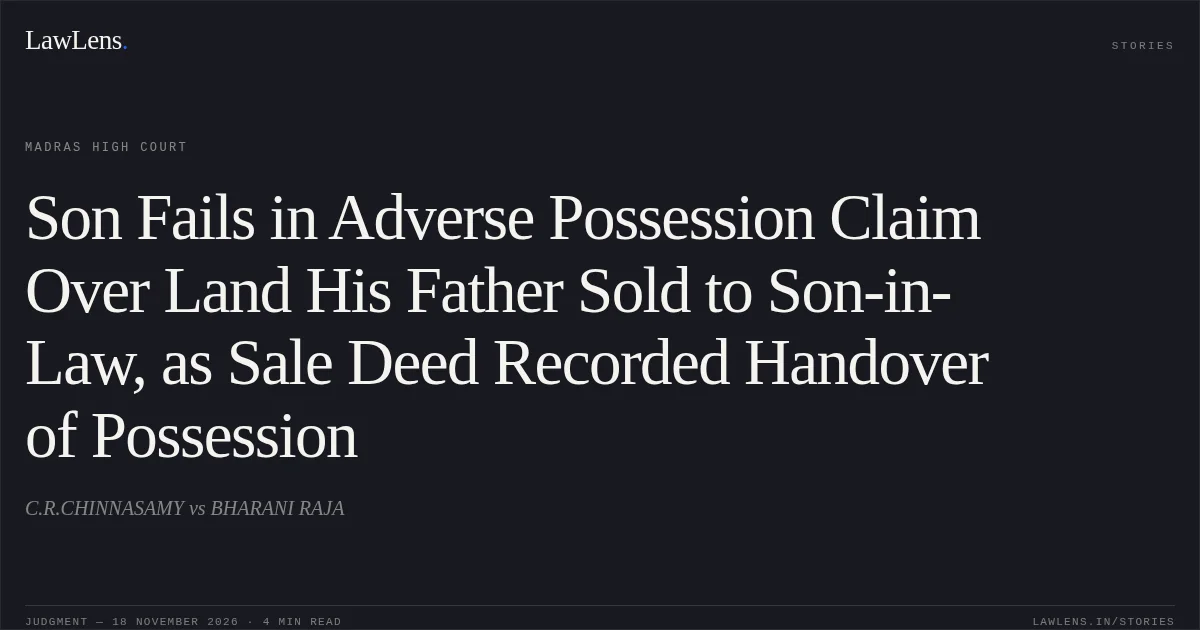
pp. 4–5The plaintiff alleged that his father sold the property to his son-in-law, the third defendant Kuppusamy, by registered sale deed dated 31.10.1994, despite the plaintiff's objection, but that possession was never delivered.
pp. 3–4The plaintiff claimed he had been in actual, exclusive, hostile and continuous possession for over 13 years, had built a residence and dug a borewell, and that Kuppusamy never possessed the property.
pp. 3–4Kuppusamy sold the property to defendants 1 and 2 by sale deed dated 28.09.2006.
p. 4The plaintiff alleged that on 23.11.2007 the defendants attempted forcible dispossession.
p. 4The defendants pleaded that the plaintiff's father had agreed to sell the land to defendants 1 and 2's side (Samiyappan and the second defendant) on 03.08.2000 for ₹5,60,000 per acre, receiving ₹1,50,000 as advance, and that the vendor's heirs had not executed the sale.
pp. 4–5The defendants pleaded non-joinder of necessary parties and absence of cause of action.
pp. 4–5The trial court dismissed the suit by judgment dated 06.04.2010.
p. 6The first appellate court (A.S. No. 69 of 2010, Principal Subordinate Court, Erode) affirmed on 22.10.2010.
pp. 6–7The plaintiff preferred this second appeal under Section 100 CPC. The respondents did not appear.
p. 802Issues
i.1. Whether the plaintiff perfected title to the suit property by adverse possession against the original owner and subsequent purchasers, given the 1994 sale to Kuppusamy and the 2006 sale to defendants 1 and 2.
p. 5 · pp. 10–11ii.2. Whether the plaintiff proved actual, continuous, uninterrupted and hostile possession with animus possidendi for the statutory period of 12 years.
pp. 11–12iii.3. Whether the plaintiff's possession was adverse, having regard to the recital of delivery of possession in Ex.A1 and Ex.A2.
pp. 10–11 · p. 13iv.4. Whether the plaintiff is entitled to a declaration of title and a consequential permanent injunction.
p. 5 · p. 13v.5. Whether a substantial question of law arises for interference in second appeal with concurrent findings.
pp. 12–1303Law Applied
Article 65 of the Limitation Act, 1963, which prescribes a 12-year period for a suit for possession based on title.
pp. 12–13Adverse possession must be continuous, uninterrupted, open, and with the knowledge of the true owner for the full statutory period.
pp. 12–13Possession must be nec vi, nec clam, nec precario, and the claimant must prove animus possidendi.
p. 10 · p. 12A claimant seeking declaration of title must prove his own case by substantive evidence and cannot rely on weaknesses in the defence, and mere oral evidence is insufficient to prove possession.
pp. 10–11 · p. 11An Advocate Commissioner cannot be appointed to determine possession.
pp. 11–12Under Section 100 CPC, interference with concurrent findings requires a substantial question of law.
pp. 12–13Provisions in the judgment · 2 · Linked ones open on LawLens
Code of Civil Procedure, 1908 Section 100
Limitation Act, 1963 Section 65
04Reasoning
The court first examined Ex.A1, the 1994 sale deed to Kuppusamy, and found recitals of delivery of possession.
pp. 10–11The court held that the plaintiff's claim of possession was not proved by sufficient documentary evidence and that the oral testimony of PW1 and PW2 was insufficient.
pp. 10–11The court treated the 2006 sale to defendants 1 and 2 as an interruption within the 12-year period, so the plaintiff's possession could not be treated as adverse to the original owner.
p. 11The plaintiff's own admission that he restrained Kuppusamy from taking possession showed his possession was unlawful and that animus possidendi was not established.
p. 12The plaintiff's documents were limited to kist receipts (Ex.A3–A6), electricity bills (Ex.A7–A9), and the 2000 agreement (Ex.A10), which were found insufficient to show the nature and character of possession, and there was no evidence of the house's construction.
p. 11The court observed that Ex.A2 recorded handover of possession to defendants 1 and 2.
p. 13The court stated that the plaintiff entered possession on 01.11.1994 and that the suit was filed within 12 years.
p. 1105Holding
The plaintiff failed to prove continuous, uninterrupted and hostile possession for 12 years with animus possidendi, his possession was interrupted by the 2006 sale to defendants 1 and 2, and Ex.A1 and Ex.A2 recorded delivery of possession.
pp. 10–13Both courts below reached concurrent findings, and no substantial question of law arose under Section 100 CPC.
pp. 13–14The second appeal was dismissed with no costs. The decrees of the trial court (06.04.2010, O.S. No. 847 of 2007) and first appellate court (22.10.2010, A.S. No. 69 of 2010) were upheld, and the connected miscellaneous petition was closed.
p. 14Original Court PDF
C.R.CHINNASAMYvsBHARANI RAJA
Click to open original judgment
Original judgment, available to read, download and summarize on LawLens.in