01Facts
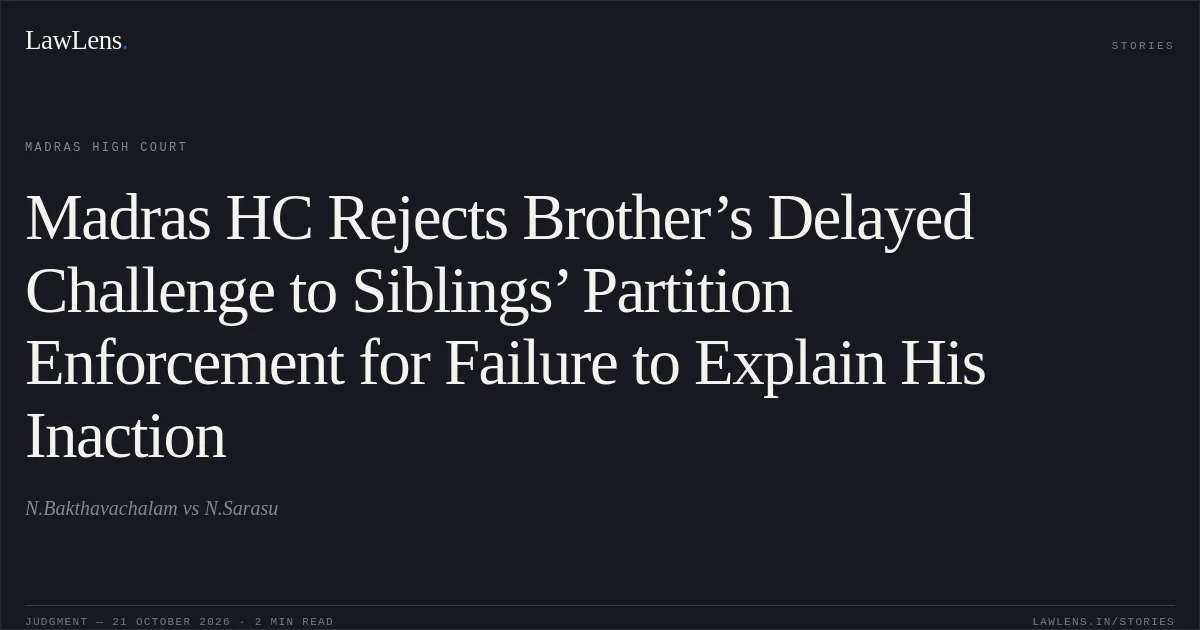
The consolidated revisions arose from execution proceedings concerning a partition decree in O.S. No. 90 of 2009.
The decree described the property as Survey No. 216/3, although the parties later proceeded on the basis that the intended property was Survey No. 216/30A.
The petitioner had remained ex parte in the suit and execution proceedings. After the decree-holders obtained amendment of the survey number, the petitioner unsuccessfully contested the amendment before the trial court and in revision.
pp. 5–6, 10–11The petitioner also failed to pursue Section 47 CPC applications, which were dismissed for default.
p. 8He sought condonation of delay in challenging orders in execution applications and in challenging the dismissal of his applications to set aside ex parte orders. The delays were 374 days in two matters and 1,447 days in another; the applications concerning the execution-application orders were also filed after substantial delay.
pp. 2–3, 9The High Court considered the petitioner’s participation in other proceedings, the opportunities afforded to him to file counter-affidavits, and the reported delivery of possession in two matters.
pp. 8–9, 12–1402Issues
i.1. Whether the petitioner established “sufficient cause” under Section 5 of the Limitation Act to condone the delays in challenging the execution orders and the dismissal of his applications to set aside the ex parte orders.
pp. 9, 12–14ii.2. Whether the petitioner’s contention that he should be allowed to contest the execution applications, including on the merits of the amended survey number, justified condonation of delay.
pp. 7, 11–1203Law Applied
Section 5 of the Limitation Act permits condonation only where the applicant establishes sufficient cause for the delay.
p. 12In Shivamma (Dead) by LRs v. Karnataka Housing Board and Others, 2025 INSC 1104, the Supreme Court held that a court considering condonation must assess the reasons for delay and cannot consider the merits of the underlying case unless sufficient cause is first shown.
p. 12The Court also dealt with the revisions under Section 115 CPC and referred to the execution applications made under Order XXI read with Sections 94 and 151 CPC.
p. 1, 4Provisions in the judgment · 5 · Linked ones open on LawLens
Code of Civil Procedure, 1908 Section 115Section 94Section 151Section 47
Limitation Act, 1963 Section 5
04Reasoning
The petitioner knew of and participated in the related proceedings: he filed Section 47 CPC applications, contested the survey-number amendment, and appeared in the revision concerning that amendment. He was also given opportunities to file counter-affidavits in the execution applications but did not do so.
pp. 8–9, 12–13The Court found that his participation during the relevant periods undermined his explanation for the delays, which were not satisfactorily accounted for.
p. 13Applying Shivamma, the Court held that the petitioner’s asserted merits and request for an opportunity to contest could not substitute for establishing sufficient cause.
pp. 12–13It also noted that possession had been delivered in two matters and found the delay in the remaining execution-application challenge unexplained.
p. 1405Holding
The High Court held that the petitioner had not shown sufficient cause for the delays and found no merit in the revisions.
p. 14It dismissed all six civil revision petitions and the connected miscellaneous petitions, with no order as to costs.
p. 14Original Court PDF
N.BakthavachalamvsN.Sarasu
Click to open original judgment
Original judgment, available to read, download and summarize on LawLens.in