01Facts
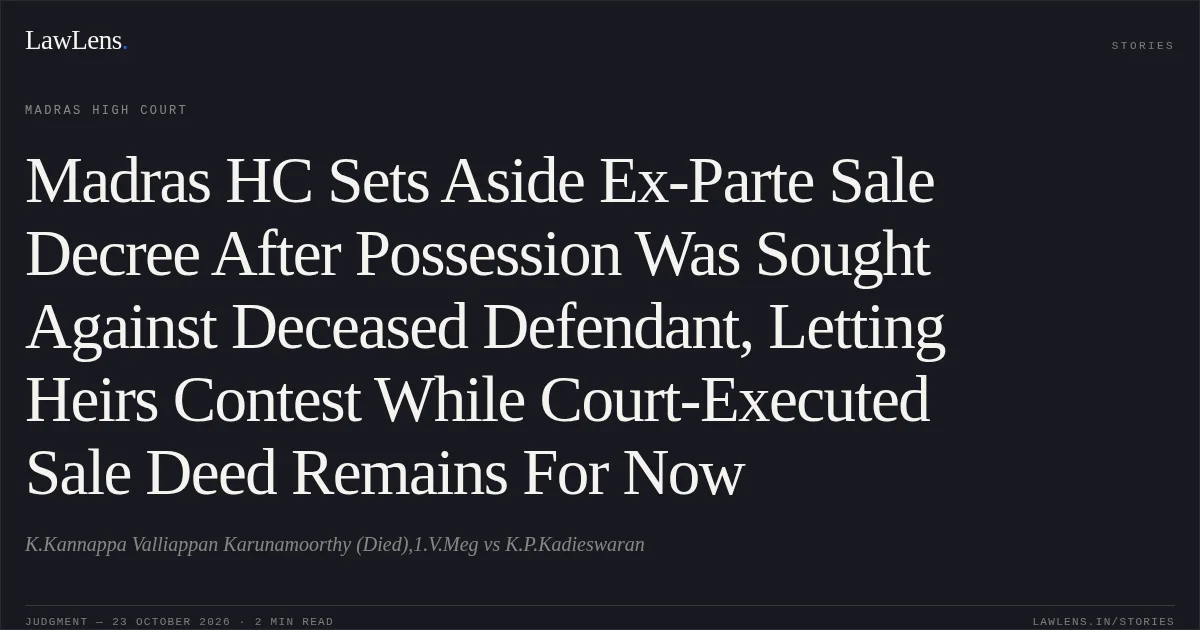
The plaintiff obtained an ex parte decree for specific performance against the deceased defendant in O.S. No. 700 of 2023. A sale deed was subsequently executed by the Court, and the plaintiff sought possession in a further execution petition.
pp. 3–5 · ¶ 7–10The defendant died on 7 December 2024. His legal heirs sought condonation of delay and impleadment in the suit and challenged the execution proceedings. They alleged that the plaintiff had been informed of the death, including by WhatsApp, but had continued proceedings without bringing it to the Court’s attention. The plaintiff disputed their claim. The applications were dismissed, prompting the revisions.
pp. 3–5, 6–9 · ¶ 7–10, 13–1702Issues
i.1. Whether the legal heirs should be permitted to come on record and contest the specific-performance suit after the sole defendant’s death
pp. 6–9 · ¶ 13–17ii.2. Whether the ex parte decree and ensuing execution proceedings could stand where the defendant had died and the legal heirs had not initially been impleaded in the execution petition
pp. 6–9 · ¶ 14–1703Law Applied
The judgment does not cite a specific statutory provision or precedent governing the applications.
pp. 1–2 · ¶ 13–17It applies the procedural principle that, where a sole defendant dies and his legal representatives remain in possession of the property, they must be afforded an opportunity to be heard before proceedings affecting their interests are pursued.
pp. 6–9 · ¶ 13–17The Court also considered the revisional and supervisory jurisdiction invoked under Section 115 CPC and Article 227 of the Constitution, respectively.
pp. 1–2 · ¶ 13–17Provisions in the judgment · 1 · Linked ones open on LawLens
Code of Civil Procedure, 1908 Section 115
04Reasoning
The Court found that the plaintiff’s counter-affidavit did not specifically deny the heirs’ categorical assertion that he had received the death certificate and been informed of the death; it merely stated that supporting documents had not been produced.
pp. 7–10 · ¶ 15–17The heirs remained in possession, had not initially been impleaded in the possession execution proceedings, and the execution had proceeded against the deceased defendant. In those circumstances, dismissing their applications effectively permitted execution against a deceased person without first hearing the persons in possession. The Court therefore found sufficient grounds to interfere, while leaving the already-executed sale deed undisturbed pending trial.
pp. 7–10 · ¶ 15–17, 18(iv)–(v)05Holding
The revisions were allowed. The ex parte decree was set aside, and I.A. Nos. 4, 5 and 6 of 2026 were allowed.
pp. 9–10 · ¶ 18The legal heirs were directed to be impleaded as defendants 2 to 5 and to file their written statement within four weeks; the Trial Court was directed to frame issues thereafter and endeavour to dispose of the suit within six months.
pp. 9–10 · ¶ 18The sale deed was not disturbed at that stage: its effect would depend on the outcome of the suit, with directions for its validation if the plaintiff succeeded or for its cancellation if the suit was dismissed. No costs were awarded.
pp. 9–10 · ¶ 18Original Court PDF
K.Kannappa Valliappan Karunamoorthy (Died),1.V.MegvsK.P.Kadieswaran
Click to open original judgment
Original judgment, available to read, download and summarize on LawLens.in