Facts
The assessee’s premises were searched under Section 132 of the Income-tax Act, 1961 on 05.07.2018, followed by notices under Section 153A for Assessment Years 2011–12 to 2019–20.
Source reference: para. 3.1; pp. 3–4After earlier writ proceedings challenging the notices were dismissed, the Assessing Officer passed assessment orders under Sections 144 and 153A dated 28/29.01.2022, followed by penalty orders dated 25–28.07.2022.
Source reference: para. 3.1; pp. 3–4The learned Single Judge held that the assessments for AYs 2011–12, 2012–13 and 2019–20 were time-barred, but upheld the assessments for AYs 2013–14 to 2018–19 by first applying the extension under TOLA and thereafter adding the period of court-ordered stay.
Source reference: paras. 3.2–3.4; pp. 4–5Both the assessee and the Revenue filed cross-appeals.
Source reference: para. 3.5; pp. 5–6Issues
Whether, for determining the applicability of Section 3(1) of the Taxation and Other Laws (Relaxation and Amendment of Certain Provisions) Act, 2020 (“TOLA”), the limitation period under Section 153B must first be computed by including the exclusions under its Explanation, or whether TOLA is to be applied to the unadjusted period under the main provision before adding the excluded period.
Source reference: para. 10; p. 17Whether the assessments completed on 28/29.01.2022 for AYs 2011–12 to 2019–20 were barred by limitation under Section 153B, read with TOLA.
Source reference: paras. 19–23; pp. 24–27Whether the consequential penalty orders and demand notices were liable to be quashed on account of the assessments being time-barred.
Source reference: paras. 24–28; pp. 28–30Law Applied
Section 153B of the Income-tax Act prescribes the time limit for completing assessments under Section 153A, while its Explanation requires specified periods—including the period during which assessment proceedings are stayed by a court—to be excluded in computing limitation.
Source reference: paras. 6–7; pp. 14–15Section 3(1) of TOLA extends a statutory time limit falling within the specified COVID-19 window, ultimately extending the relevant income-tax deadline to 30.09.2021 by notifications.
Source reference: paras. 8–9; pp. 16–17The Court held that the Explanation to Section 153B is an integral part of the limitation provision and must be applied before testing the resultant date under TOLA, relying on CIT v. Plantation Corporation of Kerala Ltd., K.P. Madhusudhanan v. CIT, Pfizer Healthcare India (P.) Ltd. v. DCIT and DCIT v. Saint Gobain India (P.) Ltd.
Source reference: paras. 12–15; pp. 18–22It further applied the principle that limitation provisions, particularly in taxing statutes, must be strictly construed, relying on K.M. Sharma v. ITO, New Noble Educational Society v. CCIT, R. Rudraiah v. State of Karnataka and Hope Textiles Ltd. v. Union of India.
Source reference: para. 18; pp. 23–24The Court also relied on Ashok Kumar v. State of Haryana and Arjan Singh v. Punit Ahluwalia for the proposition that an interim order extended only until a specified date does not continue thereafter without express renewal.
Source reference: para. 20; pp. 25–26Reasoning
The Court treated the limitation period under Section 153B as a composite period comprising the main statutory period and the exclusions in the Explanation, rather than as two sequential and independent stages.
Source reference: paras. 14–16; pp. 21–22The undisputed base limitation date was 30.09.2020.
Source reference: paras. 20–21; pp. 25–26For the years in which court protection existed, the stay period was computed as 218 days, or at the maximum 287 days if the benefit of the suo motu COVID orders was extended; this produced adjusted dates of 07.05.2021 or 19.08.2021, both outside TOLA’s window ending on 31.03.2021.
Source reference: paras. 20–21; pp. 25–26TOLA therefore could not extend the limitation period for AYs 2013–14 to 2018–19.
Source reference: paras. 20–21; pp. 25–26For AYs 2011–12, 2012–13 and 2019–20, no stay exclusion was available, so the base date of 30.09.2020 fell within the TOLA window and was extended only to 30.09.2021; the assessments passed in January 2022 were nevertheless beyond time.
Source reference: para. 22; p. 26The Court accordingly rejected the Revenue’s attempt to add the stay period after applying TOLA, holding that such an approach would improperly enlarge the limitation period and render the statutory scheme unworkable.
Source reference: paras. 17–19; pp. 23–25Holding
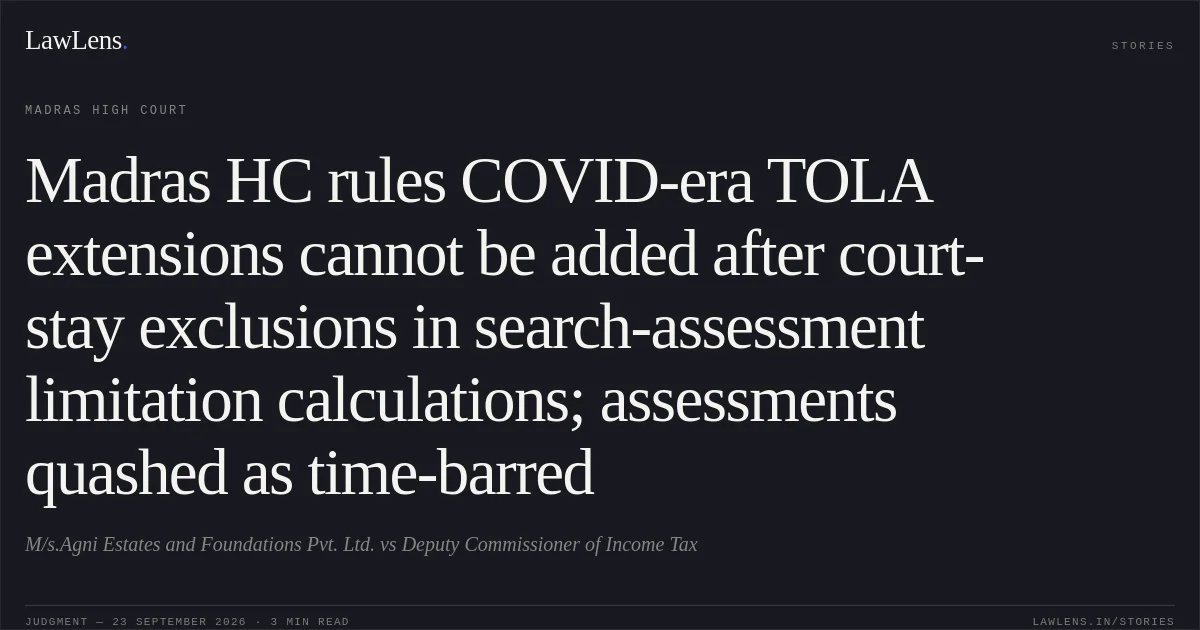
The Court held that the Explanation to Section 153B, including the exclusion for court-ordered stays, must be applied before testing the resultant limitation date under Section 3(1) of TOLA.
The Revenue’s appeals concerning AYs 2011–12, 2012–13 and 2019–20 were dismissed, and the quashing of those assessments, notices and connected penalty orders was confirmed.
Source reference: para. 28(i); p. 30The assessee’s appeals concerning AYs 2013–14 to 2018–19 were allowed; the assessments dated 28.01.2022, antecedent notices, penalty orders and consequential demand notices were quashed as barred by limitation.
Source reference: paras. 27(b), 28(ii)–(iii); pp. 29–30The Court expressly left the assessee’s other grounds, including natural justice and denial of cross-examination, open and did not adjudicate the merits of the additions.
Source reference: paras. 24–25, 28(iv); pp. 28, 30Acts & Sections Cited
15 provisions across 2 statutes referred to in this judgment. Linked provisions open on LawLens.
Income Tax Act, 1961
Taxation and Other Laws (Relaxation and Amendment of Certain Provisions) Act, 20201
Original Court PDF
M/s.Agni Estates and Foundations Pvt. Ltd.vsDeputy Commissioner of Income Tax
Click to open original judgment
Original judgment, available to read, download and summarize on LawLens.in