01Facts
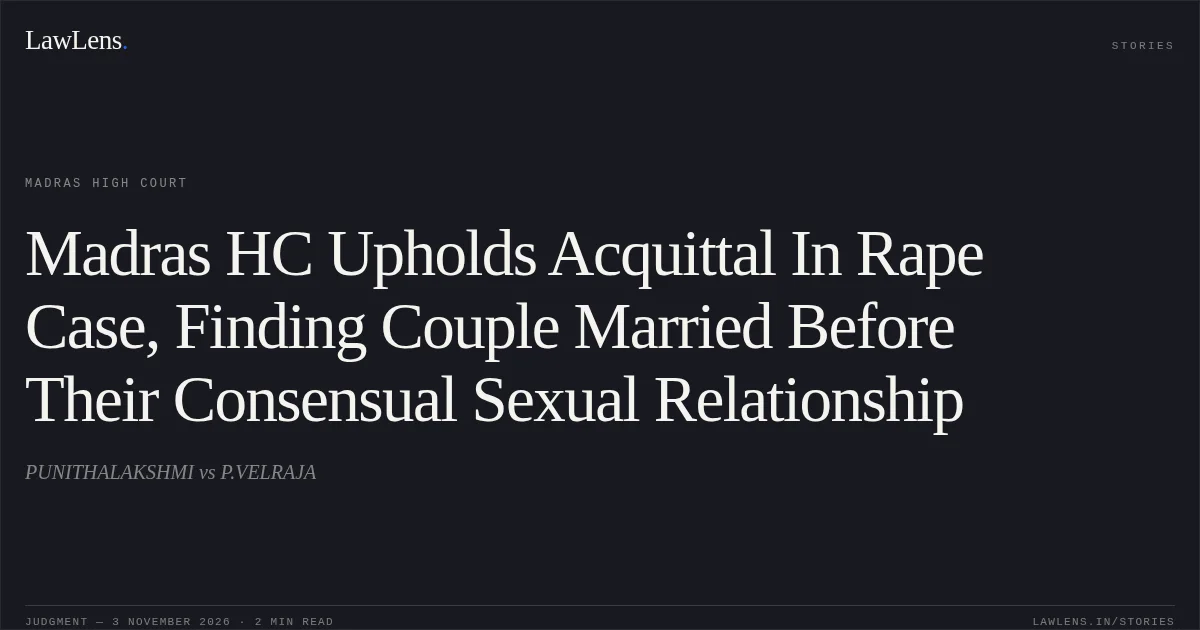
The prosecution alleged that P. Velraja took the complainant to Rameswaram on 25 November 2004, had sexual intercourse with her on a promise of marriage, and later interfered with her proposed marriage to another person.
pp. 2–3 · ¶ 2–5A case was registered under Sections 376, 417 and 312 of the Indian Penal Code (IPC), and the trial court acquitted him after hearing the evidence.
pp. 2–3 · ¶ 2–5The complainant challenged the acquittal under Section 397 read with Section 401 of the Code of Criminal Procedure (CrPC).
p. 1Velraja’s defence was that the parties had married on 20 September 2004 and that their relationship was consensual; the defence relied, among other evidence, on a marriage receipt, testimony from his wife and the priest, and the complainant’s bank-passbook entry naming him as nominee.
pp. 4–5 · ¶ 9–1102Issues
i.1. Whether the trial court’s acquittal on the charges under Sections 376, 417 and 312 IPC warranted interference in the appeal.
pp. 3–4 · ¶ 6–8ii.2. Whether the evidence established that the sexual relationship was non-consensual or that the alleged conduct otherwise supported conviction, including for cheating.
pp. 3–5 · ¶ 7–1303Law Applied
The prosecution charged the respondent under Sections 376, 417 and 312 IPC, and the challenge to acquittal was brought under Sections 397 and 401 CrPC.
pp. 1–2 · ¶ 1–2The judgment’s stated basis was that a consensual sexual relationship did not amount to rape on the facts found, and that the acquittal should stand where the evidence did not justify conviction.
p. 6 · ¶ 13Although the judgment refers generally to the Supreme Court having condemned false rape complaints arising when relationships turn sour, it identifies no specific precedent or more detailed legal test.
p. 5 · ¶ 12Provisions in the judgment · 5 · Linked ones open on LawLens
Code of Criminal Procedure, 1973 Section 397Section 401
Indian Penal Code, 1860 Section 376Section 417Section 312
04Reasoning
The Court accepted the defence evidence that the parties had married before the sexual relationship at issue and found that the documents and testimony supported a consensual relationship.
pp. 4–5 · ¶ 10–11It considered the complainant’s later attempt to marry another person and the respondent’s subsequent intervention, but concluded that these circumstances did not establish the charged offences.
p. 6 · ¶ 13–14Finding no evidence sufficient to convict and no basis to disturb the trial court’s assessment, the Court held that the acquittal was correct.
p. 6 · ¶ 13–1405Holding
The Court answered the question of interference in the negative.
p. 6 · ¶ 14It confirmed the Additional Sessions (Mahila) Court’s acquittal of the respondent in S.C. No. 336 of 2008 and dismissed the appeal.
p. 6 · ¶ 14Original Court PDF
PUNITHALAKSHMIvsP.VELRAJA
Click to open original judgment
Original judgment, available to read, download and summarize on LawLens.in