01Facts
The prosecution alleged that the complainant was induced through WhatsApp and Telegram to transfer money for online tasks.
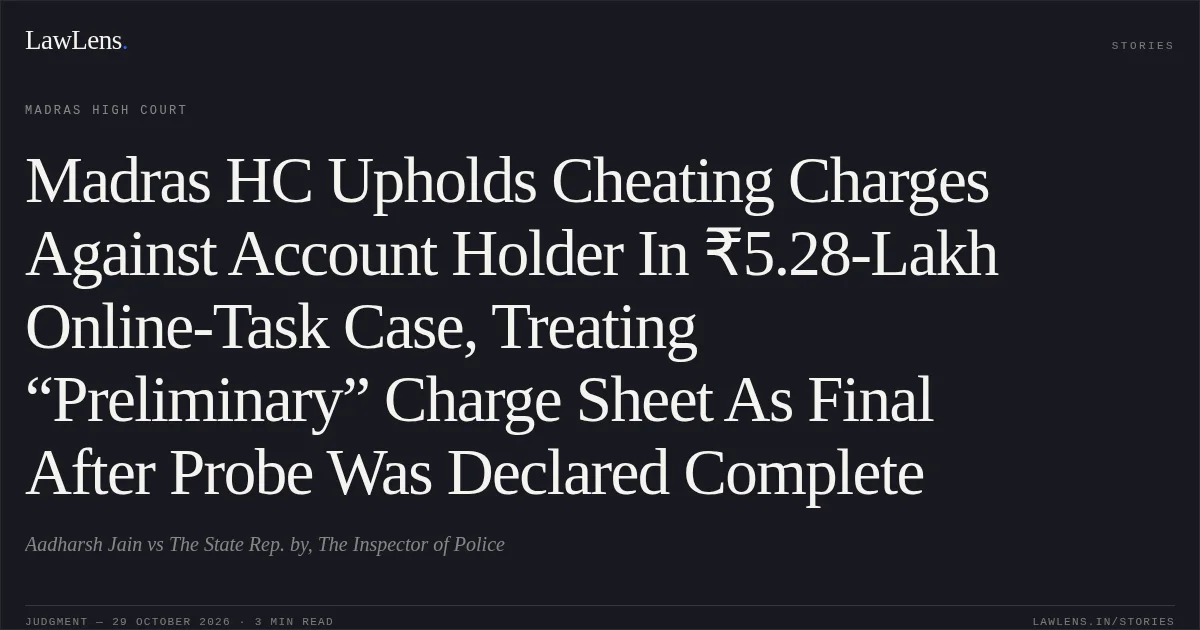
¶ 2Of the transferred funds, ₹5,28,000 was credited to an ICICI Bank account in the petitioner’s name, and the account allegedly recorded transactions totalling ₹2,53,54,365 on the relevant dates, followed by transfers to other accounts.
¶ 2–3Police filed a “preliminary charge sheet” on 5 December 2024 under Section 193(9) of the BNSS, stating that other alleged participants remained unidentified.
¶ 3The Magistrate framed charges under Section 420 IPC and Section 66D of the Information Technology Act on 26 February 2026.
¶ 5During the revision, the prosecution filed a clarification report stating that the investigation was complete and that the preliminary charge sheet could be treated as the final report because the other accused could not be traced.
¶ 6, 16The petitioner challenged the framing of charges, including on the grounds that no final report had been filed and that he had neither knowingly participated in the transactions nor retained the funds.
¶ 8–1002Issues
i.1. Whether the Magistrate could frame charges on the basis of the preliminary charge sheet, notwithstanding the absence of a separately filed supplementary or final report.
¶ 13, 27–29ii.2. Whether the prosecution materials disclosed sufficient grounds to proceed against the petitioner for offences under Section 420 IPC and Section 66D of the Information Technology Act.
¶ 21–2603Law Applied
Section 193 BNSS requires a police report on completion of investigation and permits further investigation and a further report; the description given to a report is not, by itself, decisive if the report satisfies the statutory requirements.
¶ 15, 23–24, 27–29At the charge stage, the court may sift the prosecution materials to determine whether they disclose the ingredients of the alleged offences and raise a prima facie case or grave suspicion, but should not conduct a trial or finally assess guilt.
¶ 17–19, 25State by the Inspector of Police, Chennai v. S. Selvi, (2018) 13 SCC 455; State v. A. Arun Kumar, (2015) 2 SCC 417.
¶ 17–19, 25Under Section 420 IPC, the materials must indicate cheating and dishonest inducement to deliver property; under Section 66D of the Information Technology Act, they must indicate cheating by personation through a communication device or computer resource.
¶ 14, 21–22The Court also relied on Amit Kapoor v. Ramesh Chander, (2012) 9 SCC 460, for the principle that revisional interference with a charge order is warranted where there is a patent legal infirmity or the materials, taken at face value, do not disclose the offence.
¶ 18Provisions in the judgment · 26 · Linked ones open on LawLens
Indian Penal Code, 1860 Section 420
Bharatiya Nagarik Suraksha Sanhita, 2023 Section 193Section 262Section 190Section 177Section 180Section 230
Bharatiya Nyaya Sanhita, 2023 Section 318Section 64Section 65Section 66Section 67Section 68Section 70Section 71
Protection of Children from Sexual Offences Act, 2012 Section 4Section 6Section 8Section 10
Code of Criminal Procedure, 1973 Section 227Section 228Section 239Section 156Section 173Section 170Section 175
04Reasoning
The Court accepted the prosecution’s clarification that investigation had been completed and held that the 2024 report could be treated as the final report because it was said to satisfy Section 193 BNSS; the fact that it was initially labelled “preliminary,” or that further investigation into other alleged participants had been contemplated, did not by itself invalidate the charge order.
¶ 16, 27–29The alleged credit of ₹5,28,000 to an account attributed to the petitioner, the substantial transactions through that account, the onward transfers, and the alleged connection between the account and the petitioner’s mobile number were sufficient at this stage to support proceeding on the charged offences.
¶ 26The Court treated the petitioner’s claims of lack of knowledge, non-retention of funds, and an earlier cybercrime complaint as matters for assessment against the full prosecution evidence, not as grounds to quash the charges at the preliminary stage.
¶ 30–3305Holding
The Court held that the preliminary charge sheet, as clarified by the prosecution, could be treated as the final report and that the materials disclosed sufficient grounds to proceed against the petitioner.
¶ 29Finding no basis for revisional interference, it dismissed the criminal revision and confirmed the Magistrate’s order framing charges under Section 420 IPC and Section 66D of the Information Technology Act.
¶ 34–35The trial court was directed to proceed in accordance with law, uninfluenced by the observations in the revision order.
¶ 34–35Original Court PDF
Aadharsh JainvsThe State Rep. by, The Inspector of Police
Click to open original judgment
Original judgment, available to read, download and summarize on LawLens.in