01Facts
The Enforcement Directorate forwarded material to the Tamil Nadu Director General of Police under Section 66(2) of the Prevention of Money Laundering Act concerning alleged irregularities in recruitment to 2,538 posts in the Municipal Administration and Water Supply Department.
¶ 5–6After the Directorate of Vigilance and Anti-Corruption (DVAC) did not act on his representation, Rajya Sabha Member I.S. Inbadurai petitioned the High Court.
¶ 6–7On 20 February 2026, the Court directed the DVAC to register a case on the information forwarded by the Enforcement Directorate and conduct an investigation.
¶ 6–7Inbadurai later filed a contempt petition alleging non-compliance.
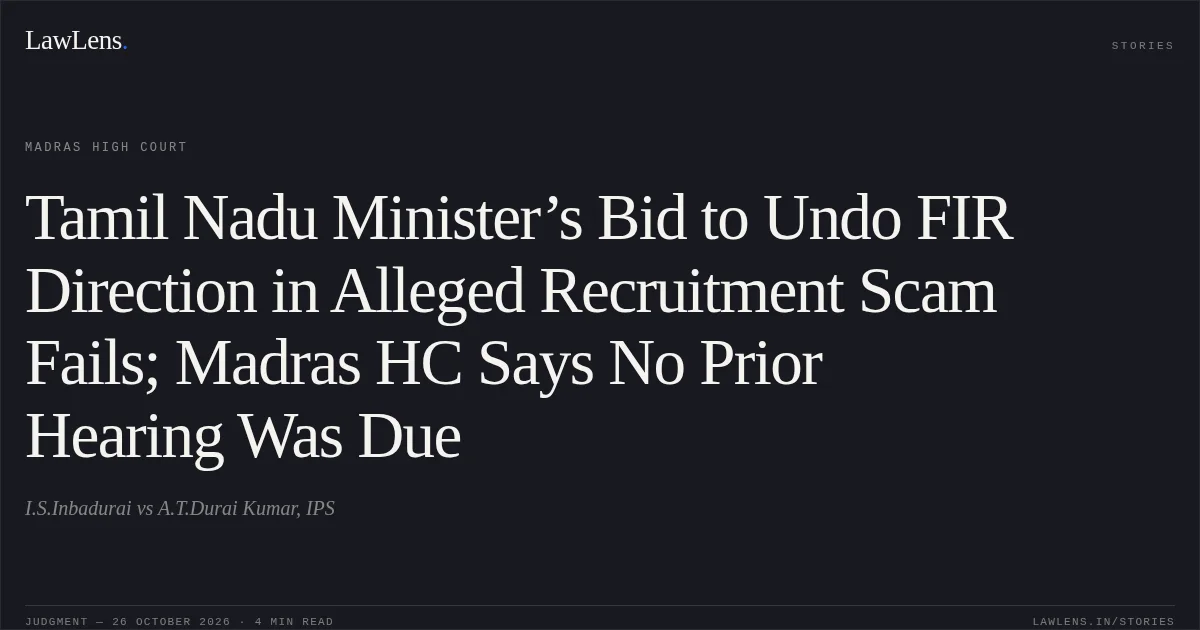
¶ 9The State and Minister K.N. Nehru sought review of the order.
¶ 9, 12At the hearing, the State withdrew its review, stating that an FIR had been registered and the investigation would proceed; Inbadurai did not press for punitive contempt relief in light of that assurance.
¶ 20–21Nehru pursued his review, principally alleging that he had not received a meaningful opportunity to be heard before the order was made.
¶ 11.1–11.802Issues
i.1. Whether a review of an order made in a criminal writ petition under Article 226 is maintainable under Rule 29 of the Madras High Court Writ Rules, 2021, notwithstanding Section 362 CrPC/Section 403 BNSS.
¶ 25–27ii.2. Whether the Minister was entitled to a pre-decisional hearing before the Court directed the DVAC to register a case and investigate, and whether the circumstances warranted recall of the order.
¶ 28–31, 35iii.3. Whether Section 175(4) BNSS required the Court, in exercising writ jurisdiction, to hear the Minister before directing registration of a case.
¶ 40iv.4. Whether the contempt petition should continue after the State reported registration of an FIR and assured the Court that the investigation would proceed.
¶ 21, 42–4303Law Applied
Article 226 of the Constitution empowers the High Court to exercise writ jurisdiction, and Rule 29 of the Madras High Court Writ Rules, 2021 permits review of its orders on the grounds in Order XLVII Rule 1 CPC; the Rules apply to Article 226 petitions, including those titled “W.P.(Crl.)”.
¶ 26Sections 362 CrPC and 403 BNSS restrict a criminal court’s power to alter or review its judgments but do not bar review by the High Court of an order made in its writ jurisdiction under its own Rules.
¶ 26–27A court of record may recall an order where a person entitled to be heard was denied a hearing, but the right to a pre-investigation hearing does not ordinarily arise for a person who may be investigated: a direction to register a case initiates investigation and determines no one’s guilt.
¶ 28, 33, 38–39Union of India v. W.N. Chadha, 1993 Supp (4) SCC 260, and E. Sivakumar v. Union of India, (2018) 7 SCC 365, support the principle that natural justice does not generally require prior notice to a proposed accused before investigation begins.
¶ 38–39Section 175(4) BNSS prescribes a safeguard for a Magistrate considering an application under Section 175(3); the Court held that it does not create a general pre-decisional hearing right in writ proceedings.
¶ 40Provisions in the judgment · 9 · Linked ones open on LawLens
Contempt of Courts Act, 1971 Section 11
Code of Civil Procedure, 1908 Section 114
Prevention of Money-Laundering Act, 2002 Section 66
Bharatiya Nagarik Suraksha Sanhita, 2023 Section 175Section 403
Code of Criminal Procedure, 1973 Section 156Section 173Section 362Section 482
04Reasoning
The Court held that the review was maintainable because the challenged order was made under Article 226, not by a criminal court exercising criminal jurisdiction, and the Madras High Court Writ Rules expressly provide for review.
¶ 26–27On the merits of Nehru’s hearing claim, the Court noted that notice had reached him sixteen days before the order was pronounced, but he made no application to bring material to the Court’s attention or reopen the hearing.
¶ 29The order directed only registration and investigation; it made no finding of guilt, and the material’s reliability and the involvement of the Minister or his relatives remained matters for investigation and, if appropriate, trial.
¶ 30–31Applying W.N. Chadha and E. Sivakumar, the Court concluded that a proposed accused was not entitled to be heard before that preliminary investigative step.
¶ 38–39It further distinguished Section 175(4) BNSS as a procedure specific to a Magistrate acting under Section 175(3), not a general hearing requirement for a writ court.
¶ 40The State’s review was withdrawn after the State reported compliance, while the contempt petitioner accepted the assurance that the investigation would proceed.
¶ 20–21, 4205Holding
The Court held that Nehru’s review was maintainable but found no basis to recall the order because he was not entitled to a hearing before the investigation was initiated; his review was dismissed.
¶ 27, 35, 41The State’s review was dismissed as withdrawn.
¶ 20The contempt petition was closed after the Court recorded the State’s assurance that the investigation would proceed on the registered FIR.
¶ 42–43No order as to costs was made.
¶ 43(iv)Original Court PDF
I.S.InbaduraivsA.T.Durai Kumar, IPS
Click to open original judgment
Original judgment, available to read, download and summarize on LawLens.in