01Facts
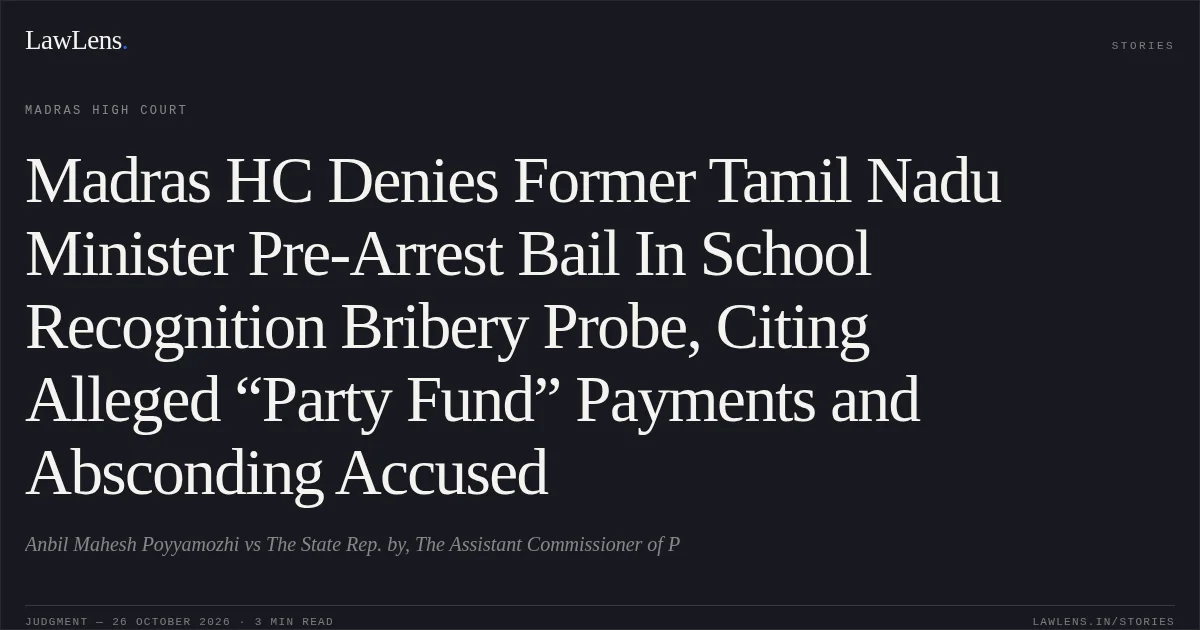
The petitioner, a former Tamil Nadu Minister and MLA, sought anticipatory bail in Crime No. 64 of 2026, initially registered against others for alleged cheating and related offences concerning money collected from private-school managements in return for promised government approvals
pp. 1–2During investigation, the police alleged that the petitioner had links with the accused, received money described as “party fund,” and assured school managements that their demands would be met; Sections 7 and 12 of the Prevention of Corruption Act, 1988, as amended in 2018, were added
pp. 2–3The petitioner attended police questioning, answered 240 questions, and produced records following searches of three premises
pp. 3–4, 8–9The prosecution opposed bail, citing 177 identified victims, an alleged collection of approximately Rs. 400 crores, the need to trace the money trail, and the allegation that the petitioner was shielding absconding accused A2
pp. 4–5The petitioner also argued that the case should be investigated by the Directorate of Vigilance and Anti-Corruption (DVAC), rather than the Central Crime Branch
pp. 5–602Issues
i.1. Whether the petitioner should be granted anticipatory bail while the corruption investigation was ongoing and the prosecution asserted that custodial interrogation was necessary
pp. 8–9, 16–18ii.2. Whether the investigation should be transferred from the Central Crime Branch to the DVAC because the case involved alleged corruption
pp. 5–7, 6–703Law Applied
The Court considered Sections 316(5), 318(4) and 3(5) of the Bharatiya Nyaya Sanhita, 2023, and Sections 7 and 12 of the Prevention of Corruption Act, 1988, as amended in 2018
pp. 1–3On anticipatory bail, it referred to Gurbaksh Singh Sibbia v. State of Punjab, which recognises the breadth of the court’s discretion and the importance of personal liberty, while also relying on CBI v. Anil Sharma, P. Chidambaram v. Directorate of Enforcement and Devinder Kumar Bansal v. State of Punjab for the proposition that custodial interrogation may be particularly important in corruption and complex financial investigations
pp. 9–16The Court treated the seriousness of the alleged corruption, the stage and needs of the investigation, and the risk of interference with witnesses or evidence as relevant to the exercise of discretion
pp. 16–18It also held that the choice of investigating police unit is ordinarily for the police, absent an inherent lack of jurisdiction
pp. 6–7Provisions in the judgment · 5 · Linked ones open on LawLens
Bharatiya Nyaya Sanhita, 2023 Section 316Section 318Section 3
Bharatiya Nagarik Suraksha Sanhita, 2023 Section 183
Code of Criminal Procedure, 1973 Section 438
04Reasoning
The Court rejected the request to transfer the investigation, reasoning that the DVAC did not have exclusive jurisdiction over corruption-related cases and that the CCB’s authority had not been shown to be lacking
pp. 6–7On anticipatory bail, it considered the allegations that the petitioner had received “party fund” payments and that A2 was being shielded, alongside the prosecution’s account of 177 victims and a substantial alleged money trail
pp. 7–8, 16–18Although the petitioner had cooperated with questioning and searches, the Court held that this did not eliminate the asserted need for custodial interrogation to identify the destination of the funds and unravel the alleged conspiracy
pp. 8–9, 17–18It also considered the investigation to be at a developing stage and found that granting pre-arrest protection before A2’s apprehension could impede the investigation
pp. 16–1805Holding
The Court held that the circumstances did not warrant anticipatory bail and dismissed the petition
p. 19The petitioner’s challenge to the CCB’s conduct of the investigation was also rejected; the Court declined to direct that the matter be transferred to the DVAC
pp. 6–7Original Court PDF
Anbil Mahesh PoyyamozhivsThe State Rep. by, The Assistant Commissioner of P
Click to open original judgment
Original judgment, available to read, download and summarize on LawLens.in