01Facts
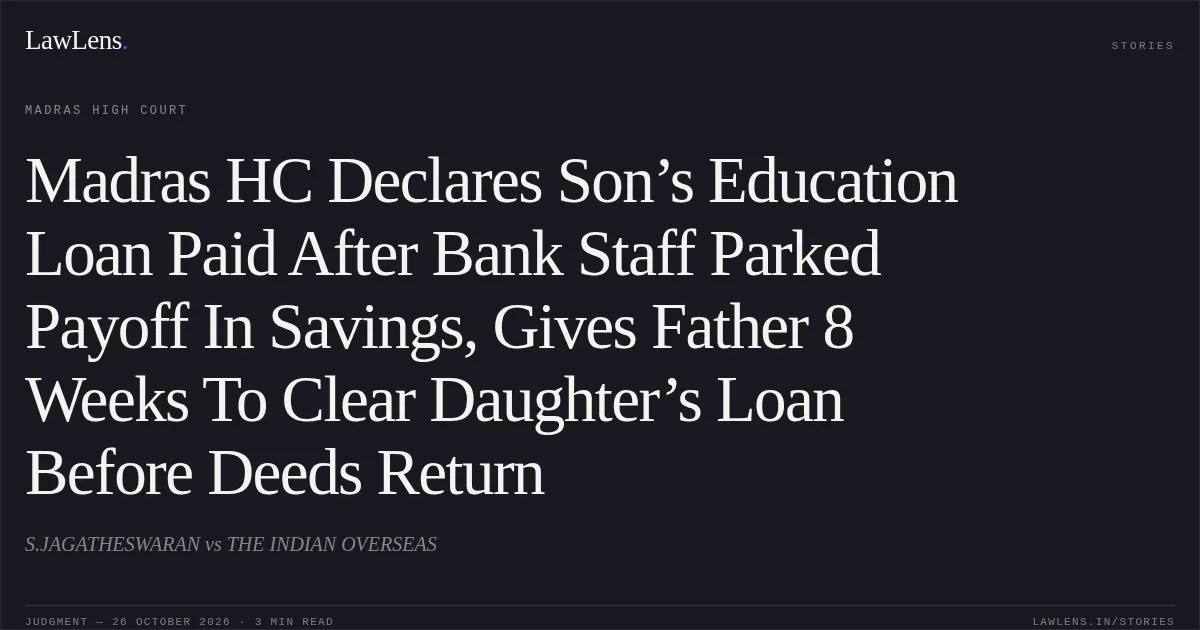
Indian Overseas Bank sanctioned an education loan of ₹12.70 lakh to the first petitioner, with his father, the second petitioner, as co-obligant; the father also acted as co-obligant for a separate education loan obtained for the first petitioner’s sister.
¶ 2, 6–7The petitioners contended that they had paid the amount required to discharge the first loan on 30 June 2025, but the Bank later claimed further interest and withheld the title deeds, also citing the outstanding sister’s loan.
¶ 3–5After an earlier writ petition resulted in a direction to consider the petitioners’ representation, the Bank issued the challenged demand.
¶ 4The petitioners sought closure of the first loan, cancellation of the memorandum of deposit of title deeds (MOD), and return of the documents.
02Issues
i.1. Whether the Bank could claim further interest on the first petitioner’s loan after its officials received the repayment amount but deposited it into the petitioners’ savings account before later crediting it to the loan account.
¶ 15–17ii.2. Whether the Bank could rely on its general lien to retain the collateral documents for the separate education loan obtained for the first petitioner’s sister.
¶ 18–2003Law Applied
Section 171 of the Indian Contract Act, 1872 recognises a banker’s general lien over goods bailed to it, subject to the applicable legal principles governing that right.
¶ 7, 10Relying on Syndicate Bank v. V. Vijay Kumar, the Court treated the banker’s lien as relating to movables entrusted to the bank by way of bailment.
¶ 10Following S. Balaji v. The Banking Ombudsman and the authorities considered there, including M. Shanti v. Bank of Baroda, the Court stated that a general lien cannot be exercised where the two loans are not between the same set of persons.
¶ 18The Court also applied the principle that Article 226 relief may be available against a State instrumentality where its conduct in a contractual matter is unfair.
¶ 9Provisions in the judgment · 1 · Linked ones open on LawLens
Indian Contract Act, 1872 Section 171
04Reasoning
The Bank’s own challans, completed and signed by its officials, recorded that the cash was intended to clear the education loan; the Bank also admitted that there was no pay-in slip from the petitioners and that its staff deposited the money into the savings account.
¶ 15–16The Court therefore rejected the Bank’s account of the transaction and held that the delay in crediting the repayment, and the resulting interest demand, arose from the Bank’s own conduct and was unfair.
¶ 16–17As to the sister’s loan, the Court held that the loans involved different sets of borrowers and that the Bank’s general lien could not, in principle, justify retaining the documents for that separate debt.
¶ 18Nevertheless, considering the petitioners’ ability to pay and the amount outstanding on the sister’s loan, the Court directed payment of that amount, with accrued interest, before release of the documents.
¶ 19–2005Holding
The Court disposed of the writ petition by declaring the first petitioner’s education loan fully closed, with no further amount payable on that account.
¶ 21(i)It directed the second petitioner to pay ₹4,44,028.64, together with interest accrued until payment, within eight weeks; upon payment, the Bank must cancel the MOD and release the original deeds.
¶ 21(ii)–(iii)No costs were awarded.
¶ 21(iv)Original Court PDF
S.JAGATHESWARANvsTHE INDIAN OVERSEAS
Click to open original judgment
Original judgment, available to read, download and summarize on LawLens.in