01Facts
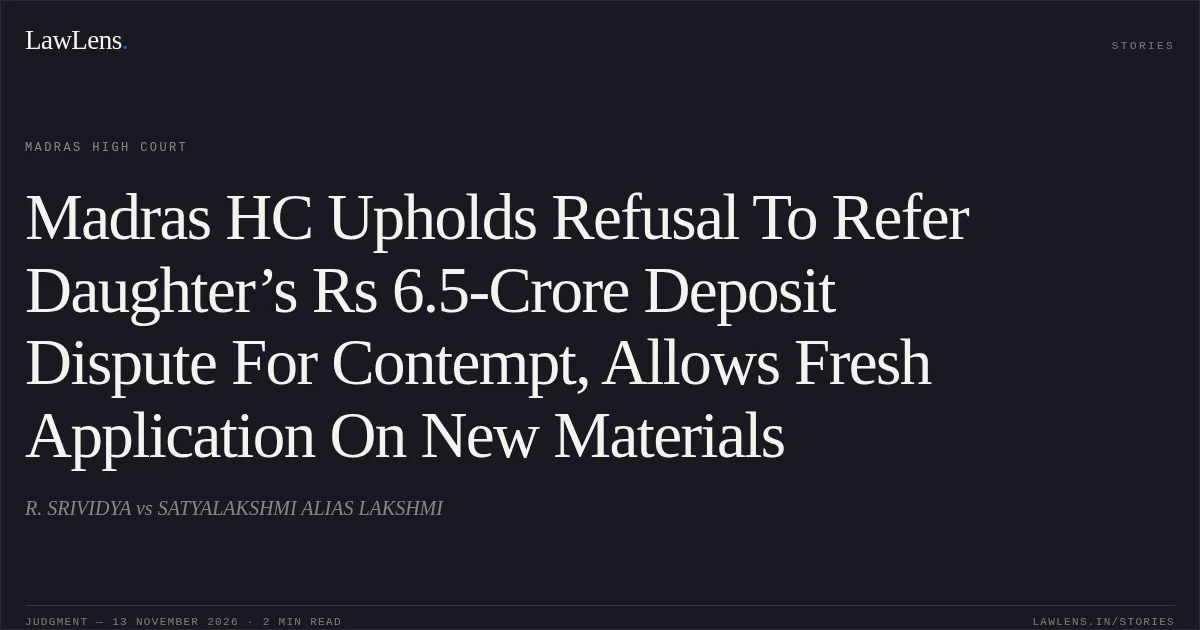
The petitioner filed a partition suit and obtained orders appointing her and the first respondent as receivers of Karpagam Abarna Maligai, with directions concerning management and accounts.
pp. 2–4A later order directed that the business’s fixed deposits and investments be handed to auditors for safe custody and required court permission before any such funds were used for business development.
pp. 2–4The petitioner alleged that the first respondent redeemed mutual funds and fixed deposits worth approximately ₹6.50 crore and transferred the proceeds to the accounts of the other respondents, contrary to the court’s directions.
p. 5She applied to have the matter referred to the High Court to initiate contempt proceedings; the District Court dismissed the application, finding no violation.
p. 5The petitioner challenged that dismissal under Article 227 of the Constitution.
p. 1, 502Issues
i.1. Whether the District Court’s finding that its earlier orders had not been violated warranted interference under Article 227 of the Constitution
pp. 5–6ii.2. Whether materials produced for the first time before the High Court could be assessed in the revision to establish the alleged violations
p. 603Law Applied
Article 227 of the Constitution confers supervisory jurisdiction over subordinate courts.
p. 6In exercising that jurisdiction, the High Court does not interfere with a subordinate court’s understanding of its own order merely because it might reach a different conclusion on the order’s scope.
p. 6The court that issued the order is best placed to interpret its directions and determine whether they have been violated.
p. 6Materials not considered by the subordinate court cannot, for the first time, be assessed by the High Court while reviewing that court’s decision under Article 227.
p. 604Reasoning
The District Court had construed its direction concerning fixed deposits and investments as applying to Karpagam Maligai, not to item No. 8 of the suit property, and had noted that the first respondent received the money as a nominee and acknowledged the petitioner’s share.
p. 6The High Court held that it could not substitute its own view of the order’s scope merely because another interpretation was possible.
p. 6Nor could it assess new materials that had not been before the District Court.
p. 6The petitioner could, however, place those materials before that court through a fresh application.
pp. 6–705Holding
The High Court sustained the dismissal of the application and disposed of the revision petition.
p. 7It left the petitioner at liberty to file a fresh application seeking modification or clarification of the earlier orders on the basis of the additional materials; the District Court was directed to consider it on its merits and in accordance with law, after hearing all concerned parties, within eight weeks of filing.
p. 7No costs were ordered.
p. 7Original Court PDF
R. SRIVIDYAvsSATYALAKSHMI ALIAS LAKSHMI
Click to open original judgment
Original judgment, available to read, download and summarize on LawLens.in